## [# Small-Cap ETFs Face Worst Year Ever as Investors Chase Megacaps](/sections/features/small-cap-etfs-face-worst-year-ever-investors-chase-megacaps)
# Small-Cap ETFs Face Worst Year Ever as Investors Chase Megacaps
Small-cap ETFs are suffering their worst year of outflows on record as investors pile into megacap-heavy funds riding the AI boom.
[](/authors/sumit-roy)
[By Sumit Roy ](/authors/sumit-roy)
Aug 12, 2025
Edited by: ETF.com Staff
[ + Follow ](/etf/login)
Share Email LinkedIn Facebook X (Twitter)
googletag.cmd.push(function() {
googletag.display('js-dfp-tag-article_page_302x26');
});
Loading
Small-cap ETFs are being left in the dust, and so are the ETFs that hold them.
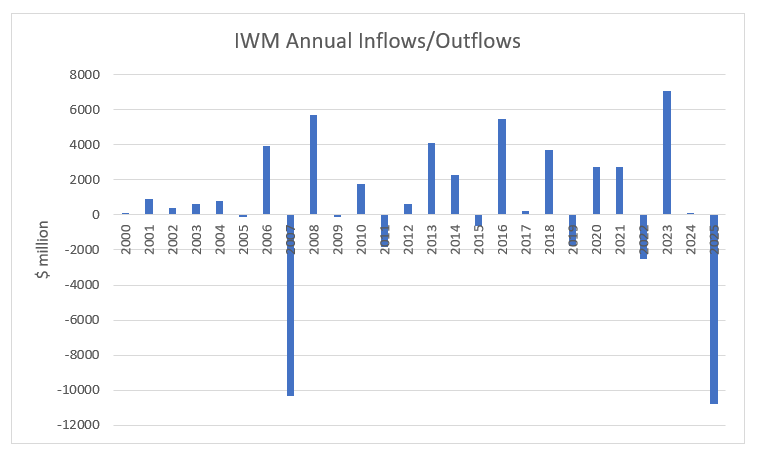
The [**iShares Russell 2000 ETF (IWM)**](/iwm), one of the largest small-cap funds in the U.S., has bled $10.8 billion in 2025, according to ETF.com’s fund flows tool powered by FactSet.
If the year ended today, that would be the worst calendar-year outflow in the ETF’s 25-year history, topping the $10.3 billion pulled in 2007. It’s a complete reversal from 2023, when IWM hauled in a record $7.1 billion.
Other big small cap ETFs are feeling the same pressure. The $80 billion [**iShares Core S&P Small-Cap ETF (IJR)**](/ijr) has lost $3.6 billion, also on pace for a record outflow.
The $63 billion [**Vanguard Small-Cap ETF (VB)**](/vb) is down $96 million in flows, only its second year of outflows ever.
The [**Pacer US Small Cap Cash Cows ETF (CALF)**](/calf) has shed $3.4 billion, its first year of outflows, cutting its asset base in half. The [**Vanguard Small-Cap Value ETF (VBR)**](/vbr) has lost $1.2 billion, its largest on record.
Altogether, U.S.-listed small-cap ETFs have seen $19.2 billion in outflows this year, even as the broader ETF market has already pulled in more than $700 billion and is on track for another trillion-dollar year.
## Sharp Underperformance
A big reason for the exodus may be tied to performance, as well as the story investors are telling themselves about where the market’s gains are coming from.
The dominant narrative in recent years is that megacaps—and especially the tech giants riding the AI wave—are the place to be.
From a performance standpoint, that’s certainly been the case.
IWM hasn’t hit a new all-time high since November 2021. Since then, the [**Vanguard S&P 500 ETF (VOO)**](/voo) is up 45% on a price basis, driven by megacap tech names like [Nvidia](/stock/NVDA) and [Microsoft](/stock/MSFT).
IWM is down 7% over that period. VB is just 2% above its 2021 highs, and IJR is down about 6%.
Year-to-date, the picture doesn’t look much better. From the start of the year through August 12, IWM and VB are up about 2–3%, IJR is down fractionally, and all trail the more than 10% gain for VOO. CALF has fared even worse, dropping more than 6% as its concentrated cash-flow strategy [struggles](https://www.etf.com/sections/news/boom-bust-assets-flee-calf-performance-slumps).

googletag.cmd.push(function() {
googletag.display('js-dfp-tag-in_article_unit');
});
## Active Strategies Buck the Small-Cap Slump
A few funds are bucking the trend. Actively managed small-cap ETFs from Avantis and Dimensional have drawn money in 2025.
The [**Avantis U.S. Small Cap Value ETF (AVUV)**](/avuv) has added $2.1 billion this year, and the [**Dimensional US Small Cap ETF (DFAS)**](/dfas) has pulled in $1.1 billion.
Both have delivered stronger long-term results than their index counterparts. Since launching in 2019, AVUV is up 107% versus a 65% gain for VB and VBR, and roughly 44% for IWM and IJR. DFAS, launched in 2021, is up 19%, ahead of most peers over the same period.
Still, despite pockets of success, the narrative is against small caps. The market’s rally has been concentrated in the biggest of the big, many riding the AI investment wave.
Small caps, lacking those tailwinds and feeling the impact of higher rates, tariffs, and slowing growth fears more acutely than larger companies, have been pushed to the sidelines.
Active managers may be keeping a slice of investors engaged, but 2025 is still on pace to be the worst year for small-cap ETF flows on record.
[ + Follow ](/etf/login)
[ Sumit Roy Senior ETF Analyst ](/authors/sumit-roy)
Sumit Roy is the senior ETF analyst for etf.com and author of (Don't) Invest Like a Pro. He creates a variety of content for the platform, including… [View Bio](/authors/sumit-roy)
Related Topics [Small Cap](http://www.etf.com/topics/small-cap)