## [# Crypto Index ETFs Launch, But Investors Aren’t Biting ](/sections/features/crypto-index-etfs-launch-investors-arent-biting)
# Crypto Index ETFs Launch, But Investors Aren’t Biting
Multi-asset crypto ETFs debut in the U.S., but bitcoin and ether funds still dominate demand.
[](/authors/sumit-roy)
[By Sumit Roy ](/authors/sumit-roy)
Sep 25, 2025
Edited by: ETF.com Staff
[ + Follow ](/etf/login)
Share Email LinkedIn Facebook X (Twitter)
googletag.cmd.push(function() {
googletag.display('js-dfp-tag-article_page_302x26');
});
Loading
The crypto index ETF category is finally here, but the early results have been mixed.
Last week, the [**Grayscale CoinDesk Crypto 5 ETF (GDLC)**](/gdlc) converted into an exchange-traded fund after the SEC approved NYSE Arca’s rule change clearing the way for multi-asset crypto ETFs in the U.S.
Formerly known as the Grayscale Digital Large Cap Fund, prior to its conversion, GDLC functioned as a quasi–closed-end vehicle that traded on the OTC market.
That structure created big swings away from the value of its holdings. In its early years, shares routinely traded at hefty premiums, reaching as high as 296%. Starting in 2021, the trend reversed and discounts became the norm, widening at one point to 63%.
This year, GDLC’s discount ranged from about half a percent to 18% and sat at roughly 6.6% just before the ETF conversion.
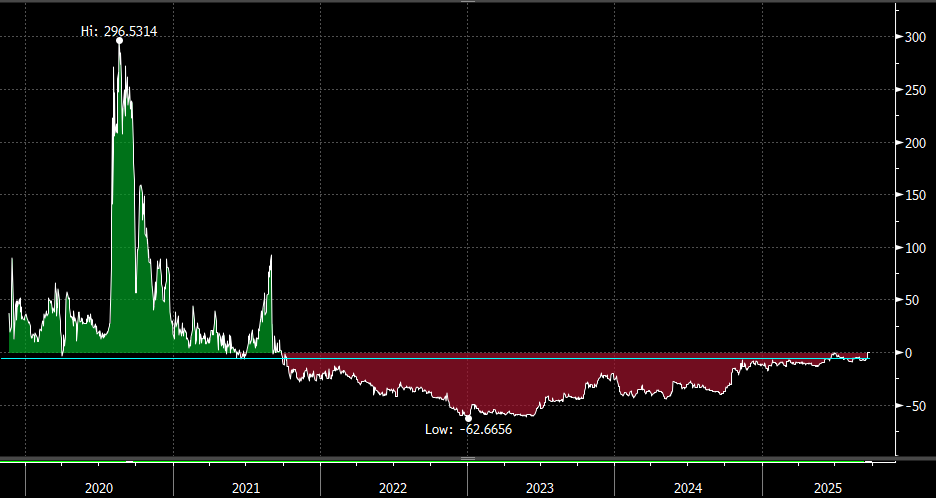
*Source: Bloomberg*
## Conversion Sparks Outflows
As an ETF, GDLC now trades in line with its net asset value thanks to the creation and redemption mechanism. But that same mechanism has also unlocked the ability for investors to pull money out.
Since Friday, redemptions have totaled $141 million, cutting assets under management to $744 million, down from a high of $965 million in August. Some of the outflows likely reflect investors capturing the quick closure of the discount, while the broader pullback in crypto markets also contributed.
The dynamic is similar to what happened when the [**Grayscale Bitcoin Trust (GBTC)**](/GBTC) and [**Grayscale Ethereum Trust (ETHE)**](/ETHE) converted last year. But unlike those funds, which charge eye-popping fees of 1.5% and 2.5%, GDLC is cheaper at 0.59%.
That could limit some of the selling by price-sensitive investors (though its fee is still above the lowest-cost crypto index ETFs, which may keep demand in check).
googletag.cmd.push(function() {
googletag.display('js-dfp-tag-in_article_unit');
});
## Not the Only Index ETF
While GDLC can claim the title of first U.S. crypto index ETF that holds more than just bitcoin and ether, it quickly found competition. The [**Hashdex Nasdaq Crypto Index US ETF (NCIQ)**](/NCIQ) launched in February with only bitcoin and ether, but this week Hashdex expanded the portfolio to include XRP, Solana and Stellar.
NCIQ now has 74% in bitcoin, 15% in ether, 7% in XRP, 4% in Solana and a small slice to Stellar. It has $150 million in assets and charges 0.25%.
GDLC’s portfolio looks similar. Its latest holdings include 73% bitcoin, 16% ether, 6% XRP, 4% Solana and 1% Cardano, with no exposure to Stellar.
Both portfolios reflect the dominance of bitcoin and ether in the crypto market, but they are even more concentrated than the market itself. The two coins have a combined market capitalization of nearly $2.7 trillion, representing more than 70% of all crypto. In the five-asset baskets used by GDLC and NCIQ, their share climbs closer to 90%.
That weighting could—and likely will—decline if more assets are added over time.
## Single Asset ETFs Preferred
The slow start for GDLC and NCIQ highlights investors’ preference for more targeted crypto ETFs. U.S. spot crypto ETFs have already pulled in $33.4 billion this year, with nearly all of it going into single-asset funds. The [**iShares Bitcoin Trust (IBIT)**](/IBIT) has gathered $23.5 billion, while the [**iShares Ethereum Trust (ETHA)**](/ETHA) has taken in $9.8 billion.
One detail worth noting from Grayscale’s filings is that at least 85% of GDLC must be invested in “Approved Components,” or cryptocurrencies that already underpin spot ETPs listed on U.S. exchanges. The other 15% can be spread across additional assets.
With the SEC’s recent approval of generic listing standards for commodity-based ETPs, the number of approved components is expected to expand significantly, potentially giving GDLC, NCIQ, and similar funds the flexibility to add dozens of new crypto assets over time.
For now, even though U.S. investors finally have access to true crypto index ETFs, early signs suggest the real demand remains with single-asset products like bitcoin and ether ETFs.
[ + Follow ](/etf/login)
[ Sumit Roy Senior ETF Analyst ](/authors/sumit-roy)
Sumit Roy is the senior ETF analyst for etf.com and author of (Don't) Invest Like a Pro. He creates a variety of content for the platform, including… [View Bio](/authors/sumit-roy)
Related Topics [Crypto](http://www.etf.com/topics/cryptocurrency)
[Bitcoin](http://www.etf.com/topics/bitcoin)
[Ethereum](http://www.etf.com/topics/ethereum)
[Advisor Center](http://www.etf.com/topics/advisor-center-0)