## [# The Xtrackers RREEF Global Natural Resources ETF: The Strategic Value of Natural Resource Investing](/sections/etf-industry-perspective/xtrackers-rreef-global-natural-resources-etf-strategic-value)
# The Xtrackers RREEF Global Natural Resources ETF: The Strategic Value of Natural Resource Investing
Why Allocating Capital to Natural Resources Can Strengthen Portfolios and Drive Investment Returns
[](/authors/xtrackers-dws)
[By Xtrackers by DWS](/authors/xtrackers-dws)
Dec 15, 2025
Edited by: ETF.com Staff
Share Email LinkedIn Facebook X (Twitter)
googletag.cmd.push(function() {
googletag.display('js-dfp-tag-article_page_302x26');
});
Loading
## IN A NUTSHELL
- With ongoing geopolitical unrest, increasing pressure on global supply chains, and the resources required to sustain the rapid pace of technological advancement, the demand for global natural resources continues to rise.
- Adding a natural resources component to a portfolio strategy offers the potential to reduce volatility, provide broad market and currency exposure, and serve as a hedge against inflation.
- The[ **Xtrackers RREEF Global Natural Resources ETF (NRES)**](https://go.dws.com/q8ZQyjfb) is designed to provide investors access to this vital asset class, capturing opportunities across a broad range of commodities.
- Actively managed, NRES strategically invests in global companies involved in the extraction, production, and distribution of essential raw materials.
googletag.cmd.push(function() {
googletag.display('js-dfp-tag-in_article_unit');
});
## Introduction
Natural resource investing—allocating capital to assets such as energy, metals, agriculture, timber, and water—can potentially be a foundational element of a well-diversified investment portfolio. Global natural resources companies are central to modern supply chains, and their strategic importance is heightened by the increasing frequency of supply chain disruptions, geopolitical events, and international trade tensions.
As the world grapples with economic uncertainty, geopolitical shifts, and the accelerating pace of technological change, the strategic importance of investing in natural resources is more relevant than ever.
In today’s volatile geopolitical landscape, an allocation to natural resources can be a prudent, forward-looking strategy, providing portfolio diversification, inflation hedging, and compelling supply-demand dynamics.
We will also highlight the [**Xtrackers RREEF Global Natural Resources ETF (NRES)**](https://go.dws.com/q8ZQyjfb) and demonstrate how taking an active approach to natural resource investing can yield potential advantages to the traditional passive approach.
## The Case for Natural Resources Investment
### Diversification and Portfolio Resilience
**Portfolio Diversifier:** One of the most compelling reasons to include natural resources in an investment portfolio is diversification. Each commodity, whether oil, gas, or agricultural products, is driven by its unique supply and demand dynamics, influencing price performance. This enables natural resources to be an effective portfolio risk diversifier when combined with equities and fixed income, which can be vulnerable during periods of volatility or economic downturn.
**Reducing Volatility:** Sectors such as energy and precious metals tend to react differently to macroeconomic events compared to industries like technology or consumer discretionary. Their unique price drivers could add stability during market dislocations.
**Crisis Protection:** In times of geopolitical tension or currency instability, commodities often become more valuable, serving as a safe haven for capital. Historically, assets such as gold and oil have experienced price surges during global crises, reinforcing their role as protective allocations.
## Inflation Hedge and Currency Protection
**Inflation Hedge:** Commodities like oil, gold, and agricultural goods, have historically provided an effective hedge against inflation. As the cost of goods rises, the underlying raw materials that support production typically appreciate as well.
Intrinsic Value: Unlike paper assets, physical commodities often maintain real value regardless of currency fluctuations, often appreciating when inflation erodes currency-based investments.
**Global Currency Diversification:** Because many natural resources are globally traded, investing in them inherently provides exposure to multiple markets and currencies. This diversification can reduce the risks tied to any single economy or currency regime.
## Compelling Supply and Demand Dynamics
The finite nature of many natural resources creates powerful long-term investment opportunities. As population growth, urbanization, and industrialization continue worldwide, demand for energy, metals, agricultural products, and water is projected to increase significantly.
**Energy Reality:** The Russian Ukraine conflict underscored that conventional energy sources remain essential. Even as investment in renewables accelerates, natural gas will continue to play a critical role in electricity generation, particularly during seasonal peaks. Weather-related disruptions can affect wind, solar, and hydro output, making natural gas a necessary complement for reliable energy supply.
**Scarcity Premium:** Limited supply and rising demand can lead to price surges for critical resources. For example, rare earth elements vital for electronics or lithium for batteries are in high demand, and their scarcity drives up their value.
**Emerging Market Growth:** Rapid economic development in Asia, Africa, and Latin America is fueling heightened demand for raw materials. This structural trend creates long-term tailwinds for resource producers and related investments well into the future.
## Resource Nationalism at Play
Control and access to natural resources often lie at the heart of global politics. Countries and corporations investing in resource assets can gain strategic advantages, whether through energy independence, technological leadership, or secure supply chains.
Restricting access to critical minerals is a prime example of a country utilizing its natural resources to gain economic leverage. These strategic minerals are essential for advanced manufacturing, defense, and future technologies, elevating their importance to matters of national security for many governments.
China, the world’s largest producer of critical minerals, wields significant control over their export of critical minerals to influence global supply chains and maintain its competitive edge in technology and defense. China continues to reduce and limit the export of 17 minerals used in products vital for autos, consumer electronics and defense.1 This dominance can be accomplished due to their leading position as the producer of many refined critical minerals.
### Figure 1: Production of and Demand for Refined Critical Minerals by Geography, 2024
![]()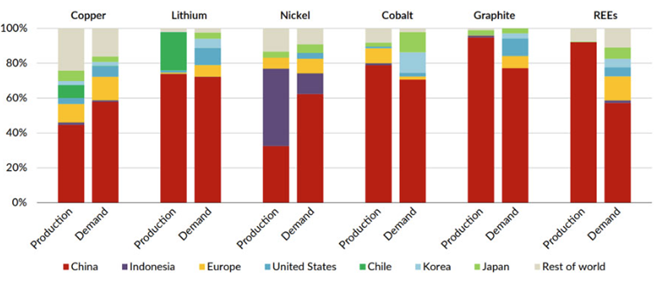
Source: IEA (2024), Global Critical Minerals Outlook 2024, IEA, Paris https://www.iea.org/reports/global-critical-minerals-outlook-2024
Notes: REE’s = rare earth elements. Production refers to refined minerals production while demand refers to refined minerals consumption. Rare earths are magnets only.
In 2024, Chinese mining acquisitions overseas reached their highest level in over a decade, as its companies raced to secure the raw materials that underpin the global economy amidst mounting geopolitical tension.2 This trend has continued unabated in 2025.
### Figure 2: Mining Concentration by Geography and Ownership
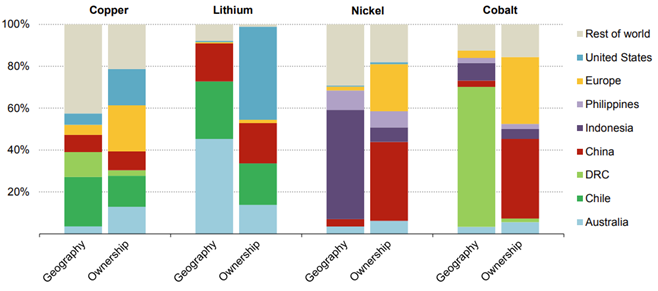Source: IEA (2024), Global Critical Minerals Outlook 2024, IEA, Paris https://www.iea.org/reports/global-critical-minerals-outlook-2024.
Ownership based on company headquarters location. For projects run by multiple companies, production is assigned to the company with the largest share. For copper, data are in the top 20 mining companies in 2023 representing 57% of production. For lithium, data cover 100% of production in 2023; for nickel, 93% of production; and for cobalt 97% of production.
The U.S. has emerged as a net exporter of oil and natural gas, strengthening its position in the global energy landscape. By contrast, Europe’s longstanding dependence on Russian energy has exposed critical security vulnerabilities, particularly in times of geopolitical conflict. For the U.S., maintaining energy self-sufficiency while supplying allied nations is a strategic imperative – supporting both domestic stability and the energy independence of its partners.
Whenever a country can control the means of production and distribution of essential natural resources, the potential for supply chain disruptions and restricted access can have a significant impact on their underlying prices.
## Potential for Attractive Returns
While natural resource markets can be cyclical and volatile, they also offer compelling opportunities for long-term investors who take a diversified approach.
**Commodity Supercycles:** Extended periods of strong demand and limited supply can result in multi-year price rallies, such as the oil boom in the 2000s or the more recent surge in battery metals.
**Dividend Income:** Many resource companies, particularly in the energy and mining sectors, offer attractive dividend yields supported by robust cash flows and disciplined capital management.
## Risks and Considerations
Despite the advantages, investing in natural resources carries inherent risks. Prices can be volatile due to factors such as weather, geopolitical events, technological innovation, and regulatory change. Environmental risks and the social license to operate are increasingly important. Investors must conduct thorough due diligence, diversify across resource types and geographies, and consider the overall risk profile of their portfolios.
## NRES: An Active Approach to Natural Resource Investing
The [**Xtrackers RREEF Global Natural Resources ETF (NRES)**](https://go.dws.com/q8ZQyjfb) is designed to identify and capitalize on opportunities across a broad range of commodities. NRES strategically allocates to approximately 90 publicly traded global companies, offering exposure across three primary commodity related sectors: agribusiness, energy, and metals & mining.
**Experienced Investment Team:** NRES is managed by the DWS Liquid Real Assets platform, a team with deep experience across natural resources and direct commodity investing.
**Comprehensive Investment Process:** The Liquid Real Assets Team employs a disciplined, research-driven approach, ranking securities through traditional valuation analysis, as well as insights into commodity and capital expenditure cycles.
**Extensive Global Resources:** Leveraging the DWS global research platform, the team integrates fundamental analysis and the firm’s CIO View into portfolio construction, blending top-down perspective with bottom-up research to identify the most attractive investment opportunities.
## Why an Active Management Approach?
An actively managed ETF demonstrates many of the same advantages of a passively managed ETF – including price transparency, liquidity, and tax efficiency – while adding the potential for outperformance. Through strategic investment decisions, active managers can seek to generate alpha while maintaining competitive fees. Active strategies enable a manager the flexibility to quickly adapt to changing market conditions, particularly during periods of uncertainty.
## Why Xtrackers? Innovation, Access, and Value
- **Innovation:** Delivering value-added, systematic strategies for markets that matter
- **Access:** Opening gateways to new opportunities and liquidity across global markets
- **Value:** Offering cost-effective investment solutions in targeted, high-conviction areas
Xtrackers by DWS is one of the largest global ETF providers, with over $407 billion assets under management (AUM).3 The U.S. Xtrackers platform encompasses 41 ETFs with over $29 billion in AUM,4 including Thematic, Currency Hedged, High Yield, China, and other asset classes.
## Conclusion
Investing in natural resources is a strategic choice for investors seeking diversification, inflation protection, and access to global growth trends. The [**Xtrackers RREEF Global Natural Resources ETF (NRES)**](https://go.dws.com/q8ZQyjfb) offers broad global exposure to companies engaged in the extraction and production of precious metals, oil & gas, steel, paper & forestry, and agricultural products.
As an actively managed ETF, NRES leverages the experience and insights of the DWS Liquid Real Assets team to identify and capitalize on opportunities across the global natural resources landscape – seeking to add value through disciplined security selection and active risk management.
## Glossary
**Active investment management:** An investment strategy where the goal is to outperform a specified benchmark.
**Alpha:** The excess return of an investment relative to its benchmark.
**Critical minerals:** Any mineral, element, substance, or material that has been designated by the Secretary of the Interior as essential to the economic or national security of the United States.
**Emerging Markets:** Economies of countries that are in the process of rapid industrialization and significant economic growth.
**Inflation hedging:** Investments made to protect against the decreased purchasing power of money due to rising prices.
**Intrinsic value:** The real value of an asset based on fundamental factors, as opposed to the price assigned by the market.
**Passive investment management:** An investment strategy where a fund’s portfolio mirrors a market index, such as the S&P 500.
**Portfolio diversification:** The strategy of spreading investments across different asset classes and types to reduce portfolio risk associated with price volatility, thus limiting exposure to any single asset or risk.
**Portfolio resilience:** The ability of an investment portfolio to withstand adverse market conditions without suffering substantial losses.
**Resource nationalism:** A country’s efforts to assert greater control over its natural resources—often through state ownership, export restrictions, or taxation—to maximize domestic benefits.
1 Source: Reuters, 9/8/2025
2 Source: Financial Times, 7/6/2025
3 Source: DWS as of 6/30/2025
4 Source: DWS as of 10/6/2025
The Xtrackers brand represents all systematic investment solutions. Xtrackers ETFs ("ETFs") are managed by DBX Advisors LLC (the "Adviser") and distributed by ALPS Distributors, Inc. (“ALPS”). The Adviser is a subsidiary of DWS Group GmbH & Co. KGaA and is not affiliated with ALPS.
War, terrorism, sanctions, economic uncertainty, trade disputes, public health crises and related geopolitical events have led and, in the future, may lead to significant disruptions in U.S. and world economies and markets, which may lead to increased market volatility and may have significant adverse effects on the fund and its investments.
**Carefully consider the fund's investment objectives, risk factors, and charges and expenses before investing. This and other information can be found in the fund's prospectus, which may be obtained by calling 1-844-851-4255 or by visiting www.Xtrackers.com. Read the prospectus carefully before investing.**
Investing involves risk, including the possible loss of principal. Stocks may decline in value. There are special risks associated with natural resources investments, this means that the fund is more vulnerable to the price movements that particularly affect one or more of the various industries and sub-industries within the natural resources sector. Funds investing in a single industry, country or in a limited geographic region generally are more volatile than more diversified funds. This fund is non-diversified and can take larger positions in fewer issues, increasing its potential risk. An investment in this fund should be considered only as a supplement to a complete investment program for those investors willing to accept the risks associated with the fund. Please read the prospectus for more information.
Diversification does not guarantee against a loss.
Xtrackers ETFs ("ETFS") are managed by DBX Advisors LLC (the "Adviser") and distributed by ALPS Distributors, Inc. ("ALPS"). The Adviser is a subsidiary of DWS Group GmbH & Co. KGaA and Is not affiliated with ALPS.
Shares are not individually redeemable, and owners of Shares may acquire those Shares from the Fund, or tender such Shares for redemption to the Fund, in Creation Units only.
The brand DWS represents DWS Group GmbH & Co. KGaA and any of its subsidiaries such as DWS Distributors, Inc., which offers investment products, or DWS Investment Management Americas, Inc., and RREF America L.L.C., which offer advisory services.
**Investment products: No bank guarantee | Not FDIC insured | May lose value**
ALPS Distributors, Inc., 1290 Broadway, Suite 1100, Denver, CO 80203
© 2025 DWS Group GmbH & Co. KGaA. All rights reserved. 108339-1 (11/25) DBX006923 (10/26)
[ Xtrackers by DWS ](/authors/xtrackers-dws)
Xtrackers by DWS is a global provider of passive solutions with an index track record going back over 20 years. Xtrackers provides investors with… [View Bio](/authors/xtrackers-dws)
Related Topics [Commodities](http://www.etf.com/topics/commodities)