## [# Why Int'l Stocks Are Pulling Ahead of U.S. Stocks in 2026](/sections/features/why-intl-stocks-are-pulling-ahead-us-stocks-2026)
# Why Int'l Stocks Are Pulling Ahead of U.S. Stocks in 2026
International markets have opened a wide performance gap over U.S. equities in 2026.
[](/authors/sumit-roy)
[By Sumit Roy ](/authors/sumit-roy)
Feb 10, 2026
Edited by: ETF.com Staff
[ + Follow ](/etf/login)
Share Email LinkedIn Facebook X (Twitter)
googletag.cmd.push(function() {
googletag.display('js-dfp-tag-article_page_302x26');
});
Loading
U.S. investors who ventured abroad this year have been rewarded.
The [**Vanguard Total International Stock ETF (VXUS)**](/vxus) is up more than 9% year to date, while the [**iShares Core MSCI Emerging Markets ETF (IEMG)**](/iemg) has gained roughly 11%. By contrast, the [**Vanguard Total Stock Market ETF (VTI)**](/vti) is up just over 2%.

The wide performance gap in 2026 comes after international stocks outperformed U.S. stocks by their largest margin in over 30 years last year.
So what’s driving the reversal?
## The Dollar Is a Big Part of the Story
One of the clearest tailwinds for international stocks has been the U.S. dollar.
After falling more than 9% last year, the dollar is down another roughly 1.5% so far this year. For U.S.-based investors, a weaker dollar provides a mechanical boost to foreign equity returns, since stocks priced in euros, yen, or emerging-market currencies translate into more dollars.
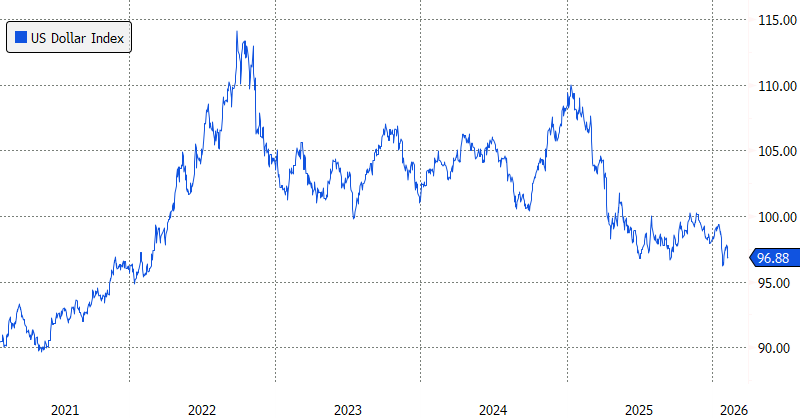
A weaker dollar also tends to ease global financial conditions, particularly for emerging-market governments and companies that borrow in dollars. As debt burdens become easier to service, risk appetite improves, which can support equity markets abroad.
googletag.cmd.push(function() {
googletag.display('js-dfp-tag-in_article_unit');
});
## Growth Expectations Outside the U.S. Are Improving
Another factor is a shift in the global growth outlook.
While U.S. economic growth remains solid, expectations for growth outside the U.S. have improved meaningfully. Governments in Europe and Asia have ramped up fiscal spending, with defense spending playing a particularly large role. That has helped lift growth expectations and, in turn, profit expectations for foreign companies.
## U.S. Assets Have Lost Some Shine
At the same time, the relative appeal of U.S. assets has softened.
Policy uncertainty has increased, particularly around trade. Tariffs and trade wars have added a layer of unpredictability that some global investors are choosing to sidestep, at least at the margin. There hasn’t been a broad exodus from U.S. markets, but it does help explain why capital flows have become more balanced after years of heavy U.S. concentration.
Technology, the largest sector in the U.S. market, has also become somewhat of a headwind for the market this year. After driving returns for much of the past decade, tech stocks have pulled back amid concerns about the sustainability of the AI boom and the potential for AI to disrupt software business models.
When technology stumbles, the entire U.S. market feels it.
## Valuations Still Favor International Markets
Valuations remain another key differentiator. International stocks currently trade at roughly 17x forward earnings, compared with about 22x for U.S. equities. While that valuation gap has narrowed from its extremes a year ago, international markets still offer a meaningful discount.
Historically, relative valuation gaps between U.S. and international stocks have tended to be cyclical. Long stretches of U.S. outperformance have often been followed by periods in which international markets catch up or pull ahead. There’s no guarantee that pattern repeats, but it’s one reason investors are taking a fresh look at global diversification.
## Flows Are Following Performance
That renewed interest is showing up clearly in ETF flows.
Over the past year, investors have poured roughly $29 billion into VXUS, which offers broad exposure to developed and emerging markets outside the U.S. Another roughly $28 billion has flowed into IEMG, reflecting growing appetite for emerging-market equities in particular.
After more than a decade of underperformance, sentiment around international stocks has finally shifted. Last year marked the largest margin of international outperformance over the U.S. since 1993, and this year the gap has widened again.
Whether the trend continues is far from certain. But for investors who had grown accustomed to U.S. markets leading every year, the past two years have served as a reminder that global leadership does rotate, and that diversification sometimes works when it’s least expected.
[ + Follow ](/etf/login)
[ Sumit Roy Senior ETF Analyst ](/authors/sumit-roy)
Sumit Roy is the senior ETF analyst for etf.com and author of (Don't) Invest Like a Pro. He creates a variety of content for the platform, including… [View Bio](/authors/sumit-roy)
Related Topics [International](http://www.etf.com/topics/international)
[Equity](http://www.etf.com/topics/equity)
[Emerging Markets](http://www.etf.com/topics/emerging-markets)