## [# This Little-Known Fund Is the Best-Performing ETF of 2026](/sections/features/little-known-fund-best-performing-etf-2026)
# This Little-Known Fund Is the Best-Performing ETF of 2026
BWET is up 243% so far this year.
[](/authors/sumit-roy)
[By Sumit Roy ](/authors/sumit-roy)
Mar 04, 2026
Edited by: ETF.com Staff
[ + Follow ](/etf/login)
Share Email LinkedIn Facebook X (Twitter)
googletag.cmd.push(function() {
googletag.display('js-dfp-tag-article_page_302x26');
});
Loading
The best-performing ETF of 2026 so far comes from a corner of the market few investors pay attention to.
The [**Breakwave Tanker Shipping ETF (BWET)**](/bwet) has surged about 243% year to date, fueled by a spike in tanker freight rates following the outbreak of war between the United States, Israel and Iran in the Middle East.
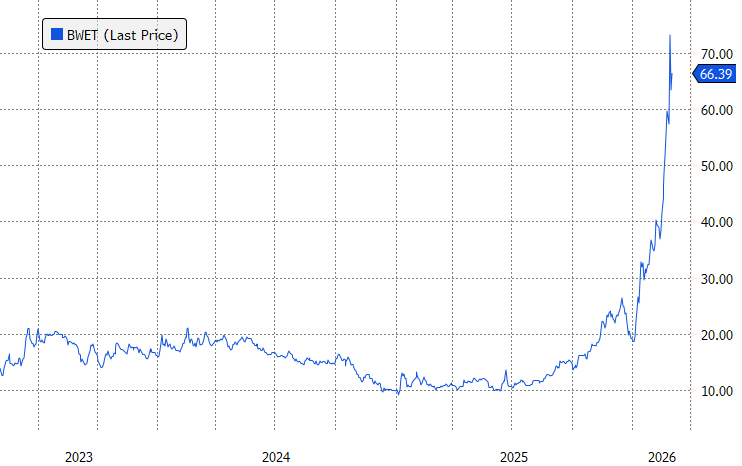
Freight rates surged as the conflict disrupted shipping through the Strait of Hormuz, one of the most important oil transit chokepoints in the world.
Roughly 20 million barrels of oil per day, or about one-fifth of global consumption, normally pass through the strait.
The fighting dramatically increased the risk of navigating through the corridor. As a result, some vessels are likely delaying voyages, while others may be demanding higher charter rates to compensate for the added risk.
## How BWET Works
Those rising freight rates are exactly what BWET is designed to track. BWET holds tanker freight futures, derivatives tied to the cost of transporting crude oil by sea.
The fund invests in futures expiring one to six months into the future, with a weighted average maturity of roughly 60 to 90 days.
About 90% of the portfolio consists of TD3C futures, which track the cost of transporting crude on very large crude carriers from the Middle East to China.
VLCCs are the largest oil tankers in the world and can carry roughly two million barrels of crude per voyage. They dominate long-distance crude shipping, particularly the massive trade flow from the Persian Gulf to Asia.
The remaining 10% of the fund tracks TD20 futures, which measure freight rates for Suezmax vessels moving crude from West Africa to Europe.
Because most of the portfolio tracks shipments leaving the Persian Gulf, BWET is highly sensitive to disruptions around the Strait of Hormuz.
googletag.cmd.push(function() {
googletag.display('js-dfp-tag-in_article_unit');
});
## A Hedging Market That Attracts Traders
Freight futures markets were originally developed to help shipowners, oil companies and commodity traders hedge transportation costs.
An energy company expecting to move crude from the Middle East to Asia, for example, can lock in freight rates months in advance using TD3C futures.
If shipping costs spike later, the gains on the futures contract help offset the higher charter cost.
But these markets also attract traders looking to profit from changes in global shipping demand and vessel supply.
BWET essentially packages those derivatives into an ETF wrapper, allowing anyone to gain exposure without opening a futures account.
Because freight rates can swing dramatically during disruptions and then fall just as quickly once conditions normalize, the ETF functions more like a trading vehicle than a long-term investment.
Shipping rates tend to mean revert once supply and demand come back into balance.
## A Fund Few Investors Noticed
Despite its recent surge, BWET has largely flown under the radar. The ETF launched in 2023 but had only about $3 million in assets at the start of this year.
Assets have since climbed to $26 million, driven in large part by the fund’s gains, though the ETF has also pulled in about $14 million of inflows during the rally.
BWET’s sister fund, the [**Breakwave Dry Bulk Shipping ETF (BDRY)**](/bdry), is slightly larger with roughly $43 million in assets.
That ETF tracks dry bulk freight futures, which measure the cost of transporting commodities such as iron ore, coal and grains.
BDRY focuses on near-dated contracts tied to several vessel types. About 50% of the portfolio tracks Capesize ships, the largest dry bulk vessels typically used to transport iron ore.
Another 40% tracks Panamax ships, the largest vessels capable of transiting the Panama Canal. The remaining 10% tracks Supramax ships, medium-sized bulk carriers often equipped with onboard cranes.
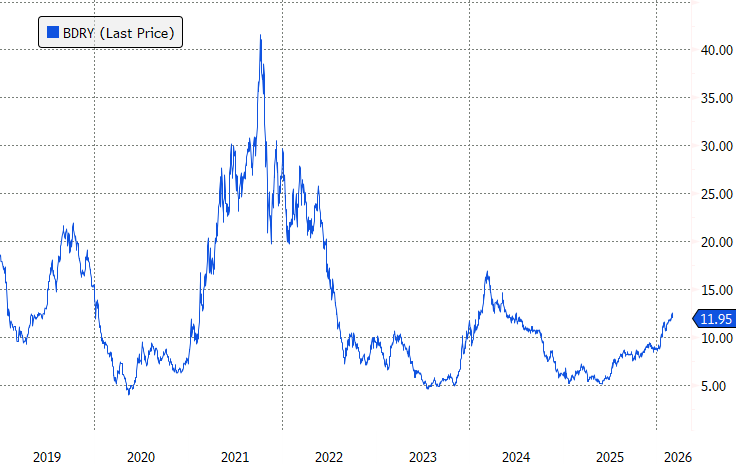
Dry bulk shipping experienced its own dramatic surge during the pandemic-era commodity boom.
Freight rates soared in 2021 as supply chain disruptions and strong demand for raw materials strained global shipping capacity. At one point that year, BDRY had climbed nearly 500%.
But those gains didn’t last. The ETF gave back all of them the following year as freight rates cooled—a stark reminder of how fast shipping markets can turn.
[ + Follow ](/etf/login)
[ Sumit Roy Senior ETF Analyst ](/authors/sumit-roy)
Sumit Roy is the senior ETF analyst for etf.com and author of (Don't) Invest Like a Pro. He creates a variety of content for the platform, including… [View Bio](/authors/sumit-roy)
Related Topics [Oil & Gas](http://www.etf.com/topics/oil-gas)
[Energy](http://www.etf.com/topics/energy)
[Shipping](http://www.etf.com/topics/shipping)