## [# Market Holds Up as Money Rotates Out of Tech](/sections/features/market-holds-money-rotates-out-tech)
# Market Holds Up as Money Rotates Out of Tech
Weakness in tech has been offset by gains in energy, utilities and other sectors, keeping the broader market from a deeper decline.
[](/authors/sumit-roy)
[By Sumit Roy ](/authors/sumit-roy)
Mar 18, 2026
Edited by: ETF.com Staff
[ + Follow ](/etf/login)
Share Email LinkedIn Facebook X (Twitter)
googletag.cmd.push(function() {
googletag.display('js-dfp-tag-article_page_302x26');
});
Loading
The U.S. stock market has avoided a correction so far despite a growing list of headwinds.
Oil prices have surged, recently hitting a fresh three and a half year high near $110. Investors are also weighing concerns about private credit and softening in the labor market.
Even so, the S&P 500 has held up relatively well. The index is down just under 5% from its late January all time high and is off a little more than 2% for the year.
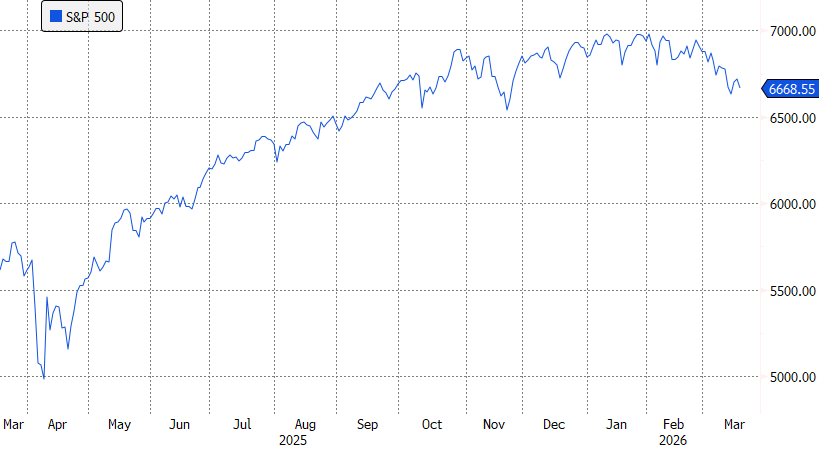
That resilience could be tested if oil prices continue climbing or the labor market deteriorates further. Markets can also slide without a clear catalyst. At some point, a larger pullback is inevitable. For now, though, the ability of equities to absorb negative news has stood out.
What makes recent performance particularly notable is that it has come despite weakness in some of the market’s largest companies. Microsoft, the third largest stock in the index with a weight of about 5.2%, is down roughly 28% from its highs. Amazon, the fifth largest, has fallen around 17%.
Both stocks sit in sectors that have lagged the broader market. The [**Technology Select Sector SPDR Fund (XLK)**](/xlk) is down more than 3% this year, while the [**Consumer Discretionary Select Sector SPDR Fund (XLY)**](/xly) has dropped over 6%.
## Rotation Beneath The Surface
The softness in those areas has been offset by strength elsewhere.
Energy has been the standout, with the [**Energy Select Sector SPDR Fund (XLE)**](/xle) up about 31% as oil prices surged. Utilities have gained roughly 10%, while materials and industrials are each up around 8%. Consumer staples have risen about 7%, and real estate has added roughly 5%.
In other words, rather than a broad based selloff, the market has experienced a rotation.
As money has moved out of technology and consumer discretionary, it has flowed into sectors tied to commodities, defense, infrastructure and more defensive areas of the market. That shift has helped cushion the overall index.
The weakest area has been financials. The [**Financial Select Sector SPDR Fund (XLF)**](/xlf) is down about 10% amid ongoing concerns around credit conditions, particularly in private markets.
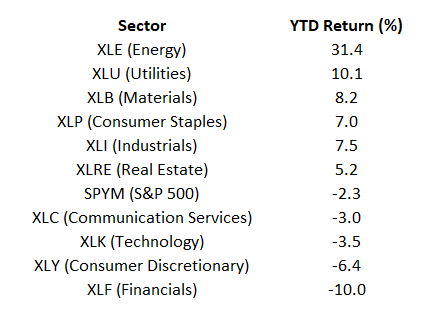
*Note: YTD Returns as of midday 3/18*
googletag.cmd.push(function() {
googletag.display('js-dfp-tag-in_article_unit');
});
## What’s Driving The Winners
The sector leadership reflects a mix of cyclical forces and longer term themes.
Energy’s strength is largely tied to higher oil prices, which have been driven by the conflict involving Iran. Utilities have benefited from their traditional role as a defensive sector, but they have also been supported by rising expectations for electricity demand tied to AI infrastructure and data center growth.
Materials have gained on the back of both economic and geopolitical factors. The push toward electrification has supported demand for metals such as copper, while gold prices have risen amid uncertainty, lifting mining stocks.
Industrials have been buoyed by increased defense spending, while consumer staples have acted as a safe haven, attracting investors looking for stability.
Some sectors are harder to pin down. Real estate has posted modest gains, though higher interest rates remain a headwind for the group. Health care has also been relatively subdued after lagging last year amid concerns about insurance profitability and regulatory pressures.
## A Market That’s Holding Together
Taken together, the picture is one of a market that is holding together despite pressure in some of its most important stocks.
The weakness in technology, consumer discretionary, and financial names has not spilled over into a broader downturn. Instead, leadership has shifted to other parts of the market.
Whether that rotation can continue will depend on how the current set of risks evolves. For now, it has been enough to keep the market from sliding into a deeper decline.
[ + Follow ](/etf/login)
[ Sumit Roy Senior ETF Analyst ](/authors/sumit-roy)
Sumit Roy is the senior ETF analyst for etf.com and author of (Don't) Invest Like a Pro. He creates a variety of content for the platform, including… [View Bio](/authors/sumit-roy)
Related Topics [Sectors](http://www.etf.com/topics/sectors)
[Advisor Center](http://www.etf.com/topics/advisor-center-0)
[Equity](http://www.etf.com/topics/equity)
[Technology](http://www.etf.com/topics/technology)
[Consumer Discretionary](http://www.etf.com/topics/consumer-discretionary)