## [# Box Spread ETFs Face Fee Pressure as New Rival Enters](/sections/features/box-spread-etfs-face-fee-pressure-new-rival-enters)
# Box Spread ETFs Face Fee Pressure as New Rival Enters
A new entrant undercuts BOXX on fees.
[](/authors/sumit-roy)
[By Sumit Roy ](/authors/sumit-roy)
Mar 20, 2026
Edited by: ETF.com Staff
[ + Follow ](/etf/login)
Share Email LinkedIn Facebook X (Twitter)
googletag.cmd.push(function() {
googletag.display('js-dfp-tag-article_page_302x26');
});
Loading
A niche corner of the ETF market is starting to see real competition.
This week, the **Roundhill Ultra Short Duration No Dividend Target ETF (XBOX)** launched with a 0.19% expense ratio, or 0.14% after temporary fee waivers, undercutting the category’s incumbent, the [**Alpha Architect 1-3 Month Box ETF (BOXX)**](/boxx), which charges 0.24%, or 0.19% after waivers.
The new launch comes at a time when demand for tax-efficient cash exposure is rising quickly.
BOXX has roughly doubled in size over the past year, pulling in $4.7 billion in inflows and reaching $10.7 billion in assets under management.
## A Strategy Built On Tax Efficiency
BOXX’s appeal stems from an unusual strategy.
The fund uses box spreads—paired options positions that effectively lock in a fixed return—to generate yields similar to Treasury bills.
The main benefit is tax treatment. Instead of distributing income like a money market fund or ultra-short bond ETF, BOXX reinvests its returns. That allows the fund’s net asset value to rise over time without paying out interest.
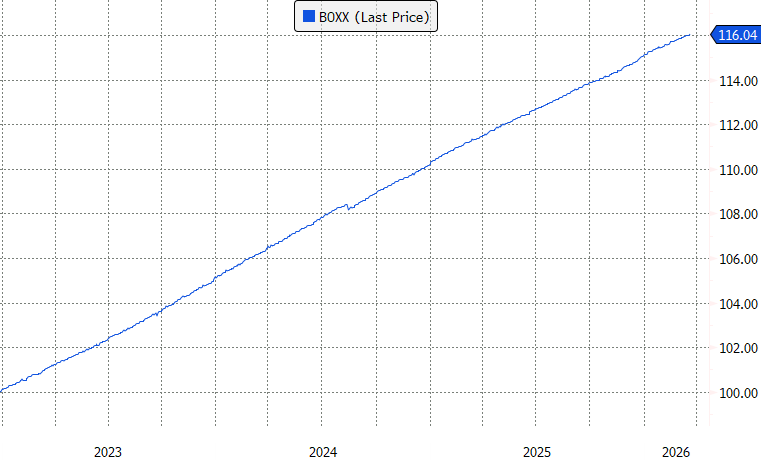
For investors, that means gains are generally realized only when shares are sold, and are taxed as capital gains rather than ordinary income.
That distinction can be meaningful. Long-term capital gains are taxed at a maximum federal rate of 20%, versus up to 37% for ordinary income. The ability to defer taxes and potentially pay a lower rate has been a major driver of demand.
googletag.cmd.push(function() {
googletag.display('js-dfp-tag-in_article_unit');
});
## A New Challenger
XBOX aims to deliver a similar outcome at a lower cost. Like BOXX, it uses combinations of exchange-listed options to construct box spreads with short maturities, generally ranging from one to six months.
The funds have differences, but they are subtle. For instance, implementation may vary depending on which underlying securities or indexes are used and how positions are managed. Additionally, BOXX targets returns similar to the 1–3 month segment of the Treasury curve, while XBOX has a slightly wider maturity range.
But from an investor’s perspective, the expected outcome should look broadly similar: a T-bill-like return with tax deferral.
## Not The Only Player
These two funds aren’t the only box spread ETFs.
The [**Wayfinder Dynamic U.S. Interest Rate ETF (CMBO)**](/cmbo) launched in November and currently has around $100 million in assets. It charges 0.35%, or 0.15% after waivers, making it more expensive than its peers on a headline basis.
CMBO targets a slightly longer segment of the curve, with exposure spanning roughly zero to 12 months, compared to the shorter focus of BOXX and XBOX.
So while all three funds use similar mechanics, they occupy slightly different parts of the ultra-short duration spectrum.
## Fee Pressure Meets First-Mover Advantage
For now, BOXX still dominates.
It has a significant size and liquidity advantage, along with strong name recognition. But XBOX’s lower fee could make it an attractive alternative, especially if investors view the strategies as largely interchangeable.
That dynamic raises a familiar question: will this niche follow the same path as other ETF categories, where competition drives fees steadily lower over time?
There’s also a more fundamental issue hanging over the space. Some tax experts have argued that the structure of these ETFs represents a form of tax arbitrage and could eventually face scrutiny. If regulators change how box spread income is treated, the core appeal of these funds could diminish.
For now, however, the strategy remains compliant under current rules, and flows suggest investors are willing to take that risk.
## Cheaper Alternatives Exist
Of course, not every investor is focused on tax deferral. For those who aren’t, traditional Treasury bill ETFs remain cheaper and simpler.
The [**iShares 0-3 Month Treasury Bond ETF (SGOV)**](/sgov) charges just 0.09%, while the [**Vanguard 0-3 Month Treasury Bill ETF (VBIL)**](/vbil) comes in at 0.06%. Both distribute income regularly and don’t rely on derivatives-based structures.
That makes them a more straightforward option for investors prioritizing cost and income over tax efficiency.
[ + Follow ](/etf/login)
[ Sumit Roy Senior ETF Analyst ](/authors/sumit-roy)
Sumit Roy is the senior ETF analyst for etf.com and author of (Don't) Invest Like a Pro. He creates a variety of content for the platform, including… [View Bio](/authors/sumit-roy)
Related Topics [Ultra-Short Term](http://www.etf.com/topics/ultra-short-term)
[Bond](http://www.etf.com/topics/bond)
[Fixed Income](http://www.etf.com/topics/fixed-income)