## [# One Basis Point Is Moving Billions Into SPYM](/sections/features/one-basis-point-moving-billions-spym)
# One Basis Point Is Moving Billions Into SPYM
A new analysis from Eric Balchunas shows how a one-basis-point fee advantage helped turn SPYM into a $100 billion ETF.
[](/authors/sumit-roy)
[By Sumit Roy ](/authors/sumit-roy)
Mar 30, 2026
Edited by: ETF.com Staff
[ + Follow ](/etf/login)
Share Email LinkedIn Facebook X (Twitter)
googletag.cmd.push(function() {
googletag.display('js-dfp-tag-article_page_302x26');
});
Loading
“Every dollar counts.”
A recent note from Bloomberg Intelligence Senior ETF Analyst Eric Balchunas shows just how far that idea has been taken in the ETF industry.
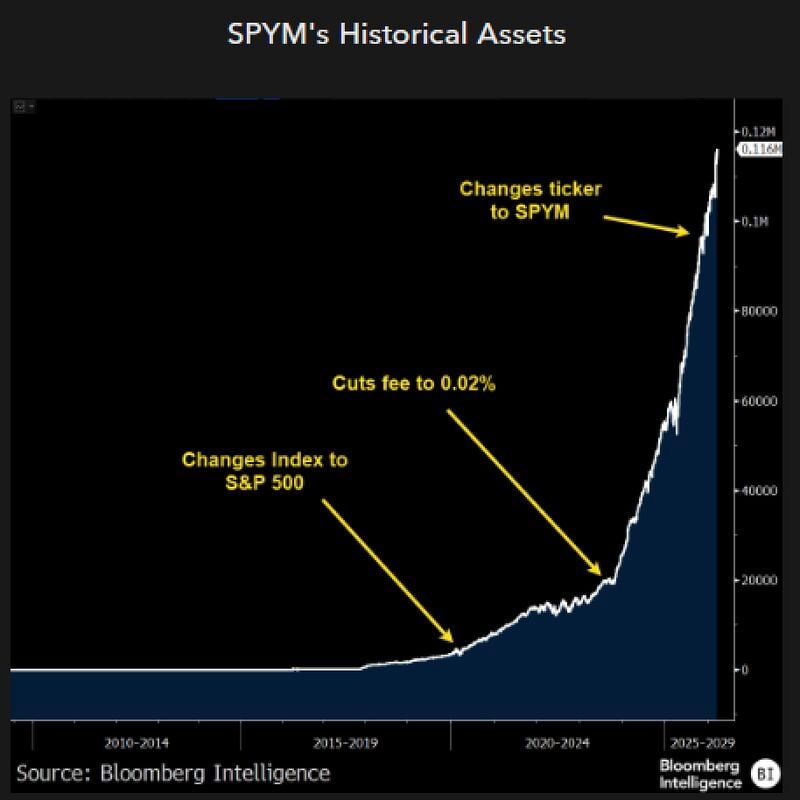
With more than $110 billion in assets, the [**SPDR Portfolio S&P 500 ETF (SPYM)**](/spym) has become one of the largest ETFs on the market after years of relative obscurity.
Balchunas points to two changes that drove that turnaround.
The first came in 2020, when the fund switched its benchmark to the S&P 500. The second came in 2023, when State Street cut the fund’s expense ratio to 0.02%, undercutting its closest rivals by just one basis point.
That tiny edge over the [**Vanguard S&P 500 ETF (VOO)**](/voo) and the [**iShares Core S&P 500 ETF (IVV)**](/ivv), which both charge 0.03%, has been enough to pull in tens of billions of dollars.
SPYM has taken in roughly $47 billion over the past year and about $24 billion year to date, making it one of the fastest-growing ETFs in the industry. Its asset base has expanded at a pace that stands out even among the largest S&P 500 funds, according to Balchunas.
On the surface, the difference is minimal. A 0.01% fee gap translates to about $1 per year for every $10,000 invested.
But in a category like S&P 500 ETFs, where holdings and performance are nearly identical, some investors don’t want to pay even that.
That dynamic is starting to override even long-standing brand preferences. Robo-advisor Betterment, historically a heavy user of Vanguard funds, has made SPYM one of its largest positions, Balchunas notes.
At the same time, SPYM’s success highlights an important nuance. Low fees alone aren’t enough.
Despite also charging 0.02%, the [**JPMorgan BetaBuilders U.S. Equity ETF (BBUS)**](/bbus) has only about $7 billion in assets and hasn’t seen anything close to the same level of demand. The difference is the index. BBUS tracks a generic large-cap benchmark, while SPYM tracks the S&P 500.
As Balchunas put it, advisors may like the JPMorgan brand, but they “love the S&P 500 Index much more.”
[ + Follow ](/etf/login)
[ Sumit Roy Senior ETF Analyst ](/authors/sumit-roy)
Sumit Roy is the senior ETF analyst for etf.com and author of (Don't) Invest Like a Pro. He creates a variety of content for the platform, including… [View Bio](/authors/sumit-roy)
Related Topics [Equity](http://www.etf.com/topics/equity)
[Advisor Center](http://www.etf.com/topics/advisor-center-0)
[S&P 500](http://www.etf.com/topics/sp-500)
[Large Cap](http://www.etf.com/topics/large-cap)