## [# The Real Measure of ETF Liquidity](/sections/etf-industry-perspective/real-measure-etf-liquidity)
# The Real Measure of ETF Liquidity
Discover how implied liquidity can offer deeper insight into ETF tradability, accessibility and performance beyond average daily trading volume (ADV).
[](/authors/mfs)
[By MFS](/authors/mfs)
May 18, 2026
Edited by: ETF.com Staff
Share Email LinkedIn Facebook X (Twitter)
googletag.cmd.push(function() {
googletag.display('js-dfp-tag-article_page_302x26');
});
Loading
Exchange-traded funds have been around for decades and are a popular vehicle choice. However, a common misconception about ETFs is that those with lower average daily trading volumes (ADV) are less liquid compared to those with higher volumes. ETF liquidity refers to how easily an ETF can be bought or sold in the market without significantly affecting its price. While this concept seems straightforward, how ETFs behave when traded is far more complex.
## Looking Beyond Trading Volume
Unlike a common stock with a fixed amount of available shares, an ETF's shares can be created in unlimited quantities. This flexibility is why an ETF's liquidity is not as closely linked to its ADV as a stock's would be. Instead, an ETF's liquidity is determined primarily by the tradability of its underlying basket of securities. In many cases, this structure allows an ETF to trade in amounts exponential to its ADV.
ETF liquidity providers, commonly called "market makers", can create and redeem shares directly with an ETF issuer — by interacting with the ETF's underlying basket of securities — to meet demand from investors. As a result, ETF price changes are based generally on the price and availability of the underlying portfolio rather than the ADV of the ETF itself.
Implied liquidity shows how much of an ETF can trade without causing liquidity issues in the ETF or its underlying holdings. Going beyond the ETF's ADV, implied liquidity can serve as a benchmark for the trade size an investor reasonably can execute without causing price impact to the underlying securities — and, by extension, the ETF itself.
googletag.cmd.push(function() {
googletag.display('js-dfp-tag-in_article_unit');
});
## How Does Implied Liquidity Apply When Evaluating ETFs?
An ETF's implied liquidity serves as a benchmark for the trade size an investor reasonably can execute without causing price impact to the underlying securities — and, by extension, the ETF itself.
### Tradability
For both passive and active ETFs, implied liquidity offers investors a more comprehensive evaluation of accessibility, surpassing the insights provided by relying solely on ADV.
### Newly Issued ETFs
Implied liquidity helps provide a more accurate assessment of an ETF with a short trading history compared to considering only ADV, which can sometimes give a false impression of low liquidity.
### Trade Size
A higher implied liquidity suggests that an ETF can be traded in larger quantities without substantially affecting the market price, making it a more liquid investment vehicle.
## ETF Liquidity in Practice
### MFS Blended Research® International Equity ETF (BRIE) Trade
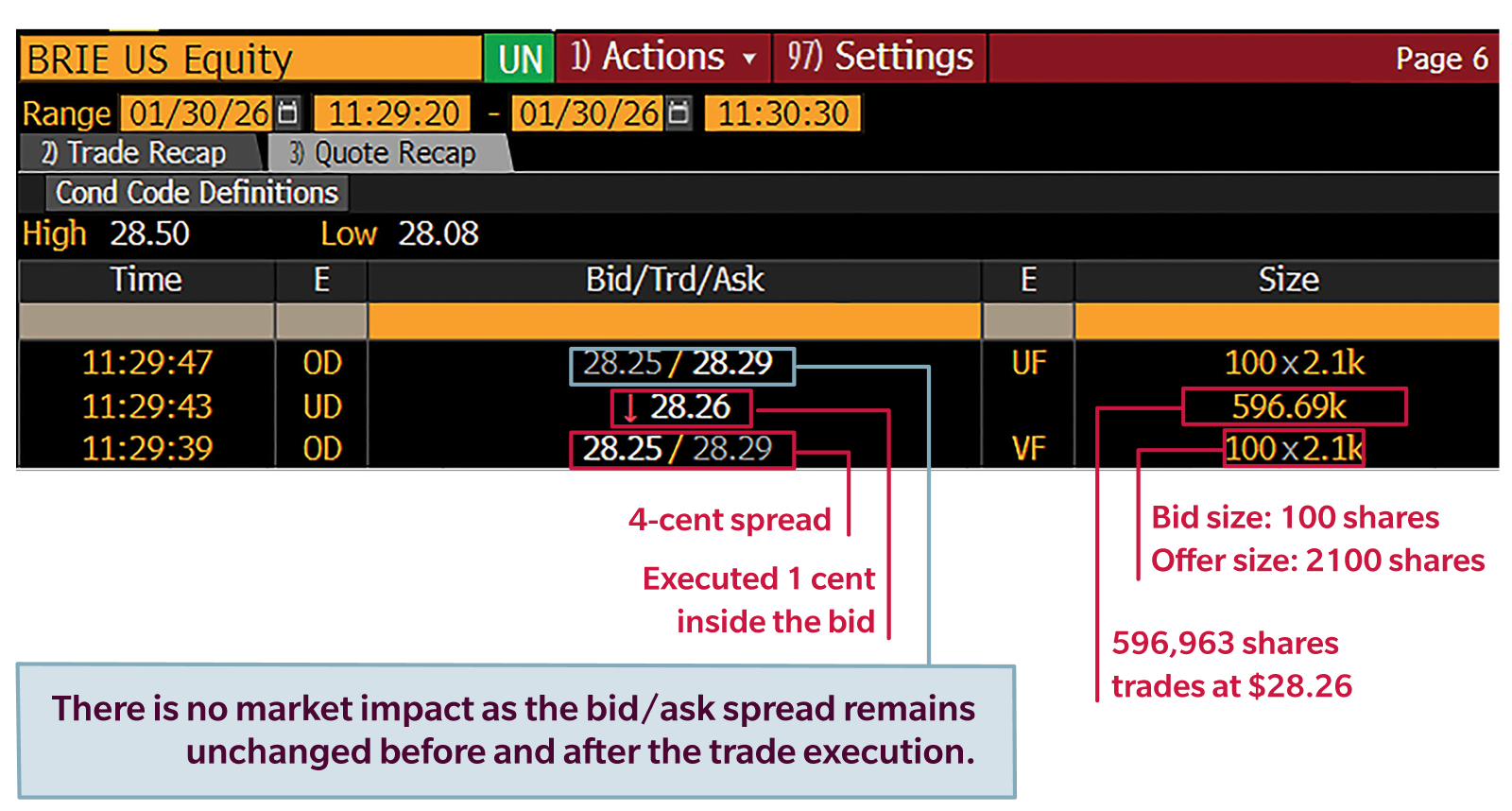
Here is a real-world, block trade example demonstrating that trade size, even when it is over 10x the 30-day ADV, does not impact the bid/ask spread.
- 30 daily average daily trading volume: 27,058
- Spread: 4 cents ($28.25 / $28.29)
- Trade: ~$17M
- Execution: 596,693 shares traded at $28.26, executed 1 cent inside the bid.
Source: Bloomberg. As of 1/30/26.
For illustrative, and educational, purposes only. This example is used as a visual aid to help further explain an ETF's implied liquidity and is not to be relied upon as investment advice or as a recommendation.
## Instilling Client Confidence
ETF liquidity is a key consideration that can impact both performance and investor confidence. That's why, at MFS, we take a proactive approach to bringing liquid solutions to our clients. By partnering with industry-leading market makers and institutional liquidity providers, we seek to deliver products that actively support and reinforce both displayed liquidity and implied liquidity, with the goal of helping investors execute trades efficiently and with confidence, even in varying market conditions.
---
Sponsored Content — Paid and produced by MFS. ETF.com's editorial team was not involved.
[ MFS ](/authors/mfs)
Our purpose is to create long-term value responsibly. In 1924, recognizing an inadequate financial system, we launched the first US open-end mutual… [View Bio](/authors/mfs)
Related Topics [Active Management](http://www.etf.com/topics/active-management)