
The Benefits of Going Virtual With ETF Breakthru Connect
Hesitant about ETF Breakthru Connect because it’s virtual instead of in-person? There’s specific benefits to going virtual you may have missed but Matt Middleton and Dave Nadig have you covered.

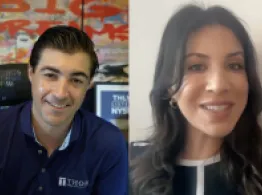
Dave Nadig, President & Director of Research at ETF.com, recently sat down with Matt Middleton, CEO of ETF.com and Founder & CEO of Future Proof, to talk through what ETF Breakthru Connect is, who it’s for, and more. This conversation focuses on the specific benefits of virtual over in-person meetings, the double opt-in requirements for recording meetings (otherwise they’re entirely off record), and how this specific format solves for existing needs of participants.
To learn more about what ETF Breakthru connect is all about, watch their broader conversation here, and then head over to ETF Breakthru Connect for more details.
How Virtual Meetings Solve for Current Gaps
Nadig: One of the big differences here, Matt, is that this time we're doing it like this, right? We're looking at a camera. We're talking to each other versus, you know, Huntington Beach. We're sitting in the sand. It's loud because there's another thousand of these conversations going on around us. There's only so far apart you can spread everybody.
Like, how do you expect this to be different? Because to me, this is a very natural environment because like we said, I'm an introvert. For other people, they really feed off the energy of being in a big crowd. How do you think these are going to be different? Because I definitely see the value in having this be a little more focused and a little more one-to-one without all the distraction.
Middleton: I think you're 100 % right. I think COVID forever changed what's possible virtually. It made us all very comfortable forcefully to kind of open up, right? During that time you had to have your meetings — because you couldn't do it in person — in the comforts of home. So you had connected in deeper ways virtually, whereas most of the time, especially in our industry, it's like in person is reserved for that handshake. I want to look through the whites of your eyes, right?
All these things. Yeah. Is it important still? 100. But this platform is complimentary and in some cases, as you described, the better solution because you don't have the distractions, right? Like I always joke, I have ADHD. So I'm like, you know, more than 15 minutes you lost me. And if there's a bright light over there,
Nadig: Now we understand the timing.
Middleton: If you have all this noise over there, someone's highly animated with their hands over there, yeah, I want, Dave, I want to pay attention to you, you're three feet away from me, but it's likely that I'm not. You're not getting my undivided attention. Well, guess what? Now, right here, I have no distractions around me, right? I've put all my do not disturbs on the technology and you have my undivided attention for 15 minutes. And it's in a concentrated space where I'm either in my home or my office where I'm most comfortable. What's your view?
Nadig: Yeah, I mean, I think also there is something that is a little bit more intimate about this because like we're not — I'm assuming we're not all recording this. This is just us getting to know each other. This isn't about hitting the meeting recorder and getting the transcript and making sure I get that into my Salesforce implementation. This is about actually getting to know the person on the other side of that screen. I find in the Breakthru meetings in person sometimes not only is it a little overwhelming, I'll be a little more guarded because I'm also sitting three feet from someone, somebody next to me. So if somebody asks me something, they may not get my completely unfiltered opinion because I am in a semi-public space.
Middleton: Yeah, I think that's a great point. One of the pieces of feedback that unfortunately you can't solve for in a live event with the written meetings program is: I made the right connection, but the conversation I really wanted to have was sensitive. And so I couldn't even share that I wanted to follow up for that sensitive reason because of what you described, right? My competitor's sitting next to me or some stranger sitting next to me. And I wanted to talk about maybe my succession plan.
Or, hey, I'm launching a new product with this new strategy. I wanted to talk it with you, but my competitor is right there. And so, how do I give you enough to want to connect with me after without making this feel like an utter waste of your time? And I think in this virtual setting, you could be more open. And I want to just capture one thing that you said, because I think from a technical standpoint, we actually had thought about this.
So the program dynamics do change from live person to virtual. And there's no shortage of every talk about AI note takers today, right? There's more note takers in meetings than there are humans usually now.
Nadig: Than there are people!
Middleton: So we thought really long and hard about this and what do we offer? Because everyone on one side wants efficiency and productivity, but on the other side, to your side, we want protection. We want to be able to speak more vulnerably or more open. And so what we actually built into this unique virtual program is the ability for each individual to say, "I want to record this," or "I don't want to record it."
And if they're again, the same way a meeting occurs, double opt-in, if there's a mutual interest to say, “Hey, yeah, I want this to be recorded." Great. We'll have it recorded and transcriptions only given to you two. Or if one person says, “No, I don't want this recorded or I can't have it for compliance reasons to my company." Great. That will never get recorded and it won't —the 15 minutes are just that. It's just the live setting. So there's elements to this where we want to kind of give people what they need and what they want, but they also want it to be the best 15 minute conversation that you went with the intention. So you have the optionality there.
Nadig: That's awesome. That's awesome. Yeah. Flexibility is key and definitely no option to do that live and in-person.
Middleton: Yeah, yeah.