

BlackRock Launches Broadest U.S. Bond Market ETF
BlackRock is pushing beyond the Agg with a new ETF that aims to capture the entire taxable U.S. bond market.

BlackRock launched the broadest U.S. bond index ETF on the market this week, the iShares Total USD Fixed Income Market ETF (BTOT).
The new fund tracks the Bloomberg U.S. Total Fixed Income Market Index, which BlackRock says expands exposure by 28% beyond the Bloomberg U.S. Aggregate Index—the benchmark followed by giants like the iShares Core U.S. Aggregate Bond ETF (AGG) and the Vanguard Total Bond Market ETF (BND).
It also reaches about 9% beyond the Bloomberg U.S. Universal Index, tracked by the iShares Core Universal USD Bond ETF (IUSB).
BlackRock says BTOT is designed to provide “comprehensive access to the full taxable U.S. bond market.” In doing so, the ETF goes well beyond traditional core bond exposure.
How BTOT Compares With AGG and IUSB
AGG and BND focus on U.S. investment-grade bonds. IUSB widens the net by including high-yield bonds. BTOT goes further still, adding exposure to segments such as Treasury inflation-protected securities (TIPS), floating-rate bonds, and bank loans.
For investors who want the broadest possible exposure to the taxable, U.S. dollar-denominated bond market, BTOT may be appealing. In particular, passive investors who prefer owning “the market” as a whole, rather than making bets on specific bond sectors, may find the approach attractive, even if the incremental impact on long-term returns turns out to be modest.
The distinction is similar to equity investors choosing between a large-cap fund like the Vanguard S&P 500 ETF (VOO), a broader U.S. index fund like the iShares Russell 3000 ETF (IWV), or the Vanguard Total Stock Market ETF (VTI). All are diversified, but performance can deviate a bit depending on which parts of the market are leading or lagging at any given time.
Yield Potential and Investor Demand
Some investors may also be drawn to the potential for higher income. Thanks to its high-yield exposure, IUSB currently sports a 30-day SEC yield of 4.35%, compared with 4.17% for AGG.
As a newly launched fund, BTOT has not yet published an equivalent yield, but its exposure to higher-yielding securitized assets and leveraged loans could translate into a modest yield pickup, albeit with additional risk.
For context, over the past decade, IUSB has delivered a total return of 25.2%, compared with 20.9% for AGG.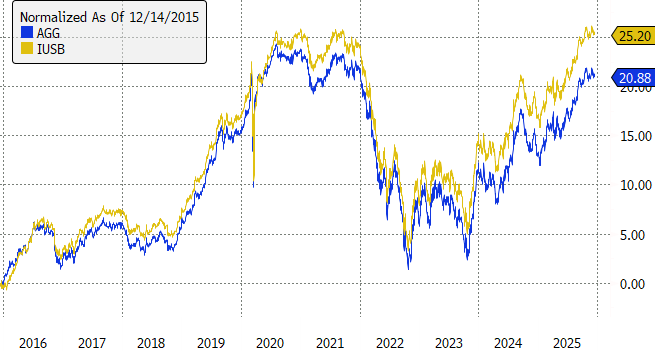
It remains to be seen how much traction BTOT will gain. AGG and BND still dominate the space, with roughly $140 billion in assets each. But IUSB has shown there is room for a broader alternative, having gathered $34 billion despite launching seven years after BND and more than a decade after AGG.
Whether BTOT can carve out similar demand will depend on how investors weigh its broader exposure, higher yield potential, and added risk.