
Vest Delivers Institutional-Level Lending to Retail Investors
Jeff Chang of Vest shares how the firm's option box strategy mimics institutional borrowing, offering potential tax deductibility while providing a low-cost alternative to traditional margin loans.

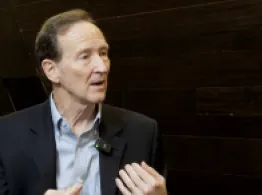
Jeff Chang, President and Co-Founder of Vest, dove into the firm's take on democratizing institutional investor options strategies at Schwab IMPACT 2025 with ETF.com's Dave Nadig. The following is a transcript of their conversation.
Transcript
Nadig: Jeff Chang, thank you so much for joining us. Look, the Vest guys, we know you guys. You're the ones who sort of invented buffers, the largest player in the space. I don't want to talk about that. But I want to talk about is you've taken that option's expertise and you've applied it to an entirely different line of business in loans. Let's walk through it. What are you actually offering to the investor and the advisor out there?
Chang: Yeah. Great. So we actually, what's really exciting is our target financing platform that we've actually created through our first iteration being synthetic borrow. And I can tell you where it came from. So we use a lot of these strategies to borrow within the products that we build.
So that's where it came from. And it really stems from, in the institutional space, how are institutional investors borrowing in let's say the option market? So what we utilize is an option box. And option boxes trade every day on the exchange. And we're saying like why can't we bring that to financial advisors and their clients?
Because the cool thing about options is there's interests embedded in options. Just like when you buy a stock, right, you get all the upside. But if you buy a call, you also get all the upside, but you didn't pay the full amount. So that interest inside is what we're trying to extract. So think about this. If I create an option box. it actually just behaves like a zero coupon bond, right?
So let's say for one year, you have a zero coupon bond that's $96, appreciates to $100. So that $4 is your interest. So if you can issue that box now imagine like if you invest in it. But what about if you want the other way and you shorted that box? Now you're borrowing at that rate.
Simplifying and Optimizing for Investors
Nadig: So is it that easy to think of for an advisor? I think a lot of advisors have learned about box spreads. We've got a couple products trading that are giving you sort of box spread interest. And there's some tax issues that could be interesting there. Is this really just kind of the other side of the trade, this is who those people are giving the money to?
Chang: Exactly. So if you think about when Apple wants to borrow money, it issues a bond, right? And then when you as the investors buy the bond. So that's what you're talking about. Now imagine now you're Apple and you short the box. Now you're issuing that bond as the borrower. Now what's really interesting is this: the options, because they clear through the exchange, just like treasuries, they don't have the credit risk that you would typically see from the bond.
So that's what makes it so pure is that the interest rate is almost very close to the credit rate. And yeah, exactly, it’s at very competitive rates. Now if you put that in context of asset-based lending today, like pledge asset borrowing and margin, where they could be charging you anywhere from like SOFR plus three, SOFR plus four, right? Now think about if you're, if I could tell you today you could get a little over 4% borrowing rate. That's amazing, right?
Nadig: That’s like T-bills. So I mean, is it really that straightforward that whole people are looking at, like, “I have a half million dollars in stock that I don't want to sell, here are my options. I can pledge that to a bank or to Schwab or to somebody else. I'm probably going to pay about 10% now, or I'm probably going to pay about 8% now.”
Margins running around ten, roughly in the ballpark there. And so you're talking about, “Hey, you could borrow at 4 to 5 instead of up in this 8 to 10 range and you're not taking any additional risks by doing that.”
Chang: Exactly. And it's actually much simpler than that. They don't have to even have to move it. So like let's say on their custodial platform, you see how much margin power you have. It's a separately managed account bolted on. They're utilizing that margin to borrow.
And that's what's exciting, is that it all is the same existing process that if they're already in other types of asset-based lending, it utilizes that same collateral. Where it can stay exactly where it is and offer these types of loans or, you know, short boxes that people can now borrow at rates in which institutions are.
Nadig: Pretty much any asset that I would be custodying at Schwab; stocks, bonds, ETFs, mutual anything, I could stick over there.
Chang: Anything that you can, that's marginal. And you can see that right on your, let's say, brokerage account.
Similar Risk Profiles to Margin and Asset-Based Lending
Nadig: Okay, great. Let's flip to the other side of it. Advisors I know are pretty conservative. I don't see a counterparty risk here unless you think the Options Clearing Corporation is going under, which I'm going to die on that hill.
So what are the risks here? Like why are there any additional risks that the investor is taking or additional hassle or restrictions that I might face versus, say, just taking the margin loan, which is sitting right there?
Chang: So the risks are going to be very similar to margin, pledge asset borrowing, other types of asset-based lending. Your security portfolio falls. uou get a margin call. That's actually going to be almost identical to those types of solutions. So it's the same risk that you would have. So obviously, a lot of our clients are already using asset-based lending. And they're using this as an alternative to say, “Hey, you know what? I can use that same margin power.”
Now it's the same ease of setting up, let's say a separately managed account where we're the subadvisor and we help you trade those out.
Nadig: So a small little hurdle, just like if an advisor is going to bring in a new SMA into an account. So there is an account creation step, which if you're just doing margin lending, maybe you don’t have to do that. So there's a tiny amount of hassle.
Chang: But what's really exciting is that in other asset-based lending, there is potential where it's not tax deductible, right? Like, today you're not able to tax deduct the interest that you pay…
Nadig: On a margin loan.
Chang: Yeah, exactly. But in this case we are shorting four sets of securities that is appreciating up. which is basically creating loss. And there's a potential where that is actually tax deductible as, let's say, capital loss carry forward or capital loss, which can carry forward forever. So then take that as a moment and think about if I'm like around a little over 4% and I'm able to deduct, let's say, short term capital loss against that. You're talking about sub 3% lending, right. That's amazing.
Nadig: Yeah I get that. The pushback would there might be that we are changing some of the depreciation and amortization rules about how businesses at least deal with the tax side. So that might be changing. But right now for sure I can see that there's arbitrage.
Chang: For individuals that in their investment accounts, you're trading options in which you could potentially have the capital loss.
Nadig: And at the moment, is this something you're just doing with Schwab?
Chang: Yeah, so it is currently available on the Schwab platform.
Nadig: Okay, great. Jeff, thanks so much. I love the innovation. Cheers.
Chang: Nice to see you.
Discover the news, data, and voices shaping the ETF community. Follow along here.