



Did "Sell America" Win After All?
There's been a "Sell America" media shtick since the first tariffs were announced. ETF Investors didn't bite. Maybe they should have?

I love digging into ETF data, especially flows data. While some folks use it as a horoscope, I mostly use ETF flows as forensics -- a way of looking backwards to make sense of an increasingly insane world. So when the whole "Sell America" trope popped up again this month on twitter:
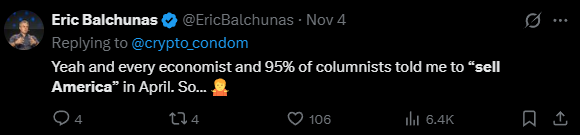
I decided to dig in. I absolutely agree with Eric that "Sell America" was a powerful media narrative in spring. But what did the pundits actually say, and how did they actually do? That seems like a more relevant analysis than just remembering stinging headlines. So I ran a bunch of data from "Liberation day" to see what ETF investors actually did during the one month bloodbath and recovery. And honestly, I was pretty surprised:
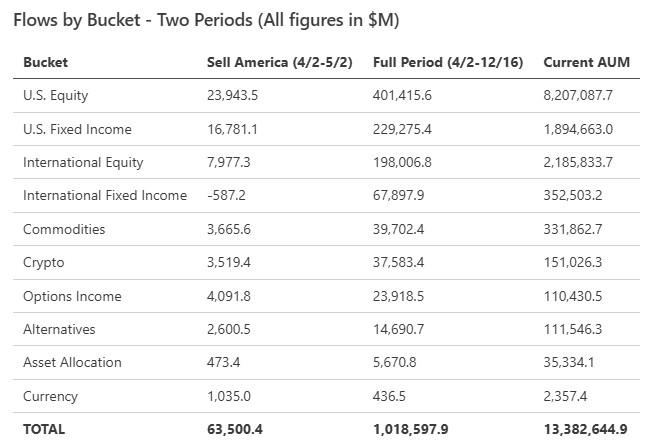
It turns out, ETF investors didn't buy the whole "Sell America" thing. They didn't really sell anything either in the immediate aftermath of "Liberation day" or in the months that have followed. So how "real" is this whole "Sell America" trope anyway?
The Actual Calls
There's no question that in that first week of April, economists were spooked. JP Morgan summed it up nicely:
"The risk of recession in the global economy this year is raised to 60%, up from 40%... these policies, if sustained, would likely push the US and possibly global economy into recession this year." — Bruce Kasman, JPMorgan Chief Economist
But the key thing I think a lot of folks miss while they're crowing about how wrong everyone was is that nearly every quote I've found of actual substance has something like "if sustained" in it. If you'll recall, the full tariff slate only lived for a handful of days until most of the tariffs -- and the biggest and scariest ones like the 145% China tariff -- were suspended, most of which have never reappeared.
Still, it's unquestionable that the press took anyone with a negative call and made them the headline -- understandable after the 9% drawdown. Quotes like this one made laps around different articles:
"I do think it's severe," Marc Chandler, global foreign exchange chief market strategist at Bannockburn, told Yahoo Finance when asked about the sell-off in the US dollar and bond market. "People are concerned that maybe we're seeing a capital strike against the US, where large pools of capital are selling US assets and taking their money home."
While saying "Some Worry" is an ancient headline-trick, there WAS a real set of data to work with: the Bank of America Fund Manager Survey. Which, like many Wall Street reports, isn't publicly available and yet at the same time is widely reported in the financial press.
Based on searching a lot, I was able to construct the follow table of position reports from the monthly survey of big institutions:
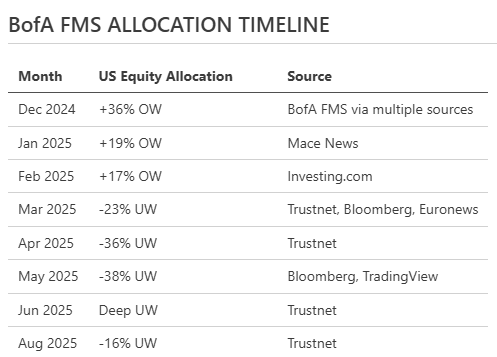
Of course you can't derive a pure portfolio out of survey responses, but it was fairly clear what the surveyed folks thought belonged where U.S. assets didn't: gold and international equities:
And by mid-April, gold was already the regular answer to the question "... and buy what?" from the Sell America crowd. On April 22nd Bloomberg reported:
Gold just blasted past another milestone, extending this year’s 30% rally and briefly surpassing $3,500 an ounce for the first time.
The moves underscore how the “sell-the-US narrative” is gaining speed. And banks have become progressively more positive: Goldman Sachs has forecast $4,000 an ounce midway through next year. Jefferies analysts say gold may be “the only true safe-haven asset left.”
Making It Real
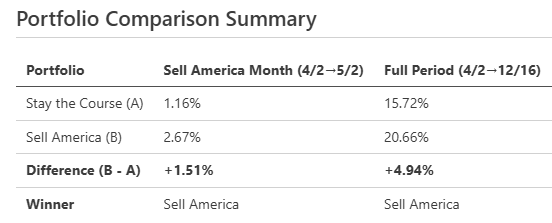
So, at the risk of the internet "Well actuallying" me into oblivion, I constructed two simple portfolios based on the best data I could scrape from a few dozen articles around the BofA survey: A "Stay the Course" portfolio, and a "Sell America" portfolio:
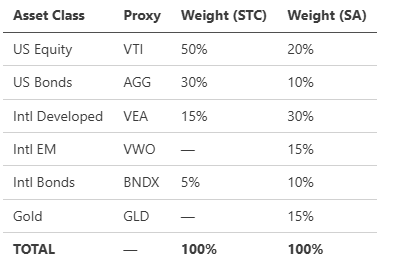
Before anyone gets bent out of shape, of course this portfolio is "wrong". No institution owned precisely this mix, and every institution owns all sorts of other things, from private equity to structured products. But honestly, I feel pretty OK about this as a proxy for what it means to have taken the bait back in March/April, and listened to the headlines, and unloaded a bunch of US bonds and Equity in favor of International and gold.
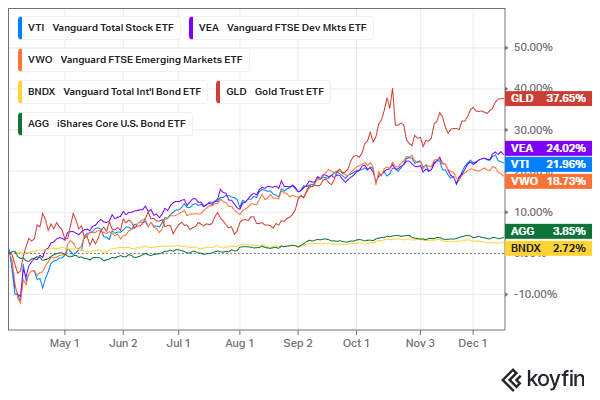
And of course, we all can see how each of these simple proxies did:
And it's first-semester B-school math to create a set of portfolios:
But Maybe ETF Investors are the Smart Ones
It's easy to look at this and read what you want into it. "It's mostly gold" has real truth to it. So does "nobody called this exactly" and "this is an overly simplistic look." But I think it's important to actually understand reality even when I disagree with it.
Personally, there's no way in heck I would have sold down all my US Equity in April. If the market drops 20% tomorrow I likely wouldn't do more than complain, not because I have some deep belief in current economic policies, but because when it comes to portfolios, what I (and I suspect you) care about is asset prices, not economics.
Whatever your politics, it seems inescapable to me that we have a strong disconnect between financial market asset prices and lived economic reality. But that disconnect doesn't mean "market crashes." Quite to the contrary, the increased, near-complete regulatory capture, the rush towards state- and crony-capitalism in various forms, and the degradation of regulatory and legal protections (whether through pardons or dis-enforcement) actually mean "number goes up" at least for the short and medium term.
I think ETF investors are smarter than we give them credit for. Sure, the "Sell America" trade may have worked in 2025 -- barely. But we "stay the course" investors hardly bled out. We just left a little bit on the table (or, have positioned ourselves presciently for 2026, we'll see!)
And while it may make you feel better to say "Hurr Hurr Media Dumb" because your portfolio didn't tank, a little humility goes a long way: the Sell America crowd beat us this year. The media, and the institutions, actually got this call right. But then -- they didn't put an end date on it either. The latest B of A study shows extreme bullishness rather suddenly, with funds reporting holding record low amounts of cash and being back to overweight equities of 42%.
I'll be honest, that's exhausting. Whipsawing your portfolio in and out of whole asset classes month by month is a terrible way to invest, and we'd all be well served to ignore more financial headlines. As Jack Bogle once said: Boring and forgetful are sometimes the best way to go about things.
Discover the news, data, and voices shaping the ETF community. Follow along here.


