

Brent Sullivan: Why 351 Exchange ETFs Are Now Everywhere
Sensational, pearl-clutching headlines about the IRS tax shenanigans and risk of 351 exchanges dominate most media coverage of this increasingly popular form of ETF conversion. While the risk of bad actors is real, according to Tax Alpha Insider’s Brent Sullivan, it misses the actual question investors should be asking: is the created ETF even interesting?

As the old adage goes, the only certainties in life are death and taxes. But an old rule applied in a new way for ETFs challenges one of those certainties.
Section 351 exchanges rely on a little-known provision of the U.S. tax code that, under specific conditions, allows appreciated securities to be contributed to a newly formed ETF without triggering an immediate taxable event. Especially for investors with concentrated stock positions, 351 conversions can provide a tax-efficient path to enhancing portfolio diversification. (Read: “Got Cap Gains? How Portfolios Can Move Into ETFs Tax-Free”)
While Section 351 has been around for decades, only recently have ETF issuers applied the rule towards new ETFs. We recently sat down with independent tax management expert Brent Sullivan to better understand the opportunities (and obstacles) ETFs launched via Section 351 may present to investors.
Below is a lightly edited transcript of our conversation.
351s Make Sense... If the ETF Itself Is Compelling
You’re obviously passionate about taxes. Why does this topic interest you so much?
I’m an engineer by training, and if you’re the kind of person who likes to take apart and learn how machines work, then tax management is for you. Money, risk, and tax going in and out of a portfolio is sort of like a computer function. Or if you like games? Then tax management is for you. I see it as a game I can’t put down.
You’ve predicted that the next big wave of ETF issuance will come via the Section 351 exchange process. With so many ETFs already launching every year, including in 2026, do you think this increase will make it harder for investors to navigate their options?
That’s why an ETF has to be compelling on its own. [Using the] 351 exchange [process] just makes it easier to allocate, but if the ETF itself doesn’t stand out or do something interesting, then using 351 doesn’t make sense. Who cares how efficient the taxes are, if the ETF itself is dumb?
The ETF has to offer a reason for allocation. Maybe the fund solves some interesting problem. Maybe it has some unique investment perspective. There has to be a reason that has nothing to do with taxation to justify an allocation, or else you get the tax tail wagging the dog.
If investors are opting for 351 conversions because of market appreciation, does the next bear market stop this trend in its tracks?
Possibly. There’s always going to be people with appreciated assets, even if the market turns down 30%. It would most likely slow things down. But I’ll just triple underline this: It all starts with the ETF.
I’ll make sure they put that in print.
Thanks. The reason I’m emphasizing this is because there’s a cringe way to write about this stuff, which is, “Look at all the taxes you’re going to dodge! The IRS is going to be so pissed!” That’s not how to think about this. It drives me nuts. It’s all sensational.
IRS Tax Risk is Overstated
We see that elsewhere: A divergence between what “degens” focus on and what investors trying to steer through retirement safely focus on.
Exactly. We’re seeing that in tax management, too. People are going bonkers about the tax management [of 351 conversions], but does the ETF itself make sense? As somebody who just loves this stuff, I’m like, “That’s dumb.” Don’t write about it that way. Other outlets are doing themselves a disservice, because their angle is “Look at all the IRS risk.” It’s just like, yo. That’s a tiny, tiny thing happening in the background. There’s no substance behind it. There’s no regulatory motion. But they’re like, “Watch out! Look at this terrible thing that’s going to happen.”
So you don’t see much regulatory risk around 351 conversions?
Well, [the Department of the] Treasury is always going to ask questions.
We should hope so.
Yeah! But you want to identify the investment case. Part of the reason I put 351.tax together is because I wanted people to see what a good 351 looks like and what a suspect one looks like. I wanted to codify what abuse looks like in this world, but not say everything is abuse.
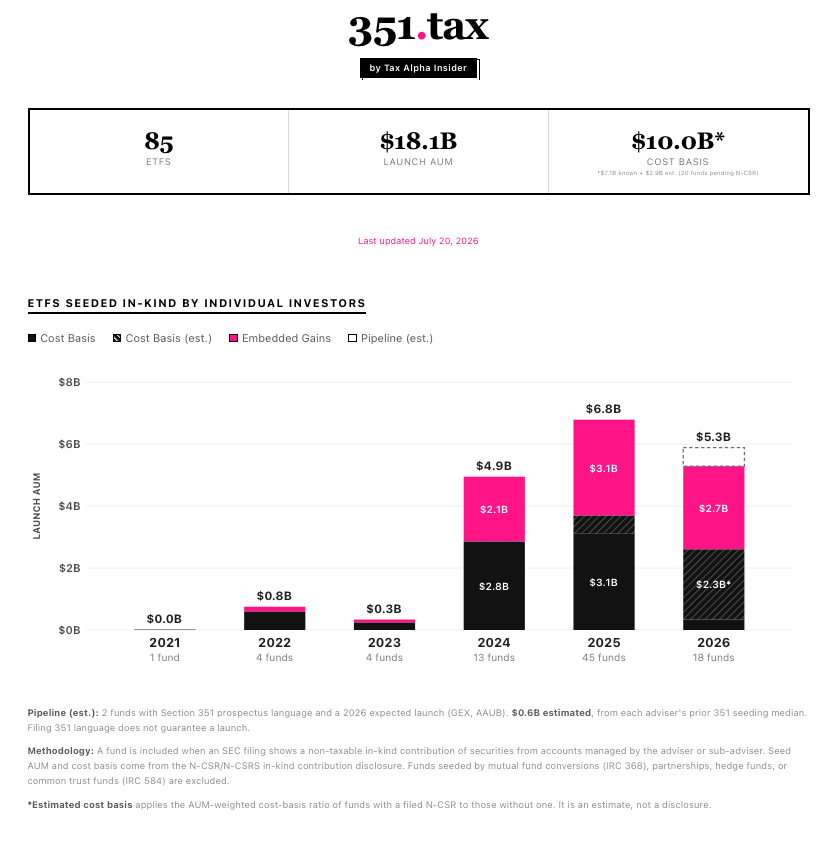
FIG 1: Screencap of 351.tax
So then what are the red flags folks should look out for?
If you have a portfolio manager who has a US equity mandate in the prospectus—which is a legally binding mandate—then you look at the assets they’ve accepted via 351 and it’s a bunch of fixed income and international equity… You’re like, “What is this?”
The portfolio’s not aligned with the prospectus. So they’re going to do a bunch of custom baskets to get rid of, in their mind, the “bad” assets. That’s not good. That’s imprudent. Of course it’s going to raise hairs on the back of the neck of the IRS.
Making Stewardship More Transparent
That should raise hairs, even if it wasn’t a 351 ETF. If the prospectus said the ETF was supposed to hold one thing, but the ETF holds something completely different, there should be raised hairs on everyone’s neck.
For sure. Particularly for Treasury and IRS, it starts to look like just a tax dodge. “Look at all these guys who took in a bunch of whackadoo positions.”
If a fund manager is behaving this way and being super aggressive on taxation, then they’re putting the rest of the position in a bad light.
There are a couple that are incredibly aggressive, and it makes me uncomfortable. By showing the asset composition over time and with what each fund was seeded with [on 351.tax], I hope I can show what competent stewardship looks like versus really aggressive stewardship. Because, if you look at these things side by side, they do not look the same.
But it’s not amenable to sensational headlines.
Let’s say I’m an investor sitting on a $4-5 million dollar SMA, and I’m interested in converting that portfolio to an ETF via a 351 exchange. How do I begin to embark on this process? Who do I even talk to?
I always tell people to call fund sponsors directly. I know that sounds crazy. Like, an individual just calling the fund sponsor? Yes. A lot of these fund sponsors are modestly sized. They typically have less than $50 billion under management. So call ‘em. They can’t give you advice, but they can tell you mechanically what would happen and give you solutions to access new funds coming to market. You might be surprised.
On which factors should I evaluate potential fund sponsors offering a 351 conversion, particularly when it comes to tax management?
You definitely want to make sure the ETF sponsor and counsel are going to act diligently behind the scenes and with prudence and thorough understanding of the tax code.
Not only do you want them to get the transaction mechanically correct, but they have to make sure every single transaction is managed with economic substance. Meaning, every single thing that happens within the wrapper has to happen with a non-tax reason, both the individual transactions and the combination of them in total. You also need a business purpose, and it can’t just be that you’re doing tax shenanigans. There has to be a reason.
A good fund shop that thinks deeply about tax risk management will have their processes in place and have documentation that substantiates every single transaction in the portfolio. There won’t be a dangling chad that will sneak up on them a few years down the road. It’s highly rigorous.
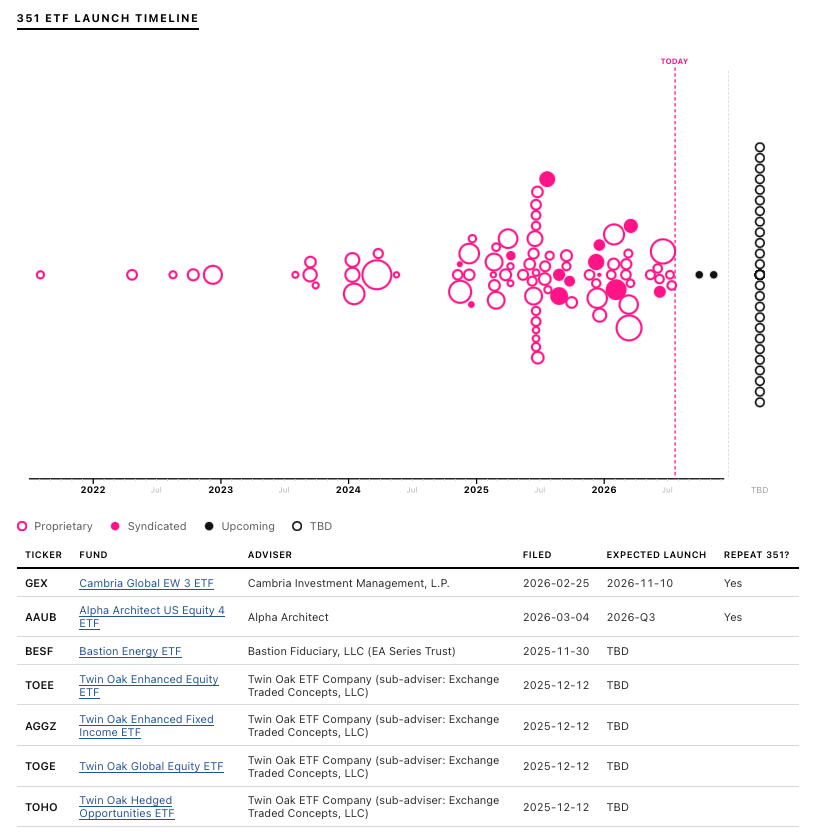
FIG 2: Screencap of 351.tax