


The Xtrackers S&P 500 Diversified Sector Weight ETF: A Quantitative Approach to Reduce Portfolio Concentration Risks
IN A NUTSHELL
- As the Technology and Tech-adjacent stocks continue to dominate the S&P 500, the potential for investors tracking this Index to experience single stock and sector concentration risks also increases.
- A common strategy to mitigate this overexposure has been to apply an equal weight investment strategy. However, this approach creates other potential issues, including concentrated sector tilts, higher turnover, and greater exposure to smaller, more volatile stocks.
- The Xtrackers S&P 500 Diversified Sector Weight ETF (SPXD) takes a rules-based approach designed to mitigate the risks associated with single-stock concentration and address sector imbalances within the S&P 500.

The S&P 500: Now Dominated by a Few Mega-Cap Stocks
The S&P 500, the standard for measuring U.S. market performance, continues to be dominated by a handful of Technology and Technology-related companies, known as the “Magnificent Seven” or the “Great Eight. “
Today’s S&P 500 sector allocations are also exceptionally skewed, as over one-third of the Index is classified in the Information Technology sector.1 This figure does not include Tech-adjacent companies such as Amazon, Tesla, Alphabet, or Meta. Looking at just the Magnificent Seven’s proportion in the Index, it accounts for about 35% of total market capitalization2 and 46% of its overall risk contribution.3
Let’s take a deeper dive into some potential solutions to both single stock and sector concentration risks and introduce the Xtrackers S&P 500 Diversified Sector Weight ETF (SPXD), which can address the problems inherent in cap-weighted strategies.
Consider Using Sector ETFs to Rebalance
A number of providers offer sector-specific ETFs that align with the 11 Global Industry Classification Standard (GICS) sectors: Communication Services, Consumer Discretionary, Consumer Staples, Energy, Financials, Health Care, Industrials, Information Technology, Materials, Real Estate, and Utilities.
If so inclined, investors can create their own sector-neutral portfolio, equal-weighting each sector and allocating approximately 9.1% to each sector. This approach helps reduce concentration, preventing any one sector from dominating the portfolio as in a cap-weighted strategy. However, since all the constituents in each ETF are cap-weighted, the largest stocks still have the greatest weight in each sector.
Additionally, the effort to rebalance 11 portfolios quarterly and incur the associated trading costs (think bid/ask spreads, commissions, and market impact) can certainly negatively impact returns.
While constructing a balanced, sector-neutral S&P portfolio is possible, it is an inefficient approach to mitigate sector concentration risk.
Why Not an Equal-Weight Approach?
Another common method to reduce single stock concentration risk is to employ an equal-weight strategy to the S&P 500. This approach allocates a 0.2% position to each stock in the Index, regardless of its market size. This means that the largest company in the index (NVIDIA at 7.75%)4 is weighted the same as the smallest (News Corp. Class B at 0.01%.)5
While this method does help reduce concentration in individual companies, it does not fully solve the issue of sector imbalances. Equal weighting simply resets each stock back to its 0.2% position on a quarterly basis. As a result, sector tilts are reduced but not eliminated. For example, in the cap-weighted S&P 500, Information Technology makes up 33.48% of the Index.6 Under an equal-weight approach, Technology remains the largest sector, though its portion drops to 13.71% - less than half of its original weight.7
While equal weighting helps reduce concentration risk, it also comes with distinct disadvantages. A market-cap strategy enables successful companies to grow naturally within the index, reflecting their long-term outperformance. By contrast, an equal-weight approach resets each stock to a 0.2% allocation every quarter, effectively trimming back the winners and limiting the ability to capture their sustained growth.
From a risk perspective, the S&P 500 equal-weighted portfolio’s annualized five-year volatility is higher (17.02%)8 than its cap-weighted counterpart (15.96%).9 Additionally, the costs of managing an equal-weight strategy, with its large turnover created by its quarterly rebalancing, could be considerable and negatively impact portfolio performance.
Finally, over the past 10 years, the equal-weighted S&P 500 Index has materially underperformed its cap-weighted counterpart.

Source: Bloomberg as of 8/29/2025
Past performance does not guarantee future results. You cannot invest directly in an index.
The Xtrackers S&P 500 Diversified Sector Weight ETF (SPXD): A Strategic Approach to Sector and Single-Stock Concentration Risk
What is a diversified sector weight strategy?
The diversified sector weight strategy is a unique, rules-based approach designed to mitigate the risk associated with single-stock concentration and address sector imbalances within the S&P 500.
Why does this matter?
This methodology sector weights companies based on their diverse business models and product lines, in contrast to traditional weighting systems that limit companies to a single sector. This process allows for alignment with all market business opportunities, not only the largest ones.
How does SPXD work?
SPXD tracks the S&P 500 Diversified Sector Weight Index, which aims to reduce concentration risk and address sector imbalances by reweighting companies within the S&P 500. SPXD utilizes an equal-weight sector methodology developed by S&P Global, powered by Syntax’s FIS sector taxonomy.
The FIS classification system employs only eight sectors and is equally rebalanced quarterly, as opposed to the MSCI/S&P GICS classification system which only reviews its allocation annually.
How is the FIS methodology different?
Unlike traditional classification systems, the FIS approach enables a company to be represented across multiple sectors and industries, and its final weight in the index is the sum of the weights from each of its business activities. Essentially, companies are categorized in multiple segments based on their revenue sources, as opposed to being placed in a single sector.
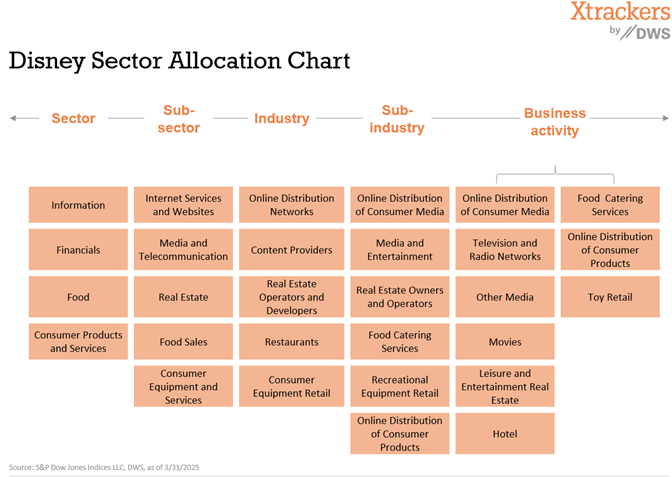
You can see the FIS sector taxonomy approach below in how it categorizes Disney (DIS), which is assigned weights in four of the eight FIS classification sectors (Information, Financials, Food, and Consumer Products and Services). It is then further classified into five Sub-Sectors, five Industries, six Sub-Industries, and nine Business Activities.
How does SPXD differ from the S&P 500?
Reduced Stock Concentration Risk
Besides being designed to equalize sector weights and balance business risks, the S&P 500 Diversified Sector Index does an effective job of reducing single-stock concentration risk. Compared to the S&P 500, it holds a broader effective number of stocks and caps maximum stock weights at lower levels – delivering a more diversified approach.
An examination of S&P Diversified Sector Weight Index’s holdings reveals how it mitigates the concentration risks inherent in many cap-weighted indices. For example, the largest position in the Diversified Index is Berkshire Hathaway at 3.85% and its top ten holdings represent only 15.63% of the total portfolio. Contrast this with S&P 500, where its largest holding – NVIDIA – has a 7.75% weighting and its top ten positions constitute 37.87% of the ETF.
Top 10 Holdings: S&P 500 Index and S&P 500 Diversified Sector Weight Index
S&P 500 Index
| Name | Ticker | Weight |
|---|---|---|
| NVIDIA Corp. | NVDA | 7.75% |
| Microsoft Corp. | MSFT | 6.88% |
| Apple Inc. | AAPL | 6.33% |
| Amazon.com Corp. | AMZN | 3.95% |
| Meta Platforms Inc. Cl A | META | 2.93% |
| Broadcom Inc. | AVGO | 2.55% |
| Alphabet Inc. CL A | GOOGL | 2.26% |
| Alphabet Inc. Cl C | GOOG | 1.83% |
| Tesla Inc. | TSLA | 1.71% |
| Berkshire Hathaway Cl B | BRK.B | 1.68% |
| Total Top 10 Holdings | 37.87% |
Source: S&P Global, 8/29/2025
Subject to change.
S&P 500 Diversified Sector Weight Index
| Name | Ticker | Weight |
|---|---|---|
| Berkshire Hathaway CL B | BRK/B | 3.85% |
| Abbott Laboratories | ABT | 1.77% |
| Jabil Inc | JBL.N | 1.53% |
| Microsoft Corp | MSFT | 1.37% |
| Procter & Gamble Co | PG | 1.36% |
| Costco Wholesale Corp | COST.O | 1.19% |
| Walt Disney Co | DIS | 1.16% |
| Sysco Corp | SYY.N | 1.15% |
| Regeneron Pharmaceuticals | REGN | 1.14% |
| Apple Inc | AAPL | 1.11% |
| Total Top 10 Holdings | 15.63% |
Source: S&P Global, 8/29/2025
Subject to change.
Reduced Sector Concentration Risk
Additionally, the FIS Syntax sector taxonomy delivers a much more balanced sector allocation, avoiding the concentration profile of its cap-weighted counterpart.
| FIS Sector | S&P 500 Diversified Sector Weight Index | S&P 500 Index |
|---|---|---|
| Financials | 12.93% | 9.60% |
| Energy | 12.49% | 6.15% |
| Industrials | 12.81% | 9.80% |
| Information Tools | 12.61% | 30.18% |
| Information | 12.55% | 24.26% |
| Consumer Products and Services | 12.56% | 5.61% |
| Food | 12.32% | 5.00% |
| Healthcare | 11.73% | 9.40% |
Where Does SPXD fit into my portfolio?
Core Large-Cap Holding: SPXD offers a more balanced alternative to traditional S&P 500 funds, providing market exposure that better reflects the breadth of the U.S. economy.
Diversification Tool: For investors concerned about single stock or sector concentration risks, particularly in Technology, SPXD can serve as an effective solution to mitigate these potential exposures.
Tactical Application: When mega-cap valuations appear stretched or market momentum is overly concentrated, SPXD can serve as a timely complement to core equity allocations.
Conclusion
The Xtrackers S&P 500 Diversified Sector ETF (SPXD) provides investors with the ability to access U.S. large-cap equities while reducing single-stock and sector concentration risks common in cap-weighted index portfolios.
Built on the Syntax FIS sector taxonomy, SPXD uses a rules-based approach that equal weights its eight sectors, helping to avoid excessive over- or under exposure. Unlike traditional indices that classify each company into just one sector, SPXD weights each company across multiple sectors to reflect the full scope of a company’s business activities.
With a low expense ratio of just 0.09%, SPXD delivers this diversification in a cost-effective, transparent ETF structure.
Glossary
Concentration Risk: The potential for financial loss due to an overexposure to a single asset, sector or geographic region.
Cap-Weighted Index: An index whose individual components are assigned weights based on their market capitalization.
Concentrated Sector Tilt: An intentional shift in a portfolio's allocation to give additional weight to a specific sector than a broad-market index would.
Effective Number of Stocks: Measures how many stocks in an index are contributing to an index’s performance. It describes how diversified an index is, not just by the number of companies, but by the amount each company's performance impacts the overall index value.
Equal-Weight Index: An index whose individual components are all assigned the same weight.
Global Industry Classification Standard (GICS): An industry analysis framework developed by MSCI and S&P Dow Jones Indices to provide investors with consistent industry definitions.
Great Eight: The Magnificent Seven group of stocks with the addition of Salesforce.
Mega-Cap Stocks: Refers to companies with a market capitalization above $200 billion.
Magnificent Seven: A group of high-performing and influential companies in the U.S. stock market: Alphabet, Amazon, Apple, Broadcom, Meta Platforms, Microsoft, and NVIDIA.
S&P 500 ETF (SPY): An ETF that aims to duplicate the performance of the S&P 500 Index.
S&P 500 Index: An index of U.S large-cap equites that includes 500 leading companies and covers approximately 80% of available market capitalization.
S&P 500 Diversified Sector Weight Index: An index that aims to enhance sector diversification and reduce individual stock concentration. By reweighting companies within the S&P 500, the index seeks to represent all business activities in the market, not just the largest ones.
S&P 500 Diversified Sector Weight ETF (SPXD): An ETF that aims to duplicate the performance of the S&P 500 Diversified Sector Weight Index.
Taxonomy: A structured classification system for categorizing economic activities, products, and companies.
1. Source: S&P Global as of 8/29/2025
2. Source: S&P Global, Bloomberg and DWS as of 8/29/2025
3. Source: S&P Global, Bloomberg and DWS as of 8/29/2025
4. Source: S&P Global as of 8/29/2025
5. Source: S&P Global as of 8/29/2025
6. Source: S&P Global as of 8/29/2025
7. Source: S&P Global as of 8/29/2025
8. Source: S&P Global as of 8/29/2025
9. Source: S&P Global as of 8/29/2025
The Xtrackers brand represents all systematic investment solutions. Xtrackers ETFs ("ETFs") are managed by DBX Advisors LLC (the "Adviser") and distributed by ALPS Distributors, Inc. (“ALPS”). The Adviser is a subsidiary of DWS Group GmbH & Co. KGaA and is not affiliated with ALPS.
Shares are not individually redeemable, and owners of Shares may acquire those Shares from the Fund, or tender such Shares for redemption to the Fund, in Creation Units only.
Carefully consider the fund’s investment objectives, risk factors, and charges and expenses before investing. This and other information can be found in the fund's prospectus, which may be obtained by calling 1-844-851-4255 or by visiting www.Xtrackers.com. Read the prospectus carefully before investing.
War, terrorism, sanctions, economic uncertainty, trade disputes, public health crises and related geopolitical events have led and, in the future, may lead to significant disruptions in U.S. and world economies and markets, which may lead to increased market volatility and may have significant adverse effects on the fund and its investments.
The top 10 holdings in SPXD as of 8/29/2025:
| Name | Weight |
|---|---|
| Berkshire Hathaway Inc | 3.83% |
| Abbott Laboratories | 1.77% |
| Jabil Inc | 1.54% |
| Microsoft Corp | 1.38% |
| Procter & Gamble Co/The | 1.36% |
| Costco Wholesale Corp | 1.17% |
| Walt Disney Co/The | 1.16% |
| Sysco Corp | 1.15% |
| Regeneron Pharmaceuticals Inc | 1.14% |
| Apple Inc | 1.10% |
Because Exchange Traded Funds (ETFs) trade on a securities exchange, their shares may trade at a premium or discount to their net asset value. ETFs also incur fees and expenses so they may not fully match the performance of the indexes they are designed to track. Investing involves risk, including the possible loss of principal. Stocks may decline in value. An investment in the fund should be considered only as a supplement to a complete investment program for those investors willing to accept the risks associated with the fund. Please read the prospectus for more information.
The S&P 500 Diversified Sector Weight Index is a product of S&P Dow Jones Indices LLC or its affiliates (“SPDJI”) and has been licensed for use by DBX Advisors LLC. S&P® and S&P 500® are registered trademarks of Standard & Poor’s Financial Services LLC (“S&P”); Dow Jones® is a registered trademark of Dow Jones Trademark Holdings LLC (“Dow Jones”); and these trademarks have been licensed for use by SPDJI and sublicensed for certain purposes by DBX Advisors LLC. DBX Advisors LLC’s ETF is not sponsored, endorsed, sold or promoted by SPDJI, Dow Jones, S&P or their respective affiliates and none of such parties make any representation regarding the advisability of investing in such product(s) nor do they have any liability for any errors, omissions, or interruptions of the index.
Carefully consider the fund’s investment objectives, risk factors, and charges and expenses before investing. This and other important information can be found in the Fund’s prospectus, which may be obtained by calling 1-844-851-4255 or downloading a prospectus at www.Xtrackers.com. Please read it carefully before investing.
Xtrackers ETFs ("ETFS") are managed by DBX Advisors LLC (the "Adviser") and distributed by ALPS Distributors, Inc. ("ALPS"). The Adviser is a subsidiary of DWS Group GmbH & Co. KGaA and Is not affiliated with ALPS.
Diversification does not guarantee against a loss.
Shares are not individually redeemable, and owners of Shares may acquire those Shares from the Fund, or tender such Shares for redemption to the Fund, in Creation Units only.
The brand DWS represents DWS Group GmbH & Co. KGaA and any of its subsidiaries such as DWS Distributors, Inc., which offers investment products, or DWS Investment Management Americas, Inc., and RREF America L.L.C., which offer advisory services.
Investment products: No bank guarantee | Not FDIC insured | May lose value
ALPS Distributors, Inc., 1290 Broadway, Suite 1100, Denver, CO 80203
© 2025 DWS Group GmbH & Co. KGaA. All rights reserved. 107987-1 (10/25) DBX006956 (10/26)


