

$34 Billion Entered Crypto ETFs in 2025, But Investors Still Lost
Crypto ETFs saw strong inflows and weak returns this year.

With one week left in the books, 2025 is shaping up to be both a successful and disappointing year for U.S.-listed crypto ETFs.
On net, crypto ETFs gathered $34.1 billion of inflows during the year-to-date period ending Dec. 23, nearly matching the roughly $35 billion that flowed into the space in 2024. Those headline numbers, however, mask a more uneven picture beneath the surface.
Inflows slowed sharply in recent months. Over the past three months, crypto ETFs took in just $790 million, as several of the largest spot products experienced outflows amid falling prices.
Bitcoin ETFs: A One-Fund Story
The biggest story of 2025 was the dominance of iShares Bitcoin Trust ETF (IBIT), which took in $25.1 billion, far and away the largest inflows of any crypto ETF this year.
Only one other spot bitcoin ETF managed to cross the $1 billion mark, the Grayscale Bitcoin Mini Trust ETF (BTC), which gathered $1.1 billion.
That stands in stark contrast to 2024, when multiple bitcoin ETFs attracted substantial assets, including the Fidelity Wise Origin Bitcoin Fund (FBTC), the ARK 21Shares Bitcoin ETF (ARKB), and the Bitwise Bitcoin ETF (BITB).
In fact, excluding IBIT, U.S.-listed spot bitcoin ETFs collectively saw $3.2 billion of net outflows in 2025.
A major driver was Grayscale Bitcoin Trust (GBTC), which continued to hemorrhage assets, losing another $3.7 billion this year on top of the $21.5 billion it shed in 2024. But even stripping GBTC out of the picture, spot bitcoin ETFs outside of IBIT attracted just $450 million in inflows.
Ethereum ETFs Gain Traction
Ethereum ETFs told a similar story. Spot ether ETFs pulled in $9.9 billion in 2025, marking a breakout year for the category.
But once again, flows were highly concentrated. iShares Ethereum Trust ETF (ETHA) led with $9.1 billion of inflows, followed by Fidelity Ethereum Fund (FETH) with $1.1 billion and Grayscale Ethereum Mini Trust (ETH) with $901 million. Meanwhile, the higher-fee Grayscale Ethereum Trust ETF (ETHE) lost $1.4 billion.
U.S.-listed spot ether ETFs now hold roughly $18 billion in assets, about one-sixth of the $114 billion in spot bitcoin ETF assets. That ratio broadly mirrors the underlying market caps, with bitcoin at roughly $1.7 trillion, about five times ether’s $350 billion valuation.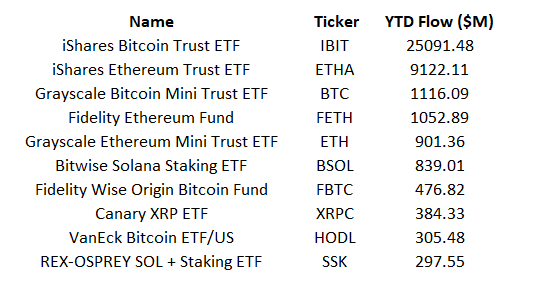
Source: Bloomberg
Category Concentration
Both bitcoin and ether ETFs remain concentrated in a single dominant fund.
IBIT’s $68 billion of assets represents roughly 60% of the spot bitcoin ETF category, while ETHA’s $10 billion accounts for about 57% of the spot ether ETF universe.
IBIT came within striking distance of the vaunted $100 billion AUM mark in October, peaking at $99.4 billion before a combination of price declines and outflows pushed assets lower.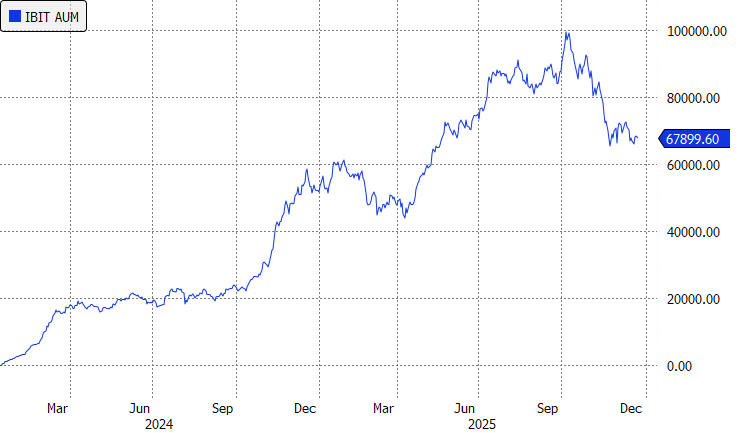
Source: Bloomberg
Notably, IBIT’s lifetime net inflows of $62.3 billion are only modestly below its current AUM, suggesting that, despite launching when bitcoin traded closer to $46,000 rather than today’s roughly $87,000, many investors are only marginally profitable, and a sizable cohort is underwater.
Strong Flows, Weak Performance
That brings us to the most disappointing aspect of the year: performance.
After roaring out of the gate—fueled by ETF inflows, strong momentum, and safe-haven demand amid equity volatility, inflation concerns, trade tensions, and geopolitical conflict—crypto prices peaked in October. Bitcoin briefly touched $125,000, while ether climbed above $4,800, its first new high since 2021.
At their highs, bitcoin and ether were up roughly 32% and 44%, respectively, for the year.
Today, both are in the red. Bitcoin is down about 8% year to date, while ether is off roughly 13%, disappointing performance in a year in which the S&P 500 is up 19.4% and gold has surged 68%.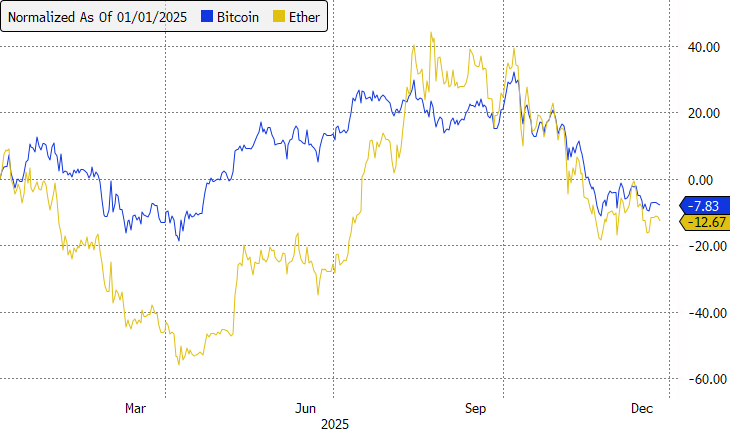
Crypto markets began to crack in October, leaving many investors puzzled as to why the asset class lagged despite strong ETF demand and a notably friendlier regulatory backdrop.
Even the U.S. president leaned fully into crypto in 2025, with the launch of Trump Coin in January and the establishment of a Strategic Bitcoin Reserve in March.
But those developments may have already been priced in. Bitcoin and ether jumped 120% and 47% in 2024, largely after the November election as traders anticipated a more permissive regulatory backdrop.
As often happens in markets, once a trade becomes crowded, momentum reverses.
Pressure on the Corporate Treasury Trade
A similar dynamic may be unfolding in the corporate crypto treasury trade pioneered by MicroStrategy and later emulated by many other firms.
That trade depended on investors paying a premium for public companies holding crypto on their balance sheets. Recently, those premiums have compressed, undermining the strategy and adding to negative sentiment across the space.
Product Launches Balloon
While performance disappointed, 2025 was a landmark year for crypto ETF launches.
In September, the SEC unveiled generic listing standards for crypto ETFs, opening the door to products holding assets beyond bitcoin and ether. Since then, ETFs targeting Solana, XRP, and even dogecoin have launched, with more expected.
That broader asset menu also made crypto index ETFs viable, allowing providers to bundle multiple digital assets into a single fund for the first time.
Separately, 2025 also saw the introduction of staking within U.S.-listed crypto ETFs, adding a yield component by allowing investors to earn rewards for helping validate blockchain transactions.
A Mixed Verdict
Taken together, 2025 was a year of contrasts for crypto ETFs.
Crypto ETFs clearly succeeded in 2025 as vehicles for access to the space. As investments, however, they largely disappointed, reminding investors that flows and performance don’t always move together.