

The Best-Performing AI ETF of the Year Isn't a Pure Chip Play
AIS is up 119% in 2026, ahead of the big semiconductor funds.

The VistaShares Artificial Intelligence Supercycle ETF (AIS) has become the best-performing AI-focused ETF of the year. Through June 3 it's up 119%, enough to rank it fifth among all US-listed non-leveraged ETFs.
The fund launched in December 2024 and has a 0.75% expense ratio.
An Index Fund That Doesn't Have to Follow Its Index
What makes AIS unusual is how it's run. It's an actively managed fund, but one that more or less tracks an index, the BITA VistaShares Artificial Intelligence Supercycle Index.
The prospectus says that the fund's sub-adviser can buy names not yet in the index or sell ones not yet removed, acting on new information between the index's twice-yearly rebalances.
If a holding's outlook sours or a fresh IPO looks compelling, the manager can move before the index does. As a result, holdings and performance can "deviate significantly" from the index.
The index itself is constructed by sorting stocks into AI buckets, like semiconductors, AI software, and data center infrastructure. Stocks are weighted within a bucket by market share, while the buckets themselves are weighted by how important the index provider judges each one to be to AI.
In essence, the fund ends up with two layers of discretion. The index provider decides which buckets of AI stocks get the most weight, and the active manager decides how closely to follow the index.
Half Chips, Half Everything Else
Right now semiconductors and semiconductor equipment make up about half the portfolio. The other half spreads across tech hardware, storage and peripherals, communications equipment, software, electronic equipment and electrical equipment.
Geographically, it leans American, with the US at 60%, Taiwan at 15%, China at 10% and South Korea at 6%. The top individual positions are SK Hynix at 11%, Micron at 8%, AMD at 5% and Marvell at 4%.
Beyond the chipmakers, the fund holds names like data center cooling company Vertiv and GE Vernova in power, with software stocks like CrowdStrike and Palo Alto Networks also in the mix.
It's worth noting that AIS's index caps any single stock between 0.2% and 4.5% and rebalances in June and December. Today, SK Hynix, Micron and AMD all sit above that 4.5% line, likely because those stocks have gone vertical, doubling and tripling in a short amount of time, so they're temporarily above the caps before the next rebalance.
They'll probably come down then, though given the discretion the manager has, it's possible one or more of them could remain above the cap.
Beating the Semi ETFs
In terms of performance, AIS's 119% gain makes it the top AI thematic of the year. But comparing it against just other AI thematic ETFs probably isn't the most useful benchmark. Semiconductor ETFs have effectively become AI plays too, even though they're usually categorized as industry funds rather than lumped in with thematics.
Measured against those, AIS still comes out ahead. It has beaten the 105% gain for the iShares Semiconductor ETF (SOXX) and the 77% gain for the VanEck Semiconductor ETF (SMH) this year, and it's ahead since its December 2024 inception too, up 229% against 183% for SOXX and 159% for SMH.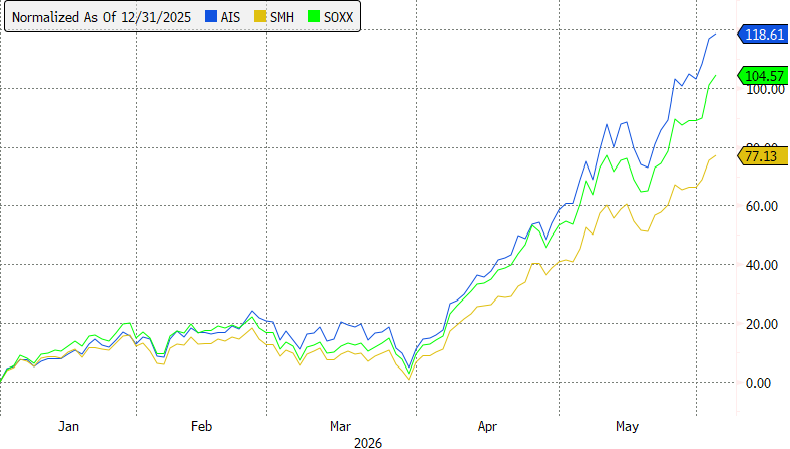
The one fund with a real claim to outdoing it is the Roundhill Memory ETF (DRAM). DRAM only debuted on April 2, so there's no year-to-date comparison to be had. But since that launch it's up 151%, against 91% for AIS, 81% for SOXX and 63% for SMH.
DRAM is a very different animal, though. It's also a thematic ETF, but one built around a single corner of the chip world: memory. Memory stocks, like semiconductors broadly, have soared thanks to the AI boom, particularly the surge in demand for the high-bandwidth memory that AI chips depend on.
DRAM zeroes in on that narrow slice, so it holds just 15 stocks versus 62 for AIS, with nearly three quarters of the portfolio concentrated in just Micron, SK Hynix and Samsung. The rest sits in other memory and storage names like SanDisk on the NAND flash side and Seagate in hard drives.
The Appeal
What could make AIS appealing to some investors is its more holistic approach to AI. That's the benefit of being a thematic ETF broadly focused on AI. It can pull from whatever industries and corners of the market the AI trade is rewarding, not just chips.
Up to now, the biggest AI winners have been semiconductor companies. Names like Nvidia, Broadcom, AMD and Marvell have skyrocketed, which has made semi-focused ETFs hard to beat.
But as the payoff from AI potentially broadens out, stronger performance could start showing up elsewhere. Software is one big candidate.
Even though most software stocks have been notable laggards so far, weighed down by fears that AI will disrupt the incumbents, software is ultimately how people will get value from all the AI infrastructure being built, so there should be winners there eventually.
CrowdStrike and Palo Alto, two cybersecurity names AIS currently holds, are already benefiting. If Anthropic and OpenAI come to market, they'd add a fresh set of AI-native names to the software and applications side, and they're the kind of holdings a pure chip fund wouldn't include.
In that regard, a fund like AIS that can rotate toward software, or whatever the next winning corner of AI turns out to be, could hold an edge over a pure semiconductor ETF down the line, whether that's SMH, SOXX or DRAM.
Of course, the fund's performance will ultimately depend on the manager and the index provider. For now, they've delivered handsomely, and the money has followed. Investors have poured $423 million into the fund this year, pushing assets under management to more than $800 million.