The Best-Performing Bond ETFs of 2025
The bond market’s standouts in 2025 are coming from under the radar parts of the fixed income world.

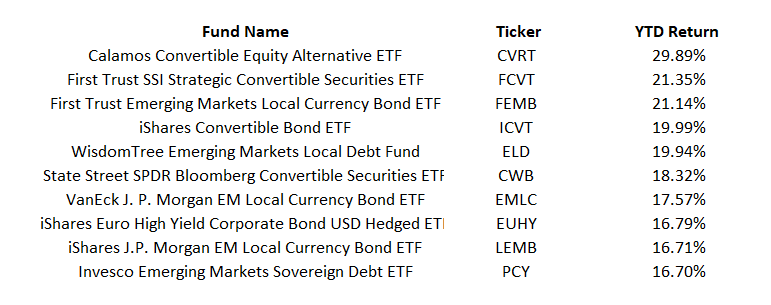
The best performing fixed income ETFs of 2025 look nothing like the broader bond market. The top of the list has been taken over by convertible bond strategies and emerging market local currency funds, two corners of fixed income that don’t resemble the plain-vanilla bond exposure most investors own.
Why Convertible Bonds Are Rallying
Convertible bonds are issued by companies and pay interest like regular bonds, but they also give investors the right to convert into stock if the share price climbs far enough. That equity option is valuable, so issuers compensate for it by offering yields that are lower than traditional corporate bonds. In a year when stocks are climbing, that trade-off has paid off.
The Calamos Convertible Equity Alternative ETF (CVRT) is the top performer in the entire fixed income category with a gain of 29.9%. It’s followed by the First Trust SSI Strategic Convertible Securities ETF (FCVT), up 21.4%; the iShares Convertible Bond ETF (ICVT), up 20%; and the State Street SPDR Bloomberg Convertible Securities ETF (CWB), up 18.3%.
The convertible bond ETF category is small with only eight funds. CWB is the largest with $4.7 billion in assets, followed by ICVT at $3.7 billion. CVRT, with $13 million, is far smaller.
CVRT and FCVT are actively managed, while CWB and ICVT track indexes. One result is that their yields vary. CVRT has a thirty-day SEC yield of 0.8% and CWB yields 1.5%.
Holdings differ as well, especially in the active funds, though all of them have heavy exposure to technology issuers. Tech companies are among the biggest users of the convertible market, so it is common to see 30–40% of these portfolios allocated to tech names. With tech stocks strong again this year, both the active and index funds have benefited.
How Local Currency EM Bonds Work
Local currency emerging market bond ETFs invest in bonds denominated in local currencies rather than in dollars. Returns reflect bond yields and price movements along with currency gains or losses. The MSCI Emerging Markets Currency Index is up 6.3% this year, giving this group a big lift.
These funds typically offer higher yields than their dollar-denominated counterparts. The major local currency funds highlighted here yield between 6% and 7%, roughly 50 to 100 basis points more than USD-based EM bond ETFs.
Investors often avoid that extra currency exposure, which is why U.S. dollar-denominated EM bond ETFs are more popular. For instance, the iShares J.P. Morgan USD Emerging Markets Bond ETF (EMB) has more than $16 billion in assets while the VanEck J.P. Morgan EM Local Currency Bond ETF (EMLC) has about $4.2 billion.
But in 2025 the currency exposure helped rather than hurt.
The First Trust Emerging Markets Local Currency Bond ETF (FEMB) leads the category with a return of 21%. The WisdomTree Emerging Markets Local Debt Fund (ELD) has gained 19.9%. EMLC is up 17.6%. The iShares J.P. Morgan EM Local Currency Bond ETF (LEMB) is up 16.7%.
One USD-denominated fund has kept pace, though. The Invesco Emerging Markets Sovereign Debt ETF (PCY) is up 16.7%. Most funds in the category have durations near five years. PCY is the outlier, with a duration close to ten years, which has helped it outperform as bond prices have rallied.
One More International Standout
Rounding out the top ten is the iShares Euro High Yield Corporate Bond USD Hedged ETF (EUHY), which is up 16.8%. Because the fund hedges euro-dollar currency exposure, it did not receive any FX boost.
Its gains came from yields and price appreciation in European high yield bonds as investor sentiment toward the region improved. Its 30-day SEC yield currently sits at 4.5%.