


Cathie Wood’s ARK ETFs: From Record Inflows to Record Outflows
Billions poured into Cathie Wood’s ETFs in a matter of days, and then just as quickly flowed back out.

A week ago I wrote about how Cathie Wood’s ARK ETFs were suddenly seeing record-breaking demand. The ARK Innovation ETF (ARKK) alone pulled in $5.6 billion in the seven days through Aug. 13, including $2.8 billion on Aug. 13, $1.4 billion on Aug. 12, and $1.1 billion on Aug. 11. The ARK Next Generation Internet ETF (ARKW) also had its largest daily inflows ever.
At the time, it looked like investors were piling back into ARK in a way we hadn’t seen since 2021. But it turns out those flows weren’t real demand at all.
They were almost certainly heartbeat trades.
What Are Heartbeat Trades?
Heartbeat trades are a tax trick. An ETF takes in a giant inflow, then sends out an equally large outflow, using the opportunity to hand off low-basis stocks that would otherwise trigger taxable gains if sold.
Usually this happens fast—one or two days of massive inflows, followed by one or two days of massive outflows. You see it often in ETFs that don’t have much natural redemption activity, like Vanguard’s funds.
The Vanguard Information Technology Index Fund ETF (VGT) is a great example: a big inflow, then a big outflow around the time of index rebalances. 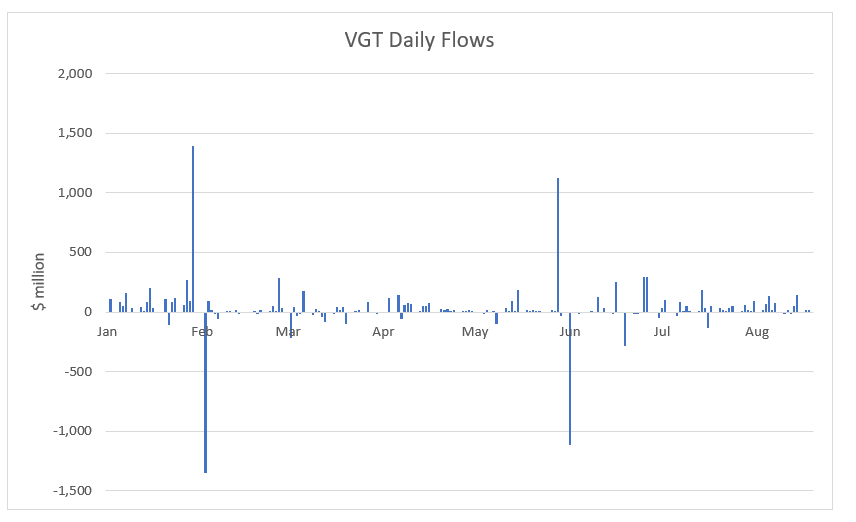
Because Vanguard funds are mostly held by long-term buy-and-hold investors, they don’t get a steady stream of redemptions. Instead, they rely on this neat tax trick to flush out embedded gains.
In contrast, a fund like the SPDR S&P 500 ETF Trust (SPY) doesn’t need heartbeats. As one of the most heavily traded vehicles in the world, it has constant inflows and outflows to naturally purge low-basis stocks.
ARK’s Heartbeats
ARK’s flows didn’t follow the typical “one-day in, one-day out” heartbeat pattern. Instead, ARKK logged seven straight days of inflows between Aug. 8–13 totaling $5.4 billion. Then came four straight days of massive outflows totaling $5.3 billion between Aug. 14–19.
It was the same thing in ARKW, with $765 million going in during that first stretch and $715 million coming back out right after.
These were the same heartbeat trades we see in other ETFs, just stretched out over multiple days.
The reason ARK needs them is obvious: it trades constantly. All that buying and selling means big potential capital gains when the portfolio rises.
That wasn’t an issue in 2022–2024, when ARK was crashing and burning. But more recently, things are working again. Many of the funds, including ARKK, have doubled off their April lows, thanks to timely trades in hot stocks like Coinbase, Roblox, Shopify, Palantir, and Robinhood.
The funds even bought into the Circle Internet Group IPO at $31, only to sell shares at prices above $200 just weeks later for a massive profit. Heartbeats let ARK flush those gains out of the portfolio without passing along a taxable bill to shareholders.
The Exceptions
Not every ARK fund showed the same heartbeat pattern. The ARK Genomic Revolution ETF (ARKG) has been dead money, up just 3% this year and still down nearly 80% from its highs. With no capital gains to purge, it hasn’t needed heartbeats.
The ARK Autonomous Technology & Robotics ETF (ARKQ) has rallied 24% this year but hasn’t shown the same inflow/outflow pattern either. It’s actually the only ARK ETF with more than $100 million of net inflows for 2025 so far ($105 million). ARKW is second with $48 million.
Across the full ARK suite, outflows are now $838 million for the year, suggesting that last week’s ARK comeback narrative was far off the mark.
The Bottom Line
Last week I framed the flows as a story of investors rushing back into ARK. That was premature.
Granted, it wasn’t a crazy idea. ARK has been on a hot streak, the Circle IPO trade was a home run, and the market has been partying like it’s 2021. This is the kind of environment ARK thrived on back then, so record demand didn’t seem far-fetched.
But the reality is those massive inflows weren’t real. They were tax-driven heartbeats, not organic demand.
That leaves ARK in an odd spot. Cathie Wood's stock picking looks sharper than it did in the dismal 2022–24 stretch, and performance has bounced hard, but investors aren’t piling back in. The fanbase that rushed in during the pandemic years—pushing assets above $60 billion—hasn’t returned. Today assets sit around $20 billion, just one-third of the peak.
Maybe that changes if the rally continues. For now, though, Cathie Wood still hasn’t won back her crowd.


