Ethereum ETFs Are Crushing Bitcoin: ETHA Pulls $2.4B as IBIT Stalls
After months of bitcoin dominance, ether is finally stealing the spotlight.

For much of the time after the launch of spot crypto ETFs, bitcoin was the undisputed star. Flows poured into the iShares Bitcoin Trust (IBIT) and bitcoin prices surged to record highs. Ether, meanwhile, sat on the sidelines, overshadowed as investors fixated on bitcoin.
Part of the problem was that it lacked a clear bullish narrative. While bitcoin’s “digital gold” story was easy for investors to latch onto, ether was harder to understand.
There was even a bearish narrative working against it. Ethereum was seen as clunky and tedious to use compared to newer competitors like Solana, which had become the platform of choice during the meme coin frenzy of the past year.
For a long time, Ethereum looked like it was falling behind—but that changed in dramatic fashion this summer.
Flows Tell the Story
So far in August, investors have funneled $2.4 billion into the iShares Ethereum Trust (ETHA). That’s the second-best month in the fund’s history, trailing only July’s massive $4.2 billion haul.
By contrast, IBIT has pulled in just $459 million, its weakest month since March, and the third-lowest since the ETF debuted in January 2024.
This marks only the second time ETHA has topped IBIT in monthly flows. The first was February 2025, when ETHA’s modest $137 million intake contrasted with IBIT’s $776 million outflow. But what’s happening in August is far more striking, with ETHA ahead by almost $2 billion.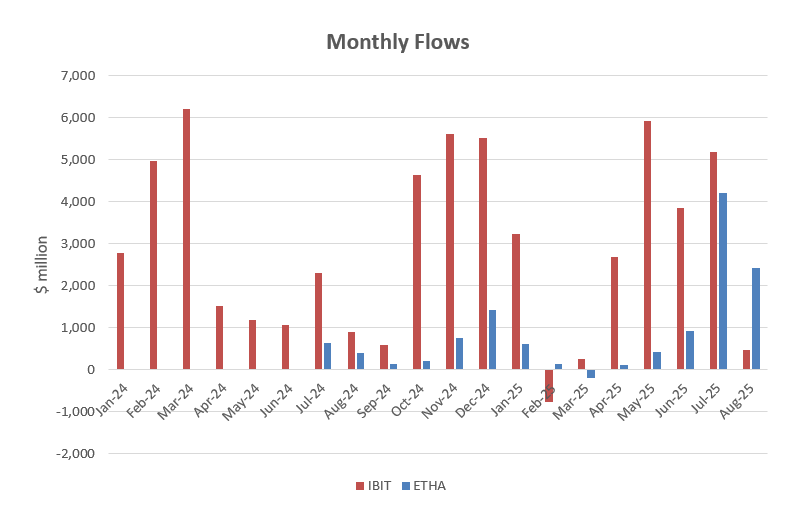
ETHA is by far the largest ether ETF, with $17 billion in assets under management, while IBIT towers over the bitcoin ETF space with nearly $87 billion.
On a year-to-date basis, IBIT still leads decisively with $20.8 billion of inflows versus $8.6 billion for ETHA. But that’s a significant narrowing from the end of June, when IBIT’s tally was $15.2 billion compared to just $2 billion for ETHA.
Market Share Shifts
That recent divergence in bitcoin and ether ETF flows is reflected in the broader crypto market. Bitcoin dominance, which measures bitcoin’s share of total crypto market value, has slipped to 57.3%, its lowest level since January. Ether’s share has climbed to 14.5%, the highest in a year. The remainder of the crypto universe accounts for 28.2%, according to CoinMarketCap.
Bitcoin is still the most valuable cryptocurrency by far, with a market cap of $2.2 trillion, but ether has surged to $561 billion, narrowing the gap.
Prices tell a similar story. After lagging badly in the first half of 2025, ether has exploded higher and is now up about 38% year to date, almost double the 20% gain for bitcoin. 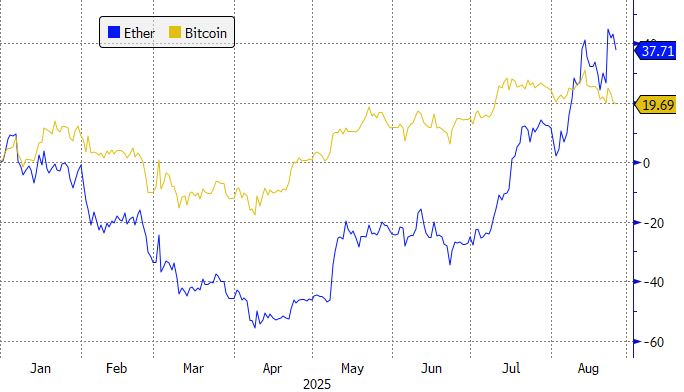
On Friday, ether finally broke through its old record from 2021, topping $4,850.
Why Now?
The turnaround for ether has been driven by three catalysts. First was a simple catch-up trade. By late June, ether was down 25% for the year while bitcoin was up 15%. With the gap so wide, many investors began buying ether on the expectation that it would close some of the distance.
Momentum then picked up when the IPO of Circle Internet Group, issuer of the USDC stablecoin, turned into a blockbuster success. The stock soared, and with it came renewed attention on Ethereum’s central role as the platform where most stablecoins are issued and transacted.
Circle’s success reminded investors that ether was a beneficiary of the stablecoin boom, even if it hadn’t been recognized as such until now.
Finally, a new set of corporate buyers appeared. Companies like Sharplink Gaming (SBET) and Tom Lee’s Bitmine Immersion Technologies (BMNR) started adding ether to their treasuries, borrowing from Michael Saylor’s MicroStrategy playbook of treating crypto as a reserve asset.
That gave ether the beginnings of its own corporate-adoption narrative, echoing one of the key bullish catalysts that fueled bitcoin’s rise.
Taken together, those factors finally gave ether what it had been lacking: a clear story investors could buy into. Once that emerged, the money followed.
The Bigger Picture
For bulls, the flows into ETHA and the breakout in ether’s price are a sign that the world’s No. 2 cryptocurrency is regaining its mojo. After a long period in which bitcoin was the dominant story, ether is proving it can attract attention in its own right.
That hasn’t really been the case since 2021, when Ethereum was at the center of the NFT and DeFi boom and briefly looked like the engine of the crypto economy. Four years later, it has a new narrative built around ETFs, stablecoins, and corporate treasuries.
For the first time in the post-ETF era, it feels like ether, not bitcoin, is setting the tone for crypto markets.