
Gold, Silver ETFs Suffer Historic Collapse On Trump Fed Pick
GLD tumbled as much as 13%, while SLV plunged 34%

Gold and silver ETFs suffered their worst single-session declines on record Friday after Donald Trump announced Kevin Warsh as his pick to replace Jerome Powell as chair of the Federal Reserve.
The reaction was swift and violent. The SPDR Gold Trust (GLD) fell as much as 13%, while the iShares Silver Trust (SLV) plunged more than 34%, marking the largest one-day drop in the history of both ETFs.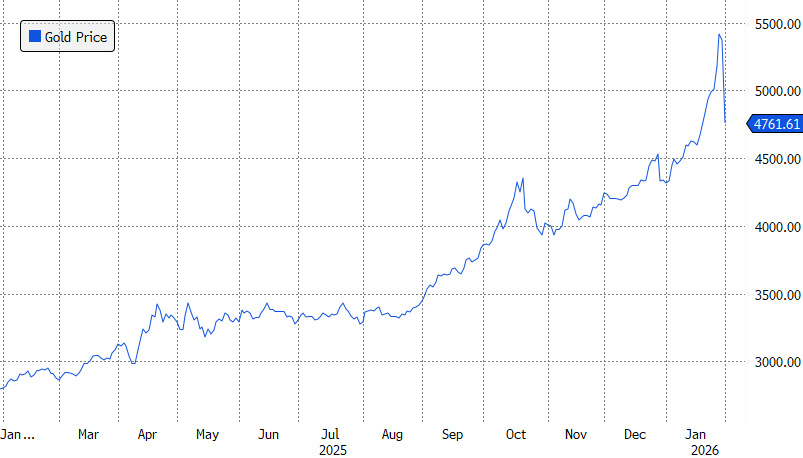
Warsh served on the Fed’s Board of Governors from 2006 to 2011, spanning the global financial crisis and its aftermath. He is currently a fellow at the Hoover Institution, a lecturer at Stanford Graduate School of Business, and serves on the boards of Coupang and UPS.
Markets immediately focused on Warsh’s long-standing reputation as a monetary hawk. During the heart of the 2008 financial crisis, Warsh repeatedly argued that inflation, not deflation, posed the greater risk to the economy. That view ultimately proved wrong, as inflation failed to materialize for more than a decade, while sluggish growth and disinflation dominated the post-crisis era.
Still, Warsh’s history suggests a clear preference for tighter policy and a greater sensitivity to inflation risks than many of the more dovish candidates President Trump could have chosen. That made the selection surprising, particularly given Trump’s repeated public criticism of Powell and the Fed for moving too slowly on interest-rate cuts.
For precious metals, the implications were bearish.
First, a more hawkish Fed chair raises the prospect of lower future inflation, undercutting one of the core pillars supporting gold and silver prices. Second, Warsh’s appointment appeared to ease investor concerns about Fed independence.
Fears that political pressure might push the central bank toward artificially low rates, and higher inflation, had driven substantial flows into precious metals over the past year. Warsh’s credibility, even among critics, suggests he would be less inclined to simply accommodate the executive branch.
The price action was historic. Prior to Friday, GLD’s largest one-day decline in its 21-year history was an 8.8% drop in 2013. SLV’s worst session had been an 18% fall during the 2008 crisis. Friday’s move shattered both records.
In the underlying metals market, silver suffered its largest single-day decline in modern history, with data going back to 1960. Gold’s drop ranked among its worst ever, rivaling sharp selloffs seen in 1980 and 1969.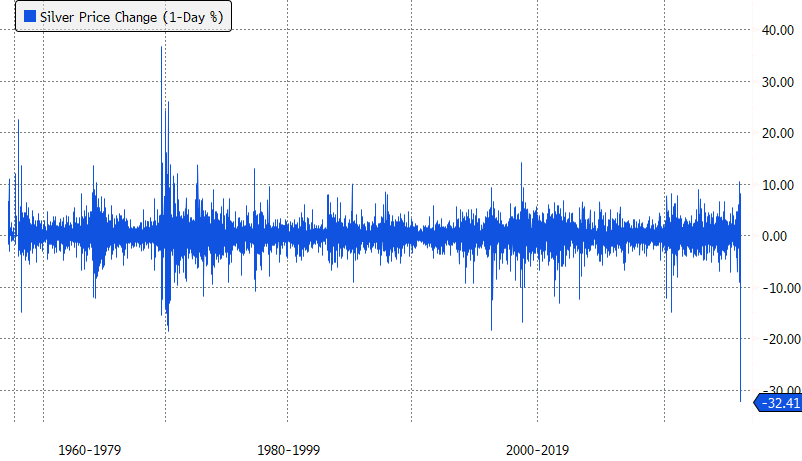
The selloff also dramatically reversed this year’s gains. Silver, which had been up roughly 62% as recently as Wednesday, was left with gains of just 6% as of this writing. Gold, previously up 25% on the year, fell back to about 9%.
Despite the carnage, both metals remain well above last year’s levels. In 2025, gold surged 65%, while silver skyrocketed 148%, setting the stage for what may have been a classic blow-off top.
Precious metals have a long history of parabolic rallies followed by abrupt, brutal reversals. Investors will now be watching closely to see whether Friday’s collapse marks a temporary shock, or the beginning of a deeper and more sustained unwind.