

Gold, Silver Hit Records as Powell Probe Raises Fed Independence Fears
Gold and silver surged to record highs after news of a DOJ probe into Fed Chair Jerome Powell reignited concerns over the central bank’s independence.

Precious metals ETFs surged to fresh record highs after Jerome Powell, chair of the Federal Reserve, said Sunday that the Fed had been served with grand jury subpoenas by the Department of Justice.
Spot gold jumped above $4,600/oz, while silver surged past $86, both all-time highs. The SPDR Gold MiniShares Trust (GLDM) rose 2.4% by midday Monday, while the abrdn Physical Silver Shares ETF (SIVR) gained 7.5%.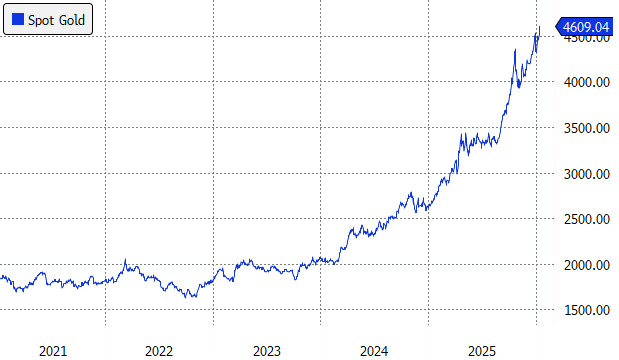
The rally reflects renewed market anxiety over the Federal Reserve’s independence. President Donald Trump has repeatedly criticized the Fed, and Powell personally, for not cutting interest rates more aggressively.
The Fed lowered rates by 75 basis points in 2025 after cutting 100 basis points in 2024, following a sharp tightening cycle in which it raised rates by 525 basis points in 2022 and 2023 to combat surging inflation.
Since then, the Fed has been gradually easing policy as it weighs the two sides of its dual mandate, inflation and the labor market. Inflation has remained above the Fed’s 2% target, in part due to higher import costs stemming from Trump’s tariffs, while labor market data has softened. That has left the U.S. central bank walking a narrow line.
Trump Pressures Fed
Trump, however, has continued to publicly pressure the Fed to move faster. He has threatened to fire Powell and previously attempted to remove Fed Governor Lisa Cook, citing alleged mortgage fraud related to actions taken before she joined the central bank.
That firing attempt was temporarily blocked by the courts, and the Supreme Court is expected to decide whether the president has authority to remove her “for cause,” a legal standard traditionally interpreted to apply to misconduct while in office, not actions taken before assuming the role.
Together, these moves have heightened concerns that political pressure is eroding the long-standing principle that the Fed operates independently of the White House.
Economists generally agree that countries with independent central banks tend to experience better macroeconomic outcomes, including lower and more stable inflation. Political interference in monetary policy has historically been associated with higher inflation and economic instability.
The DOJ Investigation
The current DOJ probe centers on Powell’s testimony last June regarding a multi-year project to renovate historic Federal Reserve office buildings. Powell has strongly rejected claims that the investigation is about misleading Congress or mismanaging the renovation.
“This new threat is not about my testimony last June or about the renovation of the Federal Reserve buildings,” Powell said in a statement. “It is not about Congress’s oversight role; the Fed through testimony and other public disclosures made every effort to keep Congress informed about the renovation project. Those are pretexts.”
Powell framed the investigation as retaliation for the Fed’s monetary policy decisions rather than a good-faith law enforcement action.
“The threat of criminal charges is a consequence of the Federal Reserve setting interest rates based on our best assessment of what will serve the public, rather than following the preferences of the President,” he said. “This is about whether the Fed will be able to continue to set interest rates based on evidence and economic conditions—or whether instead monetary policy will be directed by political pressure or intimidation.”
Powell emphasized his long public service record across administrations of both parties and said he would continue to carry out the role to which the Senate confirmed him.
The investigation and the accompanying rhetoric come as Powell’s term as Fed chair approaches its end. His term expires in May 2026, though he can remain on the Board of Governors until 2028.
Trump has signaled that he may appoint either Kevin Hassett, director of the National Economic Council, or Kevin Warsh, a former Fed governor, as the next chair.
Republican Reaction
The DOJ’s move has drawn notable pushback from several Republican lawmakers, underscoring how sensitive the issue of Fed independence has become.
House Financial Services Chair French Hill said the investigation “creates an unnecessary distraction” that “could undermine the ability of current and future administrations to make sound monetary policy decisions.” While Hill acknowledged policy disagreements with Powell, he described him as forthright and of high integrity.
Sen. Kevin Cramer, a frequent Powell critic, said he does not believe Powell is a criminal and expressed hope that the investigation would be resolved quickly to restore confidence in the Fed.
Sen. Lisa Murkowski went further, calling the probe “an attempt at coercion” and warning that if the Fed loses its independence, the stability of markets and the broader economy would suffer.
Other Republicans struck a more cautious tone. Sen. Cynthia Lummis said the public deserves answers but that she would wait for the DOJ’s findings before reaching conclusions. Sen. Roger Marshall defended the administration’s focus on waste and abuse but stopped short of accusing Powell of lying to Congress.
The controversy also threatens to spill over into the Senate’s handling of future Fed nominees. Sen. Thom Tillis said he would oppose confirmation of any Fed nominee, including the next chair, until the matter is resolved.
Why Metals Are Rallying
Despite signs of political resistance to the DOJ’s actions, markets appear worried about the implications for monetary policy, which is fueling demand for safe havens.
Gold and silver had already been on a historic run. In 2025, gold rose nearly 65%, silver surged 148%, platinum gained 127%, and palladium climbed 78%. All except palladium reached record highs, making it the strongest year for precious metals since 1979.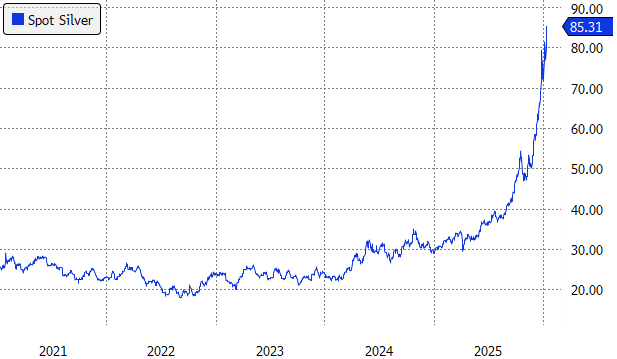
Investment demand has been a major driver. Global gold ETFs absorbed roughly $89 billion of inflows in 2025, while silver ETFs took in about $10 billion. Investors have increasingly turned to precious metals as protection against a wide range of risks, including ballooning government debt, geopolitical tensions, trade wars, stubborn inflation, and now renewed questions about the Federal Reserve’s independence.
Silver’s rally has also been supported by industrial demand tied to solar power, electric vehicles, and AI-related infrastructure, adding a growth driver to the bull thesis.