Real World AI: Use It, or Be Used by It
Useful, ubiquitous AI is here. But what are you actually doing with it?

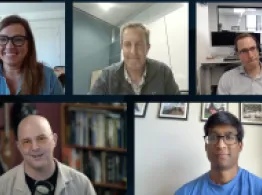
This week I was in NYC for Simplify’s annual “Entering the Fall” event, a content-rich day of conversations about markets, capitalism, and rational investing. I had the plum job of moderating a panel on AI with Perscient’s President and co-founder Ben Hunt (better known from Epsilon Theory), Jack Kokko, CEO and founder of AlphaSense, and Michael Cox, co-head of Global Equities at Piper Sandler.
This was an investment event focused mostly on “what does it mean” implications from charts like this one:
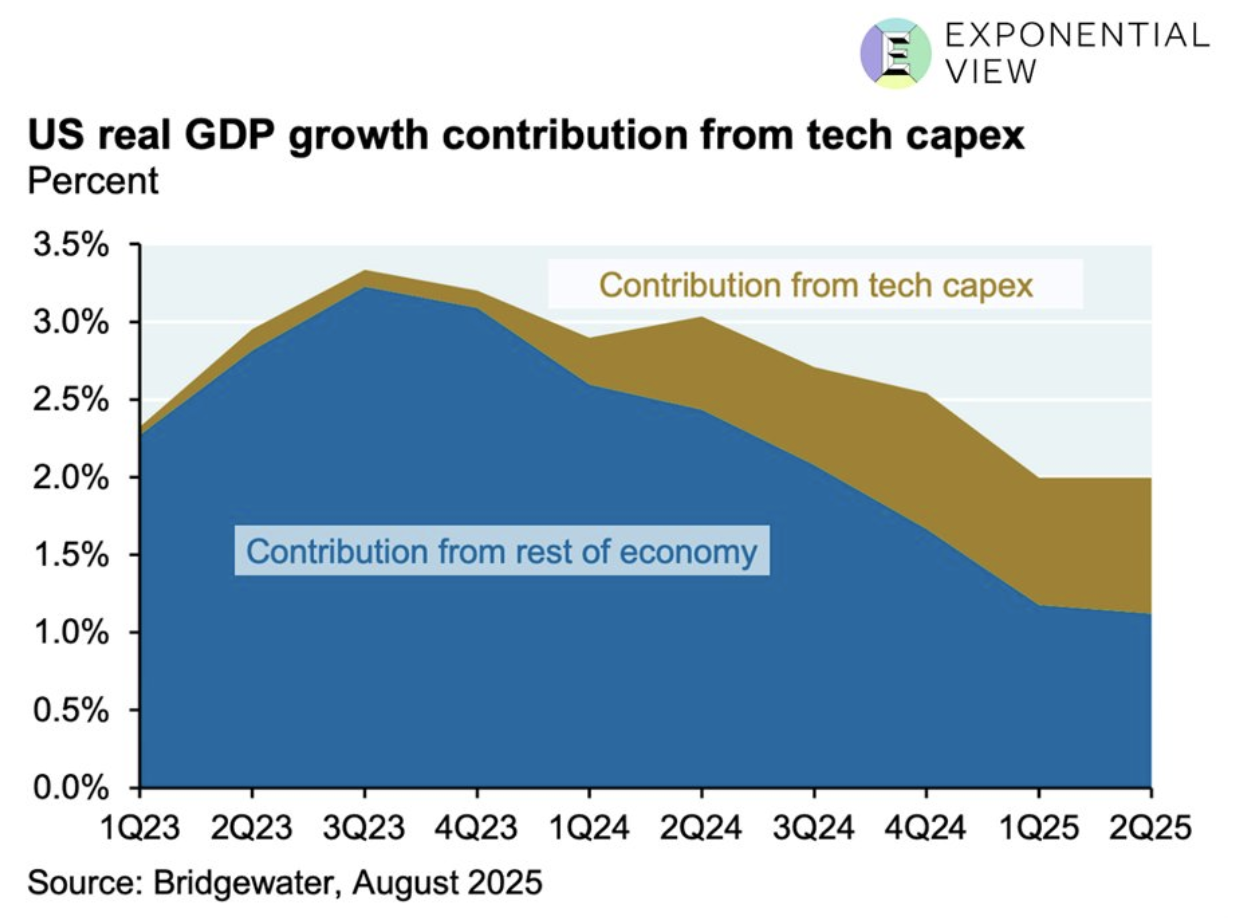
Which is to say: we talked about what the presence of AI means for markets and investors. I’d love to say we solved it all, but here were my big takeaways:
- The Capex boom will have to be matched by a productivity boom – otherwise it’s a bubble.
- The productivity boom is proving slow and unevenly distributed. Some firms are getting huge ROI, some are wasting money.
- We don’t agree on whether AI is going to make “us” – humanity, society, markets – dumber or smarter, whether it’s ultimately going to be “good” or “bad,” but we all agreed there’s no stopping this train, so our opinions won't matter much.
But all this talk about the “big ‘I’ Impacts” has left me evaluating the “small ‘i’ impacts.” As the new Prez here, one of my mandates is figuring out some policies around what kind of content we make, who produces it, for whom, and importantly, with what tools.
So here’s a rundown of what I’m using AI for, day-to-day, as we re-imagine ETF.com as a central hub for the ETF investor community. (And, incidentally, here’s our formal policy on AI usage).
5 Things I’m Using AI For Right Now
Here’s my hot take on how well AI is actually working in my day-to-day life.
1: Transcripts: In 30 years interviewing people, the most boring and labor intensive part used to be transcription. I had pedals under my desk to fast forward and rewind MP3 files while I typed as fast as I could.
Today it’s trivial to upload an audio file to the LLM of your choice and get a very good first pass transcript. My favorite way to do this is with code, using OpenAI’s Whisper API, but the no-code solution is to just upload it into Gemini, and it works. (And if you already have a meeting snoop, like Fireflies or Otter, you can use their services too).
Labor Market Heartache Factor? 0/10. Transcription is a terrible job that nobody should have to do by hand.
2: Copy Editing: In the old days, back around the global financial crisis, ETF.com staffed a significant stable of writers and analysts producing killer content in a constant stream of text. Copy editors had the job of giving those pieces their “first read,” providing content, context and line edits. A good copy editor can take a B- piece of writing and punch it up to B+ level writing.
Copy editing remains a valuable job, but in an online world where you’re producing a LOT of content on a regular basis, adding a full copy edit cycle to every piece of content is either an enormous amount of labor, or a significant amount of delay in production.
Enter Large Language Models. All three major engines (OpenAI, Claude, Gemini) do a good job at catching typos and making generalized suggestions to improve a piece of writing. In my case, I take my first drafts and load them into Claude (generally my default LLM) with instructions:
“Acting as a professional copyeditor, review the following article for typos, context and continuity errors, case-mismatches, malapropisms, duplications and data errors. Present those as a punch-list with context cues. Separately, evaluate this piece against my body of work, and fact check any assertions easily addressable with a web search. Present suggestions for improvement.”
I generally tweak this every time based on context, but it’s shockingly helpful. Not only does it help clean up the obvious slop in my own work, it usually prompts me to rethink something.
I want to be extremely clear here though: I am not using AI to “write for me;” exactly the opposite. Asking AI to write or rewrite a piece for you is, in my experience, a recipe for complete disaster. The few times I’ve ever tried I’ve immediately caught hallucinations, false assertions, boneheaded takes and instantaneous mediocrity without a hint of human soul.
But Copy Edits? Amazing.
Labor Market Heartache Factor? 7/10. I know some amazing editors. If I’m ever writing a book or a print publication again, I’ll be calling.
3: Research: Whether you use a dedicated search AI like Perplexity or just lean on one of the big-3, the old way of accessing actual information on the internet is gone.
But this is a tricky area. It’s extremely easy to ask ChatGPT to “get me up to speed on the status of ETF share classes.” But almost every time, a simple research request like that is both going to miss key points, and over-index on the most average answers. That’s understandable, because that’s what LLMs do – they’re prediction engines for likely responses.
On the other hand, I’ve found AI to shine at collecting sources, while simultaneously sucking at accuracy, currency and completeness. Chatbots are incredible Gell-Mann Amnesia machines. I can ask it about something I don’t really know anything about – like the load bearing capacities of different construction materials – and get incredibly true-sounding responses loaded with links and references. And then I ask it something about ETF regulation or market structure and it just makes stuff up or leans on 10-year-old data as current truth.
I now treat AI as my widely-read-yet-fairly-dumb but eager-and-hard-working-yet-still-unreliable intern who’s just home from college for the summer and mostly just wants a good recommendation. Don’t trust. Always verify.
Labor Market Heartache Factor: 0/10. Nobody wants to be my intern, and even flawed, it’s so much better than search.
4: Data Analysis: A year ago, if I had a spreadsheet with, say, 100 data points for every ETF, those half-a-million data points or so might as well have been invisible to a Chatbot. Now (particularly with Claude, I find), I can upload a monster spreadsheet, ask it a few longwinded questions, get a cup of coffee, and have it present tables, charts or pretty much any analysis I can think of.
The huge caveat here is that the WAY AI is going to interact with your data is through code, generally inline, in the chat window, using Python or Javascript. So for example, with my giant spreadsheet in hand I asked Claude (on August 20th):
Can you create a summary set of statistics about Funds launched in 2025 so far. Include: Breakdown by asset class (number of funds and current assets)
In response to which it took a few minutes and came back with:

Could I have done this in a spreadsheet? Of course, fairly easily, and for most of the last year, I double-checked any analysis like this against manually creating it myself in Excel to prove it out. It was so bad that in spring I taught myself Cursor and Claude Code and built actual programs to do this kind of parsing.
I’ve trashed all that code, because I haven’t found any errors in these kinds of “in the chat window” explorations since the last round of model updates. (That makes me nervous, honestly, because I can feel myself being lulled into complacency in real-time.)
So my takeaway here is similar to research: Yes, you can create significant time savings by using chat-window data analysis vs. sitting around coding things up in Python or R. But if you don’t know how to read the code, and don’t know how to recreate the analysis manually, error-checking is nearly impossible. Trust but verify.
Labor Market Heartache Factor? 5/10. There’s still no substitute for an actual analyst who can have a real conversation with me about the real data in the real world. But having a codemonkey at my beck and call – for nearly nothing – almost makes up for it.
5: Multimedia: None of the above is “generative AI” in the way that phrase is commonly used.
If I fed ChatGPT a bunch of ETF data and said “summarize the action in Leveraged and Inverse ETFs last week” and it made me an article, that’s Generative AI. And I’m not “anti” GenAI – I just think of it as its own thing, and not my thing. (For examples of how this can be done well, go check out ETFAction.com’s new AI-powered content site!)
I feel the same way about GenAI “art” as I do about GenAI “writing.” It has its place, but it’s not going to be my place. I find the vast majority of AI generated imagery or audio to be soulless, hollow, over-polished and unoriginal. There are obvious and amazing exceptions but in almost all cases, the exception is the human artist behind the keyboard who has poured their soul into creating art, and the AI is just another paintbrush in their tackle box.
I also feel like the world needs more Human right now, and I’d rather highlight real people doing real work than just covering the upgrades in the algo. So you won’t see a lot of AI generated hero images here, or AI generated graphic design elements. That doesn’t mean we won’t use AI in the process of making things: nearly every interesting feature of the Adobe stack, for instance, now has a little “AI Assist” from color correction to background removal. We’ll use a combination of human and AI-forward video editing tools (like Descript, Riverside, Veed or Premiere), but we’re going to lean on the human part where it counts.
But what about …
Those are 5 pretty simple use cases which, if I’m honest, probably mean there’s a whole body or two we won’t need in the short term as we’re building. That’s headcount that can be used for building great events, developing new technologies to connect people, creating more content or simply getting to know our community better.
And this is the low, low hanging fruit. This doesn’t even touch the incredible value already being delivered by advisor-centric AI platforms like Lydia from Shaping Wealth or Hazel from Altruist. Nor does it touch the more speculative use cases in investing, like the raft of “AI to generate alpha” companies fighting for your attention.
The challenge with everywhere, always on AI isn't whether it's "good" or "bad." The challenge is for us, as individuals, to keep up enough about it to know the difference.