

What Trump’s Fed Takeover Bid Means for TLT and Bond Investors
Trump’s attempt to fire a Fed governor has rattled markets. Here’s what it could mean for the yield curve and ETFs like TLT.

On Monday night, President Trump attempted to fire Federal Reserve Governor Lisa Cook, a stunning move that could reshape the U.S. central bank and threaten its independence. Cook has vowed to fight in court, meaning that for now, the Fed’s makeup remains unchanged.
Trump cited allegations of mortgage fraud as justification for the firing. But most market participants see the move as an effort to gain more influence over monetary policy by installing loyalists who will push rates lower to stimulate housing and the broader economy.
The Supreme Court is widely expected to decide whether Trump can fire Cook.
Early Market Response
The bond market’s initial reaction has been modest. The 30-year Treasury yield rose 3 basis points Tuesday and another 3 points by midday Wednesday, reaching 4.95%, the highest in a month. That move pushed the iShares 20+ Year Treasury Bond ETF (TLT) lower, trimming its year-to-date gain from just under 2% to just over 1%.
The 10-year yield barely budged—down 1 basis point Tuesday and up 2 on Wednesday—while the 2-year fell 4 points Tuesday and another 3 points Wednesday.
That left the curve steeper, with the long end drifting higher, the short end dipping lower, and the belly stuck somewhere in between.
The Narrative vs Reality
You can certainly paint a clean story here. A less independent Fed, pressured to run looser monetary policy, would mean higher inflation risks and therefore higher long-term yields.
Meanwhile, easier policy tends to push down short-term rates, keeping pressure on the 2-year. The 10-year sits in the middle, reflecting both forces, which explains why it barely moved.
But the reality is much messier and there are many possible paths from here.
The Supreme Court could rule that Trump cannot fire Cook, leaving the Fed intact. It could rule that he can, but her replacement ends up changing very little in practice. Or Trump could succeed in reshaping the central bank, effectively taking direct control of monetary policy.
From status quo to radical change, the scenarios cover the full spectrum, and markets will be reacting in real time as the legal and political fight unfolds.
Implications For The Curve
Either way, the pressure right now seems tilted toward a steeper yield curve. Long rates, and the ETFs tied to them like TLT, are where that pressure shows up most clearly.
If Fed independence erodes, short rates are likely to drop as policy loosens, while long rates could rise as inflation expectations climb. In that case, it’s not hard to imagine the 30-year pushing through its 2023 peak of 5.1%.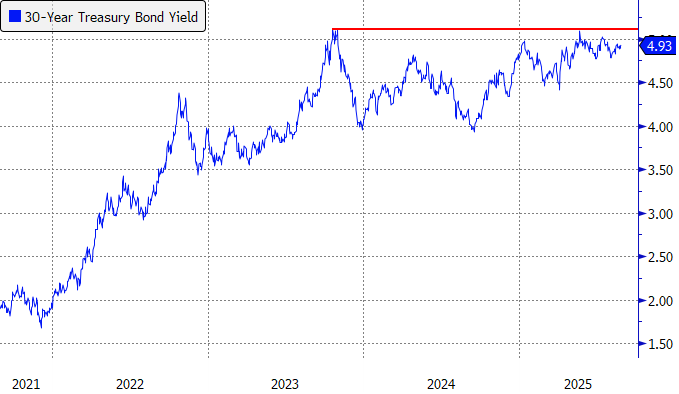
At the same time, it’s worth noting that the 30-year was already hovering near 5% before any of this, as markets wrestled with deglobalization, an AI-fueled investment boom, rising deficits, and shaky foreign appetite for Treasuries.
What It Means For Investors
The latest developments don’t make TLT a “bad” investment per se. Yields near 5% are compelling to some investors.
But ETFs that hold long-duration Treasuries are the most vulnerable to interest rate risk. If yields climb further, TLT will be among the hardest hit.
For those who want Treasury exposure with less sensitivity to rate swings, there are alternatives. The iShares 7-10 Year Treasury Bond ETF (IEF) offers intermediate exposure, while the iShares 1-3 Year Treasury Bond ETF (SHY) focuses on the short end. But there’s a trade-off. The shorter the maturity, the lower the interest rate risk, but also the greater the exposure to short-term yields falling if the Fed cuts rates.
It’s also worth remembering that there are scenarios where TLT rallies. If the economy slows more sharply, a mix of Fed rate cuts and easing inflation could drag long-term yields lower, lifting long-bond ETFs in the process.
Either way, the next few months look eventful for bond investors. Whether this ends in a reaffirmation of Fed independence or a reshaping of policy, long-term Treasuries, and the ETFs tied to them, will be at the center of the fallout.