

Software ETFs Plunge Amid AI Disruption Fears
Microsoft was a big drag on software ETFs.

Software stocks were hit hard Wednesday, as a mixed reaction to Microsoft’s earnings combined with growing concern that artificial intelligence could disrupt the software-as-a-service business model.
The iShares Expanded Tech-Software Sector ETF (IGV) fell 5.6% on the day, sliding to its lowest level since last April. The ETF is now down roughly 22% from its October highs. Microsoft accounts for about 10% of the portfolio, making it the fund’s largest holding and a major driver of the decline.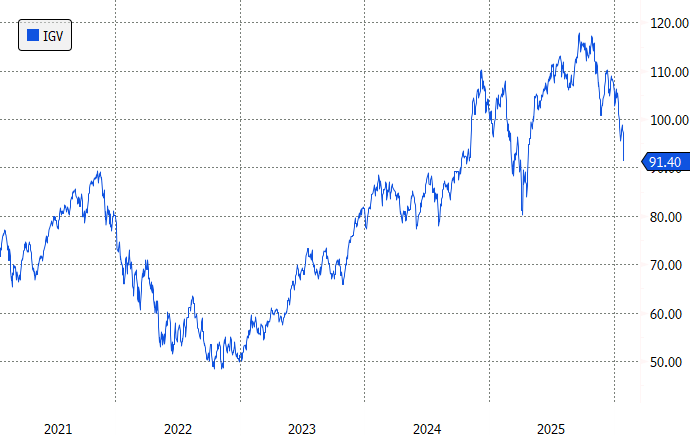
ServiceNow, the $120 billion enterprise software company, also weighed on the fund, falling roughly 13% after reporting earnings that disappointed some investors.
The weakness extended beyond software-focused funds. Broader ETFs such as the Invesco QQQ Trust (QQQ) and the Vanguard S&P 500 ETF (VOO) were dragged lower due to Microsoft’s massive size.
The stock is the third-largest company by market capitalization in the U.S., with roughly a 7% weighting in the Nasdaq-100 and about a 6% weighting in the S&P 500. At its lows, QQQ was down as much as 2.4%, while VOO fell roughly 1.5%.
Solid Results, Negative Reaction
On the surface, Microsoft’s earnings looked fine. The company reported earnings per share of $4.14 for its fiscal second quarter, ahead of the $3.92 analysts expected. Revenue came in at $81.3 billion, topping expectations and rising 17% year over year.
Investor concern focused on two areas. First was Azure, Microsoft’s cloud computing business, which posted revenue growth of 39%. While still strong, that marked a slight slowdown from the 40% growth seen in prior quarter and came in below what some investors had hoped for.
Azure is where Microsoft captures much of the benefit from booming AI demand, since it provides the cloud infrastructure enterprises use to run AI workloads.
The second concern was capital spending. Microsoft reported $37.5 billion in capital expenditures during the quarter, roughly 9% above Street expectations and up 66% from a year earlier. To some investors, the combination of slowing Azure growth and sharply higher spending raised questions about the returns on the company’s AI investments.
Microsoft pushed back, explaining that some AI computing capacity had been directed toward internal products rather than external Azure customers. AI tools such as Microsoft 365 Copilot and GitHub Copilot are seeing rapid adoption.
The company said paid Microsoft 365 Copilot seats jumped to 15 million, while GitHub Copilot now has about 4.7 million paid subscribers, up 75% year over year. Management also noted that AI capacity remains constrained, suggesting Azure growth could have been higher if resources had not been shifted internally.
Taken together, the results were not disastrous. But the stock’s sharp decline suggested that something broader than one quarter’s numbers was influencing investor sentiment.
The Debate Over What AI Means For Software
That something is the growing debate over how AI will reshape enterprise software. The most bearish view, which appears to be driving sentiment across the industry today, holds that as AI improves, companies will increasingly be able to build and maintain their own internal tools rather than pay recurring fees to software vendors.
If AI can generate code and create and update systems automatically, traditional SaaS products could lose relevance. Under that scenario, software companies’ growth would slow, pricing power would weaken, and valuations that once assumed steady expansion would need to come down.
The Bullish Case For Software
But not everyone agrees. Box CEO Aaron Levie argues that AI could actually strengthen enterprise software rather than undermine it.
Even before AI, companies had the ability to write software themselves. In many cases, they chose not to because it was not core to their business and because specialized software firms could do it better, with greater reliability, consistency, and accountability.
“Much of this software helps define these underlying workflows in your organization so you don’t have to, so each company doesn’t have to reinvent the wheel each on how to handle HR, IT ticketing, and so on,” Levie said.
These systems, which manage everything from payroll to customer records and security permissions, are designed to behave the same way every time. They are deterministic, Levie argues.
AI, while powerful, is inherently probabilistic and better suited to assisting with tasks like analysis, summarization, and content generation than replacing systems that require precision and predictability.
From this perspective, AI does not replace enterprise software. It works within it. AI still needs trusted systems where data ultimately lives. In fact, Levie has argued that as AI-driven activity increases through agents, the importance of those systems could grow rather than shrink.
At the same time, AI could also expand the revenue potential of software markets by shifting pricing away from simple seat counts toward the value of work performed. If software increasingly handles tasks that once required people, vendors may be able to tap into larger pools of spending than traditional IT budgets alone.
“Now, with AI agents, the software is actually bringing along the work with the software, which means the budget software players are going after is the total spend that goes into doing that work in the company, not just the tech to enable it,” Levie said.
An Uncertain Future For Software
There is also a middle ground. Another theory is that traditional software won’t disappear, but that it will become less valuable. Core systems that store data and keep records will still exist, but much of what makes software products distinctive could erode, leaving traditional software with narrower roles and weaker moats.
In that scenario, more value could accrue to AI-focused companies that provide agents and automation, rather than the underlying software platforms themselves.
Regardless of which view ultimately proves correct, change appears inevitable. It is also possible that AI proves to be a boon for some software firms while posing a serious headwind for others. Some companies may successfully integrate AI into their products and strengthen their position, while others, particularly those with thinner offerings or slower adoption, may struggle.
The result may not be the end of SaaS, but a more competitive and differentiated landscape. For now, the market appears to be in flux, with investors selling first and asking questions later.