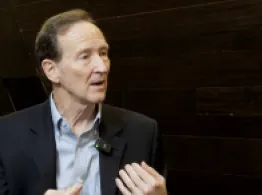

Pictet’s Wright on “Investing With Rather Than In AI"
David Wright, head of Quantitative Investments at Pictet, shares how the Pictet AI Enhanced Equity ETF (PQUS) uses artificial intelligence and decision trees to build portfolios.

Pictet's Head of Quantitative Investments, David Wright, grabbed time with Sumit Roy, Senior ETF Analyst at ETF.com, while at Future Proof Citywide. The two discussed the Pictet AI Enhanced Equity ETF (PQUS), including how the firm uses artificial intelligence in its strategy. The following is a transcript of their conversation.
Under the Hood of PQUS
Roy: David, how are you doing? Great to see you.
Wright: Yeah, it's great to be here. Thank you.
Roy: Absolutely. So I want to talk AI with you. It seems to me all anyone is talking about nowadays, especially when it comes to the investing world. AI has arguably been the biggest theme over the past year or two years, but the way that investors are betting on AI is by buying AI stocks traditionally, you know, semiconductors, NVIDIA, things like that.
But you at Pictet are doing something completely different. You're using AI to decide which stocks to buy. Can you tell us a little bit about that? You have an ETF that uses that strategy.
Wright: Yeah you're exactly right. So this is investing with rather than in AI. So PQUS, it's the Pictet AI-enhanced U.S. equity fund. It blends the best of passive and active: index-like risk and index-like performance profile with compounding outperformance on top. And that outperformance is driven not by a model that is developed and tested by a portfolio manager, but a model that is trained on hundreds and hundreds of thousands of different data points over many, many years to allow us to take the active positions.
Roy: Interesting. Now, when investors hear the word model, they think about factors or quantitative investing more broadly. How is this ETF different than, say, a factor one?
Wright: So we're explicitly not trying to take any factor risk versus its benchmark. And we're able to do that because we do three things. So firstly, when we train the model we train to forecast just that residual part of return, a piece that does not have any element of factor driven performance within it; whether that's styles, whether that's whether that's industry performance, whether that's economic exposures.
Now the risk sometimes is that the AI will still learn something like momentum. It's pretty hard to kill the momentum trade. But then when we build the portfolio, we make sure that it's tightly constrained versus the benchmark on dimensions like momentum and values. So it will be uncorrelated, it will be different to traditional factor driven performance.
Forecasting With Decision Trees
Roy: Gotcha. Now when people hear AI, they think about the chat bots that they're used to using everyday. ChatGPT, Claude. What kind of AI is this fund using? Is it large language models or something else?
Wright: So again, it's explicitly not a large language model. So language models, they do have usability in quant investing. But generally it's going to be to capture maybe sentiment from certain, I don't know, certain data sources that traditional approaches would struggle with. What we're using is a tree-based approach.
Thousands and thousands of decision trees. Now, how do they help us better than a large language model? Well, the model is trained explicitly to do one thing, and that's forecast for next 20-day residual returns. A language model is more of a generalized approach. It's not built to do specifically what we need it for.
So we train on 15 years of data, thousands and thousands of decision trees that are they produce great forecasts. They're stable, they're interpretable, and they don't take as much compute power as far as language models would take the training.
Roy: Gotcha. Now, when people think about AI models that are constantly being updated and improved. How often is your model being changed and improved?
Wright: So firstly, every three months we retrain the model. So we use a 15-year window that we train on. Every three months, we roll that by by three. So we drop off the oldest period, we add on three new months. It allows it to learn some of the new evolving dynamics within the market, the relationships and hidden patterns that a traditional quant model would struggle to fully capture.
Within that retraining as well, we're constantly adding new features, new characteristics about companies. So, for example, when we first launched this approach in Europe a couple of years ago, we used 200 different ways of assessing the company. We now use 400 ways. So yes, we both retrain the model regularly, and we evolve the types of data that we're using as well.
Roy: And what kind of performance can investors expect with this type of fund. Is it going to be swinging for the fences, or is it going to be closer to the broad market?
Wright: No, we again, this is something that is trying to give the best of passive and active. So we want to give a beta one to the market. We want to have a similar risk profile to the index. And then we want to clip away kind of 1 to 2% above the benchmark. If I look at what we've done in similar strategies in other vehicles, we've actually been delivering somewhere between 2 and 2.5% above the benchmark.
But again, we'll do that on a very consistent basis.
Roy: Now, obviously a really interesting strategy. What type of investors should consider adding this to their portfolio?
Wright: So investors that are maybe thinking about how they can evolve the course of their portfolio. So we know a lot of advisors are using passive at their core. Now that's worked for them pretty well over the last 10 to 15 years. But as equity returns likely reduce in the coming years, if they are looking to try and get a higher return from that course, then adding something like PQUS would provide a core holding and deliver some alpha on top within that core piece. That's the type of investor that should be using it.
Roy: Fantastic. PQUS, we're going to be keeping a close eye on it. David, thanks so much.
Wright: Thank you very much.
For more information about the Pictet AI Enhanced US Equity (PQUS) ETF, visit Pictet Asset Management’s fund page.
Important information
Investors should consider the investment objectives, risks, charges, and expenses carefully before investing. For a prospectus with this and other information about the fund, please visit www.pictet.com/etf or call (855) 994-4778. Please read the prospectus carefully before investing. Investing involves risk and principal loss is possible. Equity securities are subject to changes in value, and their values may be more volatile than those of other asset classes.
The Fund invests in foreign securities, which are generally riskier than U.S. securities. Securities of foreign issuers may be less liquid, more volatile and harder to value than U.S. securities. If the Fund buys securities denominated in a foreign currency, receives income in foreign currency, or holds foreign currencies from time to time, the value of the Fund’s assets, as measured in U.S. dollars, can be affected unfavorably by changes in exchange rates relative to the U.S. dollar or other foreign currencies. Foreign markets are also subject to the risk that a foreign government could restrict foreign exchange transactions or otherwise implement unfavorable regulatory, taxation, securities markets or other currency exchange rates or regulations, or imposition of economic sanctions, tariffs or other government restrictions, higher transaction and other costs, reduced liquidity, and delays in settlement.
The Fund relies heavily on a proprietary artificial intelligence selection model as well as data and information supplied by third parties that are utilized by the model. To the extent the model does not perform as designed or as intended, the Fund’s strategy may not be successfully implemented and the Fund may lose value. If the model or data are incorrect or incomplete, decisions made in reliance thereon may lead to the inclusion or exclusion of securities that would have been excluded or included had the model or data been correct and complete. The use of predictive models has inherent risks. For example, such models may incorrectly forecast future behavior, leading to potential losses. In addition, in unforeseen or certain low-probability scenarios (often involving a market disruption of some kind), such models may produce unexpected results, which can result in losses for the Fund. Furthermore, because predictive models are usually constructed based on historical data supplied by third parties, the success of relying on such models may be hindered heavily on the accuracy and reliability of the supplied historical data.
The Fund is an ETF and, as a result of this structure, is exposed to additional risks that do not apply to conventional mutual funds, including the risk that market price of an ETF’s shares may trade at a premium or discount to its net asset value, an active secondary trading market may not develop or be maintained, or trading may be halted by the exchange in which the ETF is listed. Shares of any ETF are bought and sold at market price (not NAV) and are not individually redeemed from the Fund. Brokerage commissions will reduce returns. The Fund has a limited operating history for investors to evaluate, and a new or smaller fund is subject to the risk that its performance may not represent efficiency. There can be no assurance that the Fund will achieve an economically viable size, in which case it could ultimately liquidate.
Distributed by Foreside Fund Services, LLC.