
The AI-Enabled Wealth Transfer No One is Talking About
Cameron Dawson, Matt Zeigler, and Dave Nadig on gamed markets, revenge of the real world, and why everyone should be abusing AI while the VCs are still paying for it.

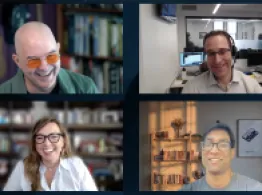
It's probably a terrible idea that every few weeks — or months — Cameron Dawson of Newedge Wealth, Matt Zeigler of Perscient and Sunpointe, and little old me sit down and talk for an hour about the state of the world and markets without any filter. Surely one of us will end up fired or worse.
But that day hasn't come yet, so here's the top 9 thoughts from this week's episode. While it's not exactly uplifting, we do laugh quite a bit about the vertigo that comes from watching your pet dog run around in circles (the pet dog in this case, is the market). Nobody loves this market or the reasons for it, fraud seems rampant, and the SEC appears to have largely left the building.
And yet: all-time highs again on a weekend front-running announcement that turned out to be specious. Again.
The Smell of Desperation
"We're in this environment where something that's like a fake ceasefire or not a real ceasefire feels like a relief because we've been so conditioned to expecting much worse news." — Matt Zeigler
Matt opened with a riff on the John Mulaney "What's New Pussycat" bit — play 17 "What's New Pussycats" in a row on the jukebox and one "It's Not Unusual" will make grown men weep with relief. That's the market right now. A fake ceasefire headline or a 90-day tariff pause isn't good news. It's just less bad news, and after months of being conditioned to expect worse, "less bad" is enough to send everything ripping higher. The bar is underground.
Insider Bets and Outsized Payouts
"The third time it happens on a weekend, we've got to start saying somebody is front running oil. At some point we have to say this is no longer a rational market. This is a gamed market." — Dave Nadig
Look, I won't claim to be an expert on the intraday proclivities of oil traders, but between the crazy prediction market bets and the straight up futures whale trades, how is it not obvious to literally everyone that we have major actors in global markets who now have inside information direct from the Whitehouse? There's literally no other explanation that holds water in my mind. At some point you have to stop calling it "smart money" and start calling it what it is: Crime. The pattern is too clean, the timing too precise, and the regulatory response too completely absent to pretend this is a coincidence.
When It All Hangs by a Thread
"You can make a very strong argument that this economy has never been more leveraged to the fate of the S&P 500 than at any other time in history." — Cameron Dawson
Maybe the main macro point of the now, and Cameron backed it with data that should make everyone uncomfortable. Record equity allocations as a percentage of household net worth. A plunging savings rate. Real spending outpacing real income since April 2025. The implication isn't subtle: the U.S. as a system can't take an extended bear market anymore. The economy and the S&P are the same trade.
A Valuation Race Against Time
"I think that as time goes on, you should effectively have a decay curve of what the peak valuation should be. If the peak valuation six months ago was 28 times forward, think six months forward that should be 27 or 26 times, because every six months you're getting closer and closer to the end of the cycle." — Cameron Dawson
At the end of the day, it's always about valuations, and Cam's point here is a good one: if 28 is the right PE now, what is it next year? Even if semiconductor earnings are still accelerating, the "right price" should be declining — because every quarter that passes brings you closer to the end of this cycle. Time itself is a valuation headwind.
Physical Assets As the Next Big Boom?
"The digital world is actually far more physical than we thought... Are we in episode 3 of Revenge of the Real World? And does this suggest that we are going to have a prolonged upcycle in more physical parts of the economy?" — Cameron Dawson
Cameron's "Revenge of the Real World" confused both Matt and I for a moment, because we were both sure we were talking about MTV's reality TV series Real World. But the premise here is essentially a version of Josh Brown's "Hard Assets. Low Obsolescence" HALO trade. The dot-com peak gave way to a twelve-year run in real assets. Now semiconductor supply constraints — the most physical bottleneck in the most digital industry — might be the next real asset catalyst. Every AI chip requires rare earths, water, electricity, and a fabrication facility that costs $20 billion and takes four years to build. The digital world runs on atoms. And a LOT of copper.
What Happens When Companies Can’t Fire Anymore?
"It's very difficult to say that the economy of the United States is growing if we are not hiring any new people. That just doesn't make a lot of sense to me... Can Meta fire another 15% of its employee base and increase its valuation? Another 15%? Another? At some point that starts straining credibility." — Dave Nadig
This is my forward-looking risk indicator, (by all means, use your own) and it's the one that keeps me up at night. The party in power argues we don't need new jobs because we've deported enough people. I find that largely a BS answer. Yes, we can make one unit of labor more productive with tech and process. But since the World War II labor boom, the economic benefit of productivity gains have really not flowed to labor. So you need actual hiring to grow the actual economy. Meanwhile, the companies getting the biggest valuation booms are the ones firing the most people. At some point "fire people, stock goes up" stops working. I just don't know when.
The Real Cost of the K-Shaped Economy
"I look in my area, my funny corner of northeastern Pennsylvania, where the increase in wages really helped push this area forward... A lot of people got nicer cars than they should have gotten. This is a couple more layoffs or a few less available jobs from having something that takes much longer to resolve itself." — Matt Zeigler
The big headline macro data sometimes misses what Matt is seeing: the driveway:paycheck gap. That's where the K-shape comes home to roost. Covid-era wages went up enough for people to stretch, but the underlying economics of the community haven't really changed. The car payment doesn't go away when the job does.
The Optics of AI Are a Lose-Lose for CEOs
"I can't imagine being one of these guys who's been having grand slam after grand slam for all these years and now has to make this decision. I feel like you're in a lose-lose situation right now." — Matt Zeigler
Matt framed the big company AI disruption problem as primarily a communication problem, and he's right. If you're running a Fortune 500 company, what do you say? Announce massive productivity gains from AI and the street will hold you to it in earnings — and it probably won't show up for two years. Announce layoffs and you get hammered in the press. Say nothing and you look like Kodak in 2005. Cameron added the historical analog: these tech companies we think of as cutting-edge are actually 40 and 50-year-old organizations with layers of ossification that make it almost impossible to innovate at the pace the moment demands.
Small Businesses Are the Overlooked AI Beneficiaries
"For a thousand bucks a month you can give five people superpowers in your organization that's probably worth $10,000 a month — that's being funded by venture capitalists. It's a huge wealth transfer to small businesses... Everybody's got to go abuse the heck out of it while the venture capitalists are still paying." — Dave Nadig
This is the counter-narrative to "AI kills jobs," and it came from a local business panel in Western Mass where I asked the room how many of them were using AI tools. Every hand went up. Not tech companies — plumbers, accountants, florists. A thousand dollars a month for capabilities that would have required a full-time hire two years ago, and it's being subsidized by venture capital burning cash to acquire market share. It's the same pattern as Uber rides that used to cost $10. The subsidy won't last forever, but right now, it's the biggest wealth transfer to small business since the SBA loan program, and nobody's talking about it.
That's it for this month. Be careful out there. And if you want the musical equivalent of this conversation, check out my playlist.