

An Investor’s Field Guide to ETF Structures
ETFs are the preferred investment vehicle for many investors these days, but they’re not all created equal. Don’t miss this deep dive into how an ETF’s legal structure can shape risk, taxes, and returns.

Most investors rarely think about the legal structure of ETFs, no more than they think about a car’s clock spring before getting on the highway. But ETFs can be architected in surprisingly different ways under the hood, with nuances that matter more than many people realize.
Two ETFs that look identical on a brokerage screen may operate within two distinct regulatory frameworks, leading to differing tax forms, expenses, dividend payouts, tracking error—and, of course, returns. Legal structure quietly shapes much of the ETF investing experience, especially for long-term investors.
Today, most ETFs use the open-end fund structure, but the exchange-traded ecosystem also includes trusts, pools, and even debt instruments, each with its own benefits and drawbacks. Knowing the differences helps you avoid surprises and stay on track for your investment goals.
Table 1: ETF Fund Structures and Their Quirks
| Structure | Used For… | Tax Treatment | Example |
|---|---|---|---|
| Open-End Fund | Pretty much everything | Long-term/Short-term cap gains rates when you sell | IVV, VOO |
| Unit Investment Trust | SPY, MDY, and DIA. That's it. | Long-term/Short-term cap gains rates when you sell | SPY, MDY |
| Grantor Trust | Metals funds & cryptocurrencies | Collectibles rate (max 28% long-term) | GLD, IBIT |
| Commodity Pool | Futures-heavy assets, like commodities and currencies | 60% long-term / 40% short-term, every year (regardless of sale) | USO, UUP |
| ETN | Mostly strategies that would be inconvenient in a commodity pool | Long-term/Short-term cap gains rates when you sell | VXX, USOI |
Open-End Funds
Open-end funds are the default ETF wrapper. Nearly every index or active equity and bond ETF uses this structure, along with many more exotic funds.
Technically, open-end funds are Registered Investment Companies, or RICs, as defined by the Investment Company Act of 1940. (Hence the nickname, “’40 Act funds.”)
RICs are the familiar template for mutual funds and ETFs, including the ability to create/redeem shares based on the net asset value of their underlying securities. While they resemble any other corporation in many ways, they’re subject to slightly different rules, including the requirement to pass at least 90% of income through to shareholders. Investors therefore receive (taxable) distributions of dividends, interest, and capital gains.
RIC diversification requirements also prohibit investing more than 25% in a single issuer’s securities, except for government securities and cash. Historically, this caveat made highly concentrated or derivatives-heavy strategies difficult to package as open-end funds, leading to alternative structures for commodities, volatility, and similar exposures.
That said, over the years ETF issuers have gotten creative in adapting the open-end fund structure to strategies once thought incompatible with it. For example, all these strategies now exist as open-end funds:
- Leveraged and inverse single stock ETFs, which use swaps and options to gain exposure to a single ticker;
- Buffer ETFs, which hold index and ETF options to constrain returns to a predefined range;
- Income-writing ETFs, which combines T-Bills with call/put options tied to a stock, index, or strategy;
- Managed futures ETFs, which pair debt instruments with a wholly-owned Cayman Islands subsidiary that follows a desired futures strategy.
But What About Closed-End Funds?
A closed-end fund (CEF) is a confusing beast. It’s an exchange-traded portfolio of assets, but not an ETF. Nor is it a mutual fund that has been closed to new investors. A CEF looks like a duck and sounds like a duck, but is instead a moose.
CEFs issue a fixed number of shares that, like ETFs, trade on an exchange intraday. However, unlike ETFs, CEFs possess no creation/redemption mechanism to adjust share supply. As such, a CEF’s market price can—and often does—diverge sharply from its underlying net asset value.
Some newer exchange-traded market entrants (Bill Ackman, we’re looking at you) have gravitated toward the CEF structure. But because CEFs often trade at hefty premiums and discounts, the structure is about as investor-unfriendly as it gets. Maybe we’re showing our ETF bias here, but we can’t recommend CEFs to any but the most stout-hearted investor.
Unit Investment Trusts
Although the unit investment trust (UIT) is the OG ETF structure, it has some limitations that eventually pushed the industry elsewhere. Nowadays, only three UITs survive: SPY, MDY, and DIA. (A fourth, QQQ, converted to an open-ended fund in December 2025.)
Like open-end funds, UITs are governed by the ‘40 Act, only with stricter rules. They must hold fixed portfolios whose holdings cannot be actively managed or subject to human discretion in any way. UITs also must fully replicate their indexes, holding all the securities in proportion to their index weights. This can get cumbersome for indexes with hundreds or even thousands of constituents, or, conversely, narrow ones concentrated in just one or a few names.
Operationally, UITs are lean, without boards, corporate officers, or investment advisors. They also lack some capabilities common in modern ETFs, including securities lending and reinvestment of dividends.
That last restriction tangibly impacts a UIT’s return. Whenever a UIT receives dividends from the stocks it holds, that cash must sit in a non-interest-bearing account until it can be distributed to shareholders. Open-end ETFs, by contrast, can reinvest those dividends immediately, often by purchasing futures or additional securities. Over time, this creates tracking difference between two funds following the same strategy.
Here’s a real-world example: Both SPY and IVV track the S&P 500 Index, but SPY is a UIT while IVV is an open-end fund. Over the past ten years, SPY has returned 325.20%, while IVV has returned 327.69% (see below). Because IVV can reinvest dividends, it tends to exhibit a slight performance edge in rising markets. (Meanwhile, in falling markets, SPY’s cash holdings can slightly cushion declines.)
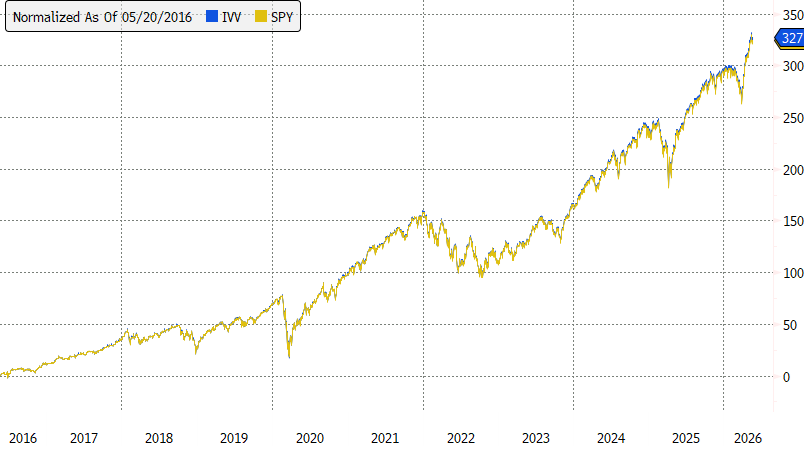
Image source: Bloomberg
Grantor Trusts
Not all ETF structures originate in the Investment Company Act of 1930, however. Several arise from the Securities Act of 1933, including the humble grantor trust.
Grantor trusts are, well, trusts in which the creator (grantor) retains owner control over the trust. These funds hold a non-managed, fixed pool of assets. While grantor trusts can create and redeem shares like any other ETF, little asset management within the ETF itself occurs, as grantor trusts generally don’t rebalance portfolios or trade securities.
Today, grantor trusts primarily are used for physically backed commodity ETFs, including precious metals funds like GLD or SLV. These metals funds hold physical bullion in secure bank vaults; to create or redeem shares, authorized participants deliver metal and cash to the issuer instead of stocks or bonds. Because no trading is involved, fund expenses mostly reflect the cost to store, insure, and secure bullion.
Likewise, grantor trusts have also found use among cryptocurrency ETFs, including bitcoin ETFs, like IBIT and GBTC, which store and secure crypto holdings in “cold storage.”
The major difference between grantor trusts and ’40 Act funds is their tax treatment. The IRS treats grantor trust shareholders as though they directly and proportionally own the underlying bullion. Gains therefore are taxed under collectibles rules, rather than standard securities rates. Long-term gains face a maximum tax rate of 28%, versus the current 20% long-term rate for open-end funds.
Commodity Pools
A commodity pool, as the name suggests, pools capital from multiple investors to buy derivatives, such as futures and options contracts. Technically, though, commodity pools are structured as limited partnerships, which has important consequences we’ll see in a minute.
Most commodity pools employ futures to gain exposure to commodities like oil or grains; USO is one of the best-known examples. Despite the name, however, commodity pools aren’t limited to only commodities. ETFs using this structure also track volatility (e.g., VIXY), currency (e.g., UUP), and even dry bulk freight shipping (e.g., BDRY).
Under the hood, commodity pools can be complex. Futures exposures require constant maintenance, since contracts expire and positions must be rolled into new contracts. Managers must also oversee the collateral backing those positions. All this portfolio management isn’t free, and typically commodity pools charge higher management fees than comparable open-end funds.
In addition, commodity pools possess significant tax drawbacks. Since commodity pools are limited partnerships, gains and losses pass directly through to shareholders, who receive Schedule K-1 forms at tax times rather 1099s. For many investors, the K-1 paperwork—and its tendency to arrive late during tax season—is one of the structure’s biggest disadvantages.
Another is that because futures positions are generally marked to market at year-end, investors can owe taxes on gains even if they never sold their ETF shares. Under current rules, 60% of those gains are taxed at the long-term rate and 40% at ordinary income rates, regardless of holding period.
ETNs
Exchange-traded notes (ETNs) occupy a strange corner of ETF Land, because they’re not really funds at all but unsecured debt obligations issued by a bank. Instead of holding a portfolio of securities, the issuer promises to pay shareholders the return of a specified index, minus fees.
Therefore, ETNs have no portfolio managers, nor do they hold any assets. The issuing bank manages whatever hedges are necessary to deliver the promised returns. Investors, meanwhile, are effectively unsecured creditors of the issuer.
The biggest risk with ETNs is counterparty risk. If the issuing bank fails, investors could lose their entire investment, regardless of what the underlying index did. That risk became painfully real during the 2008 financial crisis, when Lehman Brothers collapsed and its ETNs became worthless.
Still, the chances of bank default remain very low, and ETNs do offer some advantages over other structures. Because the issuer guarantees index performance directly, ETNs often exhibit minimal tracking error compared to products that must manage futures rolls or hard-to-trade securities.
ETN tax treatment is also more favorable than other ’33 Act funds. Under current IRS interpretations, ETNs are generally treated as prepaid forward contracts, meaning investors typically realize gains only after selling their shares. As a result, ETNs can provide commodity pool-like exposures, without the K-1 forms or annual gains taxation. For some commodities and currency strategies, that makes ETNs significantly more tax-efficient than competing futures-based ETFs.
“Wrap”-ing It Up
ETF structures are easy to ignore, but as we’ve seen, the wrapper does in fact matter. Legal structure can impact performance, cost, tracking error, counterparty risk—even the forms that show up during tax season.
None of this means one structure is universally superior, and in fact, alternative structures helped make modern ETFs possible. But what’s important to remember is that “ETF” is not a single, catch-all wrapper, but a delivery mechanism. Sometimes how the exposure is packaged matters just as much as the exposure itself.