

Defensive Equity Strategies for Yield-Seeking Investors
Income investors seeking equity exposure but concerned about market volatility may want to consider covered-call CEFs.

Diversifying sources of income can be an important strategy for enhancing yield and managing risk. Dividend-paying stocks are one way to diversify a fixed-income portfolio but may expose investors to more equity-market risk than they are comfortable with.
Income-oriented equity strategies, such as covered-call closed-end funds (CEFs), may address the need for higher income and equity exposure and are designed to reduce return volatility and downside risk.
Covered-Call Closed-End Funds: Expanding the Income Universe
Many investors find that traditional income sources, such as bonds and dividend-paying stocks, aren’t meeting their cash-flow needs. Closed-end funds may offer comparatively higher income, whether the funds invest in bonds, stocks or other types of securities. This is largely due to their structure and ability to employ leverage.
Unlike open-end funds, capital doesn’t flow freely into and out of closed-end funds after they’re launched; shareholders buy and sell their shares on an exchange, rather than transacting with the fund sponsor. For this reason, closed-end funds have a relatively stable asset base that enables them to pursue a wider array of investments and stay more fully invested than many other investment vehicles.
It also enables them to more easily employ leverage, which is used in an effort to enhance both returns and distributions. Regardless of whether or not they employ leverage, the primary objective of most closed-end funds is to provide shareholders a high level of regular income or distributions.
Covered-call closed-end funds provide the same potential benefits of equity closed-end funds but also seek to offer lower volatility and a measure of downside protection.
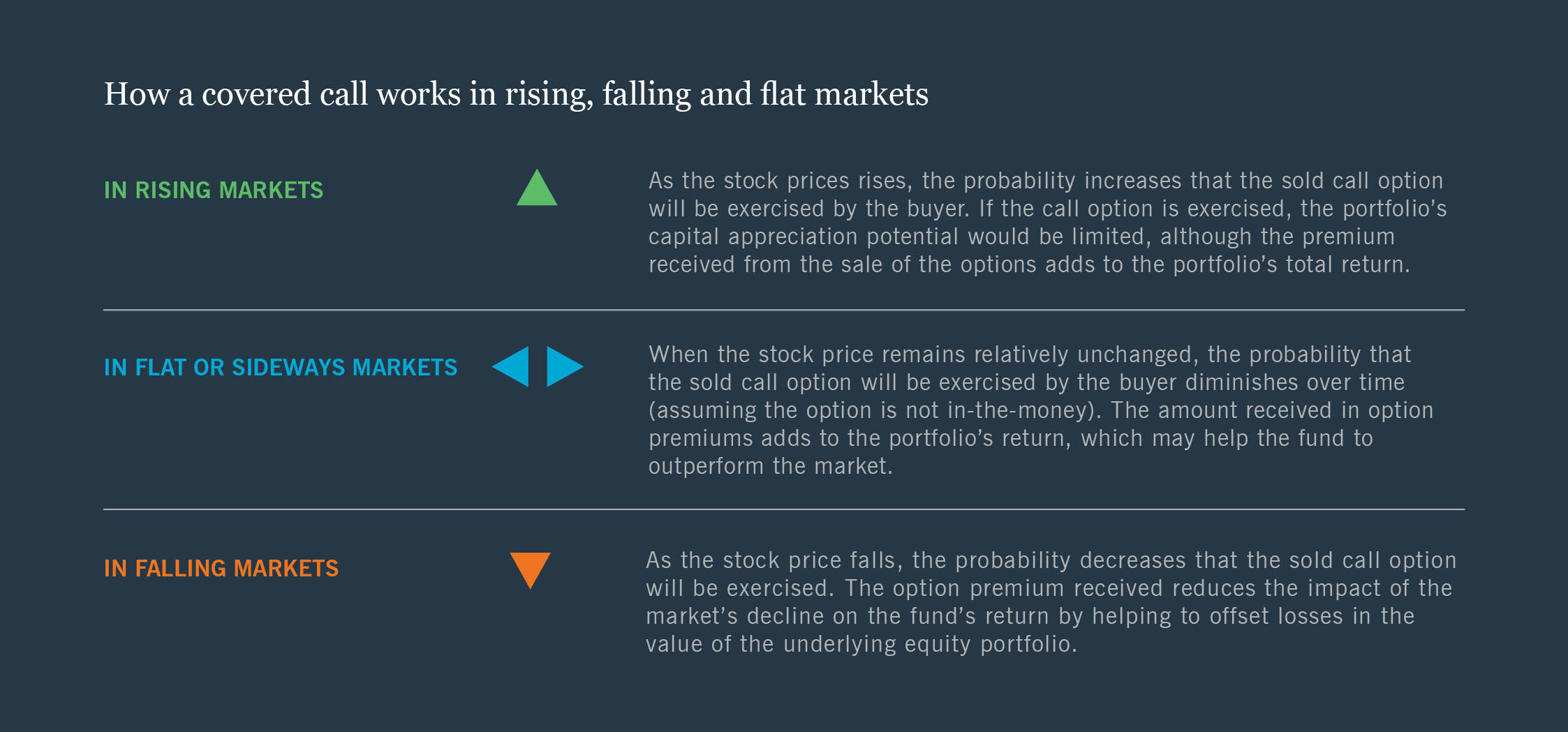
The funds combine a traditional equity portfolio with a call-option-selling program. The funds typically invest in a portfolio benchmarked to a popular equity index, such as the S&P 500 or Nasdaq-100, and then sell (or “write”) call options on all or a portion of that portfolio, collecting the premiums on the options sold.
The option premiums can act as a “buffer” in down markets, helping to offset the decline in the value of the fund’s equity portfolio and, therefore, reduce the overall portfolio’s return volatility. In exchange, the fund sacrifices some of the upside potential of the stocks held because, in a rising equity market, if the stock price rises above the option strike price (the price at which the option buyer can exercise the option and purchase the stock), the option would likely be exercised by the option buyer.
The Role of Active Management
Covered-call closed-end funds are typically actively managed strategies, with fund managers selecting and managing the underlying equity portfolio as well as the call-option strategy or “overlay”—a particularly complex process.
The fund may use options on individual stocks, baskets of stocks, a stock index or a combination of some or all of these.
It may employ a full overwrite strategy, selling options on the entire value of the underlying stock portfolio, which provides less exposure to equity-market performance and potentially less volatility, or it may use a dynamic overwrite strategy where options are sold on a varying portion of the underlying stock portfolio, providing greater market exposure and higher potential volatility than a full overwrite strategy.
Both strategies offer the potential for attractive distributions and diversification of a traditional income portfolio.
Explore Nuveen’s covered-call closed-end funds, and visit nuveen.com to learn more about CEFs.
When evaluating investment choices, investors should be aware that closed-end fund distribution sources have historically included net investment income, realized gains, and return of capital. It is important to understand these sources, and also the fund’s distribution rate relative to its NAV performance. The distribution rate should not be confused with yield or performance. You should not draw any conclusions about a fund’s past or future investment performance from its current distribution rate.
Important information on risk
Past performance is no guarantee of future results. All investments carry a certain degree of risk, including the possible loss of principal, and there is no assurance that an investment will provide positive performance over any period of time. Certain products and services may not be available to all entities or persons. There is no guarantee that investment objectives will be achieved.
Closed-end funds frequently trade at a discount from net asset value. At any point in time, including when sold, shares may be worth more or less than the purchase price or the net asset value, even after considering the reinvestment of fund distributions. It is important to consider the objectives, risks, charges and expenses of any fund before investing. For this and other information that should be read carefully, please view the prospectus or other current fund information provided by the fund’s sponsor.
Leverage typically magnifies the total return of a fund’s portfolio, whether that return is positive or negative, and creates an opportunity for increased common share net income as well as the possibility of higher volatility for the fund's net asset value, market price, distributions and returns. There is no assurance that a fund’s leveraging strategy will be successful.
This material is not intended to be a recommendation or investment advice, does not constitute a solicitation to buy, sell or hold a security or investment strategy and is not provided in a fiduciary capacity. The information provided does not take into account the specific objectives or circumstances of any particular investor, or suggest any specific course of action. Investment decisions should be made based on an investor's objectives and circumstances and in consultation with their financial advisors. Financial professionals should independently evaluate the risks associated with products or services and exercise independent judgment with respect to their clients.
Nuveen Securities, LLC, member FINRA and SIPC .