Free Cash Flow: A Guiding Light for Equities
Across markets and styles, high free cash flow businesses may provide a solid base for long-term portfolios.

Lance Humphrey, CFA & Michael Mack
Many investors have been unnerved by market volatility during the first half of 2025, thanks largely to all the uncertainty surrounding tariffs, geopolitical turmoil, and other factors. In this challenging environment, we think there is one overarching principle that can help investors manage volatility and identify companies positioned for success. Free cash flow (FCF) can be foundational for building durable stock portfolios, in our opinion.
Simply stated, FCF is the amount of cash a company is generating after paying all expenses incurred to fund operations. We think that companies with excess cash flow tend to be well positioned to grow their businesses or otherwise fund shareholder-friendly activities (such as stock buybacks, dividends, repaying debt etc.).
Why do we like FCF as a barometer? Companies with high free cash flow have more self-funding reliance, which is especially important given the current macro backdrop of higher interest rates and risk-averse lending. Also, companies rolling over expiring loans may find new terms less favorable, which can be troublesome for those that rely too heavily on debt to fund operations and growth. By contrast, companies with ample FCF should have an edge in terms of strategic flexibility.
FCF Across Investment Styles
Our research has shown that FCF has efficacy across many investment styles. In fact, one might argue that it can be used to build core equity allocations in both growth and value style boxes; for small- and large-cap equities; and for international equities as well. For evidence, the following graph shows how companies with high FCF yield (value)—which is a ratio that compares a company's free cash flow to its market capitalization—and FCF profitability (growth)—which is a ratio that compares how efficiently a company uses invested capital to generate FCF—have performed versus the broader market.
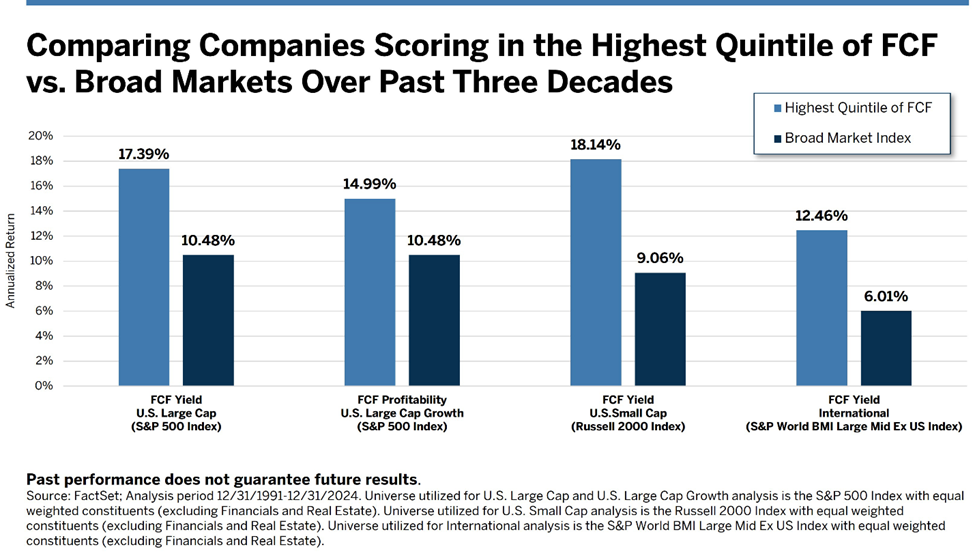
Importantly, we believe that investors should also consider a forward-looking measure of FCF, as opposed to relying solely on a historical measure of FCF, which has been an industry norm. That’s an important distinction. Looking both forward and backwards when analyzing FCF reveals a more complete picture, in our opinion.
When it comes to using FCF to help build an equities portfolio, we want to reiterate that we believe there’s no need to limit it to large-cap domestic equities. Plus, if market leadership continues to broaden out and move beyond a narrow cohort of mega-cap stocks, we think a diversified FCF approach could be especially effective. Thus, if historic and future FCF is a harbinger of company health and share price performance, why not consider applying it broadly in today’s environment?
All investing involves risk, including the potential loss of principal.
All information provided is for educational purposes only and does not constitute investment, legal or tax advice, an offer to buy or sell any security or insurance product; or an endorsement of any third party or such third party’s views. Whenever there are hyperlinks to third-party content, this information is intended to provide additional perspective and should not be construed as an endorsement of any services, products, guidance, individuals or points of view outside Victory Capital. All examples are hypothetical and for illustrative purposes only. You should obtain relevant and specific professional advice before making any investment or other decision. This material is based in part upon information from third-party sources that we believe to be reliable, but which has not been independently verified by us and, as such, we do not represent that the information is accurate or complete.
VictoryShares ETFs distributed by Victory Capital Services, Inc.
20250911-4776586