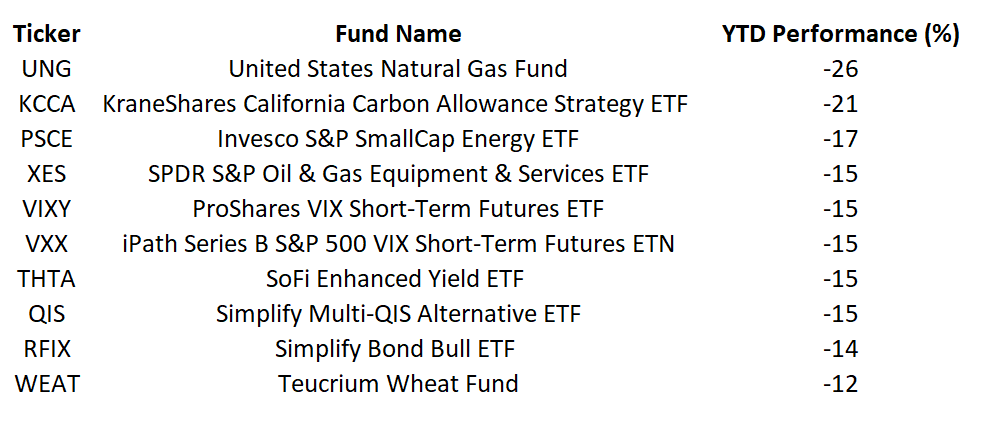
10 Worst Performing ETFs of 2025
From natural gas to the VIX, 2025’s biggest ETF losers span a wide range of markets.

In yesterday’s look at the year’s best-performing ETFs, one industry dominated: precious metals miners. Today’s list of the worst performers is the opposite; there’s no single trade driving the losses, just a grab bag of commodities, volatility, alternatives, and niche exposures that haven’t panned out in 2025.
The following list excludes leveraged, inverse, and single-stock ETFs.
Natural Gas Takes the Hardest Hit
At the bottom sits the United States Natural Gas Fund (UNG), down 26% year to date. U.S. natural gas prices recently touched nine-month lows below $3/MMBtu, erasing gains from a March rally that pushed prices to two-year highs.
That spike was fueled by a cold winter and strong LNG exports, but the market has since been weighed down by steady production growth—about 3% above last year—and inventories that sit 6% above the five-year average.
The extra daily production is roughly offsetting the increase in LNG exports, leaving the market balanced. As always in gas, weather is the wild card, as both summer cooling and winter heating can swing demand sharply.
California Carbon Credit Slump
The KraneShares California Carbon Allowance Strategy ETF (KCCA) is down 21% this year, bucking the gains seen in ETFs tied to European carbon allowances. California’s carbon market has been weighed down by weak auction demand and political uncertainty over whether its cap-and-trade program will be extended beyond 2030.
KCCA holds futures on credits from the program, which covers roughly 80% of the state’s greenhouse gas emissions.
Oil Equities Lose Steam
Two oil-equity ETFs make the list: the Invesco S&P SmallCap Energy ETF (PSCE), down 17%, and the SPDR S&P Oil & Gas Equipment & Services ETF (XES), down 15%. Crude oil saw a brief spike in June amid the Israel–Iran conflict, but prices quickly gave back those gains and now sit more than 10% lower year to date, weighing on producers and service firms alike.
Volatility’s Vanishing Act
It hasn’t been a calm year—April’s tariff-driven sell-off pushed the Cboe Volatility Index (VIX) above 50 for the first time since 2020—but markets have since surged. That’s left the ProShares VIX Short-Term Futures ETF (VIXY) and the iPath Series B S&P 500 VIX Short-Term Futures ETN (VXX) each down 15%.
The VIX now sits around 15, well below its 10-year average of 18.6, eroding returns for products designed to benefit from high volatility.
Yield and “Uncorrelated” Strategies Stumble
Some laggards this year aren’t tied to a single asset class so much as to the mechanics of their strategies.
The SoFi Enhanced Yield ETF (THTA), down 15%, uses credit spreads on equity indexes to boost income from its bond portfolio. That approach can deliver steady gains until markets move sharply against it, as they did in April’s sell-off, wiping out months of collected premiums.
The Simplify Multi-QIS Alternative ETF (QIS), also down 15%, seeks uncorrelated returns via a mix of quantitative strategies, but its 2025 path has looked surprisingly correlated. During April’s equity swoon, the ETF plunged even more than stocks and never recovered.
The Simplify Bond Bull ETF (RFIX), off 14%, is “functionally similar to owning a position in long-dated call options on U.S. Treasuries,” according to the issuer of the fund. Rising long-term rates this year have hit that bet hard, and option decay may be adding further drag.
Wheat’s Weak Year
Finally, the Teucrium Wheat Fund (WEAT) has dropped 12% as ample global wheat stocks have kept prices depressed, with no major supply shocks to offset the surplus.
For a full list of the 10 best performing ETFs of 2025, see the table below.