



This Skyrocketing ETF Is Still Flying Under the Radar
BWET keeps soaring, but investors are betting on oil instead.

The best-performing ETF of the year is still barely on anyone’s radar.
I wrote about the Breakwave Tanker Shipping ETF (BWET) on March 4, about a week after the U.S./Israel conflict with Iran began. At the time, it had already surged 243% year to date, making it the top-performing ETF of 2026.
Since then, it’s gone even higher. BWET is now up 352% on the year, and yet, almost no one seems interested.
Big Returns, Little Interest
Despite the eye-popping performance, inflows have been minimal. The fund has pulled in just $5 million year to date and has actually seen $1 million of outflows over the past month.
Total assets stand at around $20 million. That’s up from roughly $2 million at the start of the year, but it’s still tiny given the performance.
Part of the reason may be complexity. BWET holds tanker freight futures, or derivatives tied to the cost of shipping crude oil by sea. Those rates can spike when geopolitical risks disrupt key routes.
That’s exactly what’s happened this year, as threats to shipping through the Strait of Hormuz have disrupted traffic and pushed freight rates sharply higher. But unlike oil, the relationship isn’t straightforward.
If shipping becomes more dangerous but crude is still moving, rates can surge as operators demand higher compensation. Similarly, if barrels are rerouted onto much longer voyages, that can tie up ships for longer and push rates higher.
On the other hand, if disruptions become severe enough that actual volumes collapse, that can hurt freight rates.
So it’s a more conditional trade, with multiple moving pieces rather than a single clear driver.
Investors Prefer The Simple Trade
Compare that to oil. If the Strait of Hormuz is disrupted, the logic is straightforward. Supply goes down, so prices should rise.
That’s likely why investors have gravitated toward oil ETFs instead.
The United States Brent Oil Fund (BNO) has seen nearly $200 million of inflows over the past month and $436 million year to date, while the United States Oil Fund (USO) has pulled in $470 million over the past month and $580 million on the year.
Both funds have delivered strong returns as well, with BNO up about 86% this year and USO up roughly 78%. That’s still far short of BWET’s 350%+ gain, but it's still stellar. 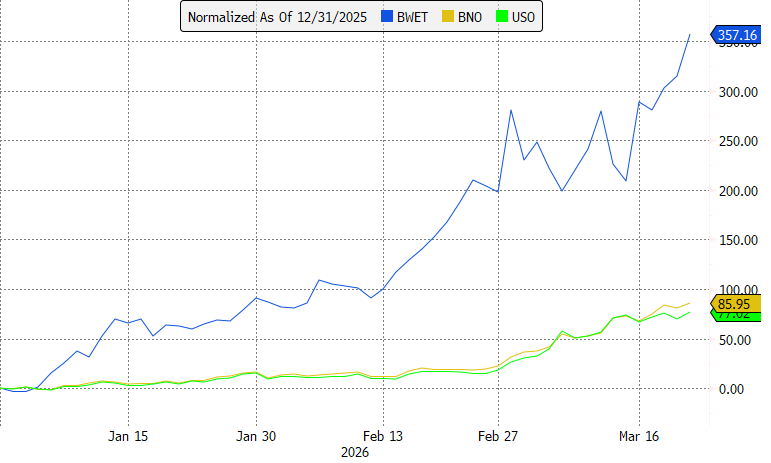
Together, the two funds manage about $3 billion, orders of magnitude more than BWET.
High Fees And Mean Reversion
There are other factors to consider too. BWET charges a steep 3.5% expense ratio, which is a tough sell for anything beyond a short-term trade.
And then there’s the nature of shipping markets themselves. Freight rates are notoriously volatile and tend to mean revert once disruptions ease. We saw that clearly with dry bulk shipping during the pandemic, when rates—and the Breakwave Dry Bulk Shipping ETF (BDRY)—surged, only to give back those gains quickly.
That dynamic makes BWET feel less like an investment and more like a trading vehicle.
To be sure, oil ETFs themselves aren’t necessarily long-term buy and hold instruments either. But the trade is far more straightforward.


