



After 11 Quiet Years, CRAK Is Finally Having Its Moment
The VanEck Oil Refiners ETF has quadrupled its assets this year as crack spreads hit records.

An 11-year-old energy ETF that spent most of its life as an afterthought is suddenly one of 2026's standout performers.
The VanEck Oil Refiners ETF (CRAK) recently hit an all-time high in assets under management. The fund holds roughly $172 million, up from $38 million at the start of the year. Its previous high water mark was around $73 million back in 2018, a level it never revisited until this year.
The jump has come from both sides of the ledger. Investors have poured about $102 million of fresh money into CRAK in 2026, while the ETF is up roughly 40% year to date, well ahead of the 29% gain for the Energy Select Sector SPDR Fund (XLE), the sector's dominant ETF.
CRAK, which charges 0.94% before a fee waiver that brings the net expense ratio down to 0.61%, holds a basket of 31 oil refiners. That includes the U.S. refining giants, Marathon Petroleum, Valero and Phillips 66, alongside international names like Reliance Industries, Neste Oyj and Orlen SA.
What it doesn't hold is the integrated majors. Exxon Mobil and Chevron both run large refining businesses, but those segments sit inside companies whose earnings and share prices are also driven by upstream production.
The Refining Business
Refiners make money on the spread between what they pay for crude and what they get for the refined products they sell, like gasoline, diesel and jet fuel.
That spread has gone vertical this year. The NYMEX 3-2-1 crack spread, which approximates the margin a refinery earns turning three barrels of crude into two barrels of gasoline and one of distillate, hit a record above $69/barrel this week. 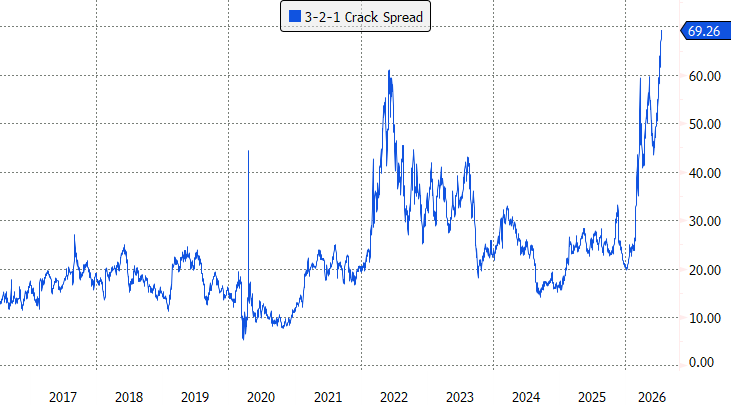
The previous record was set in the fall of 2022, when buyers were scrambling to replace Russian fuel after the invasion of Ukraine. From 2010 through 2021, the same spread averaged $19.
Crude Reverses
Interestingly, the price of crude oil has been going the other way. The outlook for supply has improved as the on-again, off-again truce between the U.S. and Iran has held well enough to reopen the Strait of Hormuz to some extent, and as a result, crude prices have come well off their highs. 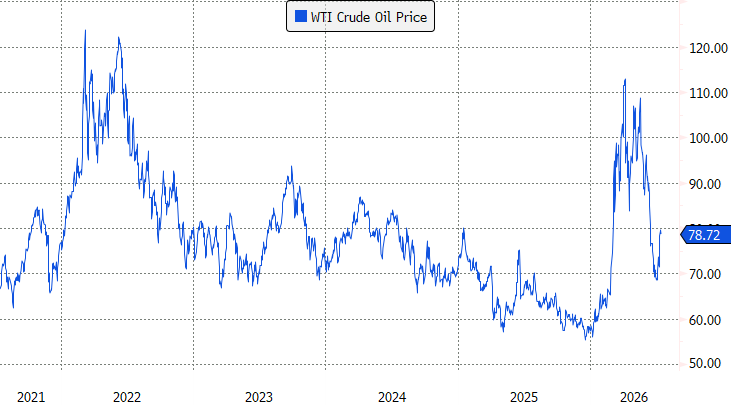
For most of the energy sector, cheaper crude is a headwind. For refiners, it can be a positive, especially when product prices stay elevated the way they have this year.
Products have stayed expensive as exports out of the Gulf remain tight. Additionally, Russia, which supplies roughly a tenth of the world's diesel, suspended diesel exports to deal with a domestic fuel crunch caused by a sustained campaign of Ukrainian drone strikes on its refineries.
The Outlook
The big question, of course, is whether this lasts. While refining stocks are outperforming in 2026, over the past five years, XLE has done better, with a gain of 191% against 138% for CRAK.
Go back to CRAK's inception in August 2015 and the gap flips back, with the refiner fund up 262% versus 155% for XLE. 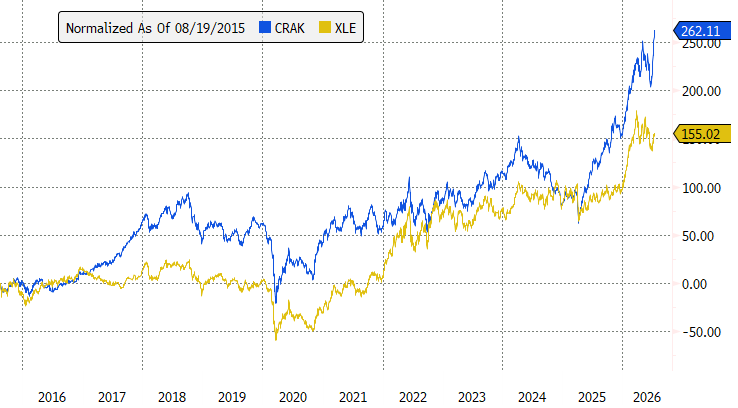
In terms of valuation, Marathon, Phillips 66 and Valero trade at low double-digit forward P/Es, roughly 10 to 12 times, against mid-teens multiples for the integrated majors like Exxon and Chevron that dominate XLE.
The relative performance from here will come down to a lot of unknowns: how fast Russian capacity comes back, whether the Middle East stays calm, and how quickly refiners can rebuild fuel inventories that have been drawn to generational lows.
None of that is forecastable with any confidence. In any case, for now, CRAK is having the best year of its life.


