Bond ETFs Hit as Oil Spike Sends Yields Higher
Rising oil prices and central bank caution pushed yields higher, weighing on bond ETFs, particularly at the short end.

Bond yields moved higher this week as surging oil prices and hawkish central bank commentary pushed investors to reconsider the outlook for interest rates.
Brent crude jumped as high as $119 per barrel overnight, its highest level since 2022 and nearly double where it started the year.
The move comes amid escalating geopolitical tensions in the Middle East. Iran launched attacks on energy facilities in neighboring Gulf countries, and Qatar said damage to its gas infrastructure could knock out roughly 17% of supply for three to five years. Qatar is the world’s second largest exporter of liquefied natural gas.
Europe and Asia, which rely heavily on imported energy, are particularly exposed. The U.S. is less affected on the natural gas side given its largely domestic market, but it is still exposed to higher global oil prices.
Central Banks Turn More Cautious
The surge in energy prices has quickly fed into central bank messaging.
The European Central Bank and Bank of England both left rates unchanged on Thursday but highlighted rising energy costs as a growing concern. Their comments echoed those of the U.S. Federal Reserve, which also held rates steady on Wednesday.
In its statement, the Bank of England said it would continue to monitor developments in the Middle East and their impact on energy prices, noting that a more persistent shock could require tighter policy.
Federal Reserve Chair Jerome Powell struck a similar tone, saying higher energy prices would likely push up inflation in the near term, though the broader economic impact remains uncertain.
The Fed’s updated projections reinforced that view. Officials raised their core PCE inflation forecast to 2.7% for 2026 and 2.2% for 2027, both slightly higher than previous estimates.
Short Term Yields Lead The Move
The reaction in bond markets was most pronounced at the short end of the curve.
On Thursday, U.K. two year yields surged as much as 40 basis points to 4.49%, their highest level since early 2025, while U.S. two year yields climbed as much as 18 basis points to 3.95%, their highest level since last July. They have since pared some of those gains to trade around 3.83%.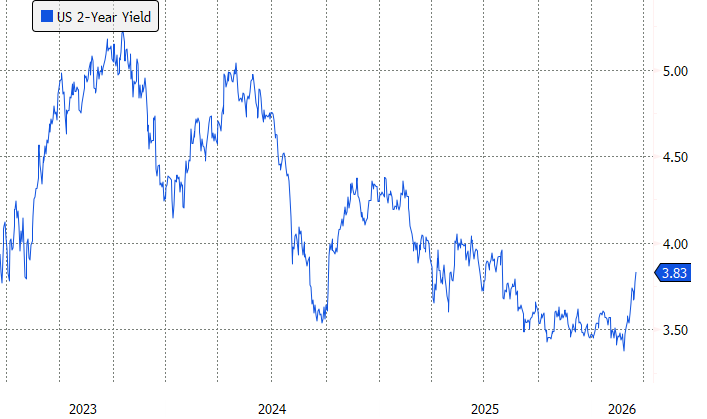
The smaller move in U.S. yields may reflect differences in central bank mandates. While the Fed balances inflation and employment, both the ECB and Bank of England place primary emphasis on price stability.
The more direct exposure of Europe to energy shocks likely also played a role. The region is more directly exposed to rising energy costs, particularly in natural gas markets.
Still, the shift in expectations has been significant. Futures markets are now pricing in no rate cuts from the Fed this year, compared with expectations for one cut before the latest meeting and two cuts earlier in the month.
Long Term Yields Remain Contained
Longer dated yields have been more stable.
The 10 year Treasury yield was little changed on Thursday at around 4.26%. That level is near the upper end of its recent six month range and up from roughly 3.95% in February, but still well below its 2025 high of 4.79%.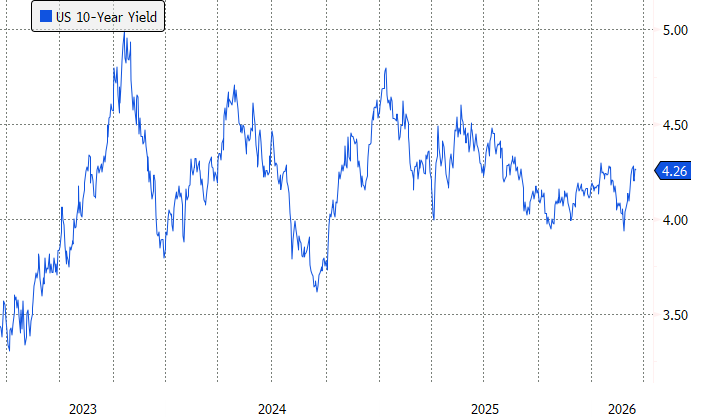
In other words, bond markets are reacting to the energy shock, but not in a dramatic way. The move looks more like a repricing of short term expectations than a wholesale shift across the curve.
Bond ETFs Reflect The Shift
Returns for bond ETFs mirror that pattern.
The iShares 1-3 Year Treasury Bond ETF (SHY) and iShares 7-10 Year Treasury Bond ETF (IEF) are both roughly flat for the year. The iShares 20+ Year Treasury Bond ETF (TLT) is still holding onto a gain of about 1%.
The relatively muted performance highlights how contained the move in longer term yields has been, even as short term rates have adjusted higher.
That said, the outlook from here remains uncertain.
Higher energy prices are pushing inflation expectations higher and forcing central banks to stay cautious. At the same time, the broader economy is showing signs of slowing, with labor market growth flattening in the U.S.
That push and pull between inflation and growth is leaving bond markets in a delicate position.
For now, yields have moved toward the upper end of their recent ranges, particularly at the short end. But in the U.S. at least, the reaction has been measured rather than extreme.
Whether that changes will likely depend on how long energy prices remain elevated and how the broader economic picture evolves.