

Bond ETFs Stumble as Rate Cut Hopes Fade and Policy Risks Mount
Fresh geopolitical and policy tensions are weighing on bond ETFs

Bond ETFs are getting off to a rocky start in 2026 as expectations for Federal Reserve rate cuts give way to renewed geopolitical and policy-related uncertainty.
Since the start of the year, the yield on the 10-year Treasury has risen from 4.17% to 4.27%, its highest level in roughly five months. The 30-year yield has moved higher as well, climbing from 4.81% to 4.91% (bond yields and prices move inversely). 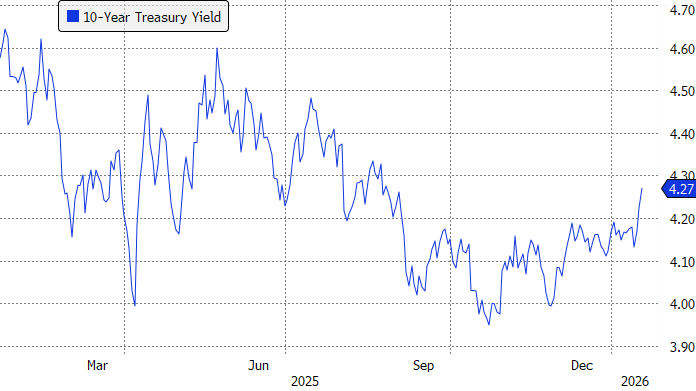
Late last year, the Fed cut rates three times, for a total of 75 basis points, helping support Treasuries and other fixed-income assets. The federal funds rate currently sits in a range of 3.50% to 3.75%. But futures markets now suggest the central bank is likely to hold off on additional cuts until at least the summer, removing a key tailwind for bonds.
Policy and Geopolitics Take Center Stage
With near-term rate cuts looking less likely, investors have shifted their focus to broader policy and geopolitical risks. Concerns around the independence of the Federal Reserve resurfaced recently after the Department of Justice threatened potential charges against Fed Chair Jerome Powell, likely in retaliation for his refusal to cut interest rates as quickly as President Trump had been pushing for.
Over the weekend, President Trump threatened new tariffs on Europe, linking trade policy to his attempt to pressure allies into backing a takeover of Greenland.
Taken together, these developments have weighed on confidence in U.S. assets, particularly Treasuries, which play a central role as global safe-haven instruments for both investors and governments.
The "Sell America" Trade
So far this year, the iShares 20+ Year Treasury Bond ETF (TLT) is down about 0.4%, after being up as much as 1.3% just last week. The iShares 7–10 Year Treasury Bond ETF (IEF) has fallen roughly 0.5% year to date.
Funds focused on the short end of the yield curve have held up better. With a closer link to the fed funds rate, shorter-term yields have been more stable, limiting price declines. The iShares 1–3 Year Treasury Bond ETF (SHY) is essentially flat for the year.
Some market participants have described the recent move as part of a broader “sell America” trade. U.S. equities also declined on Monday, though stocks are coming off a stellar 2025 and remain modestly higher so far in 2026.
The U.S. dollar has shown signs of stress as well. The U.S. Dollar Index fell just under 1% for its worst single-day decline since last April, when President Trump unveiled sweeping “Liberation Day” tariffs that rattled markets and undermined confidence in U.S. policy. The Invesco DB US Dollar Index Bullish Fund (UUP) is clinging to a gain of about 0.5% this year, after falling roughly 5% in 2025.
For now, bond investors appear caught between fading hopes for near-term Fed support and rising uncertainty around U.S. economic and political stability.