Copper’s Breakout Is Fueling a Surge Into COPX
Copper’s rally to record highs is driving massive inflows into the Global X Copper Miners ETF (COPX).

The Global X Copper Miners ETF (COPX) has quietly become one of the biggest asset-gatherers of 2026.
The fund has pulled in roughly $1.7 billion in net inflows this year, pushing assets under management to about $7.5 billion. That’s about four times what investors had in the fund six months ago.
Performance has helped.
After spending much of its first decade and a half going nowhere, COPX has exploded higher. From its April 2010 launch through April 2025, the fund delivered a cumulative total return of just 13%. Over the past eight months alone, it has surged roughly 142%.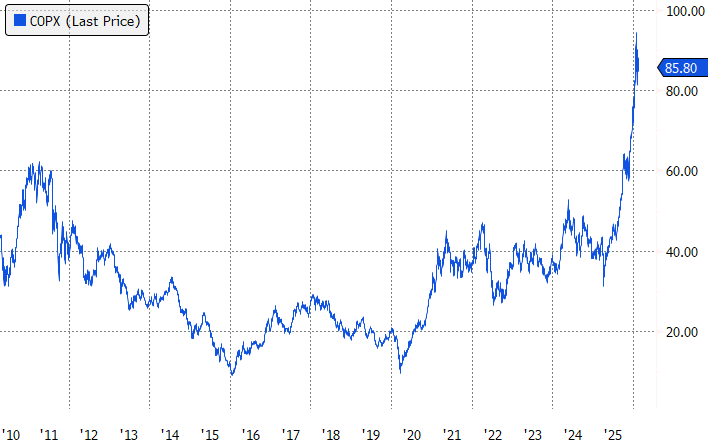
The move largely mirrors copper itself.
The benchmark London Metal Exchange three-month contract peaked just above $10,000 per metric ton in 2011. It failed to decisively break above that level for more than a decade. Late last year, it finally did. Copper is now trading near $13,000 per ton.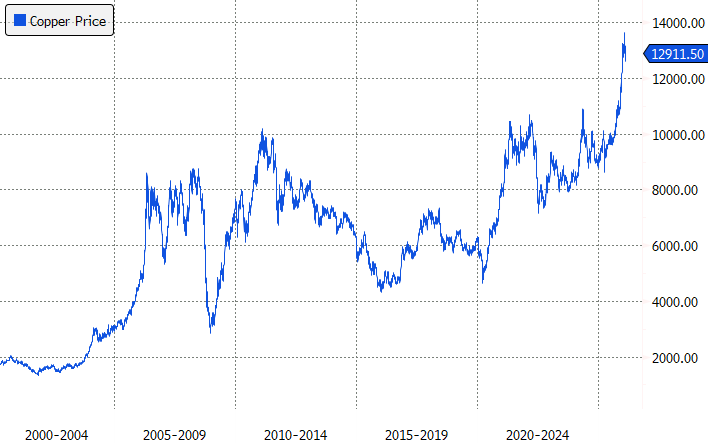
That breakout has ignited a debate about whether copper is entering a structural bull market or simply experiencing a cyclical spike.
The Bull Case
The bull case for copper has been building for years.
At its core is electrification. As more of the global economy runs on electricity instead of fossil fuels, and as electric vehicles, renewables and AI data centers prove more copper-intensive than legacy systems, demand for the metal rises. S&P Global recently projected that global copper demand could increase 50% by 2040.
On the supply side, the industry faces constraints. It takes an average of 17 years to bring a new copper mine from discovery to production. According to S&P Global, global copper production could peak around 2030 at roughly 33 million metric tons.
Without substantial new investment, demand could outpace supply by as much as 10 million metric tons by 2040. If that scenario unfolds, copper prices could move significantly higher.
The Bear Case
Not everyone is convinced that copper is set to spike.
Goldman Sachs recently argued that record-high copper prices are unlikely to be sustained. The firm believes part of the recent rally has been driven by uncertainty around potential U.S. refined copper tariffs, which has encouraged stockpiling.
If clarity emerges around those tariffs, Goldman expects that stockpiling to slow, removing a key source of near-term support.
More broadly, Goldman points to what it sees as an underlying global surplus. The firm estimates the copper market ran a 600 kilotonne surplus in 2025, the largest since 2009, and projects continued excess supply into 2026.
Rising scrap supply and softer demand growth, particularly in China, could keep the market well supplied.
In that view, copper’s recent surge reflects temporary tightness and speculative positioning rather than structural scarcity.
Bulls in Control, For Now
For now, the bulls are winning, and that has been a powerful tailwind for COPX.
But it is worth remembering that for most of the past 15 years, the bears controlled the narrative. Copper repeatedly failed to sustain breakouts above prior highs, and copper miners performed poorly.
If copper continues to hold above its long-standing ceiling, COPX could benefit from renewed confidence in the electrification thesis.
But if prices roll over, sentiment and flows could shift quickly.