



SMH vs. SOXX: Two Ways to Play the AI Chip Boom
Two of the biggest semiconductor ETFs have become popular ways to invest in the AI boom. Here’s how SMH and SOXX differ in construction, concentration and performance.

Investors looking to tap into the artificial intelligence boom have increasingly gravitated toward semiconductor ETFs.
That trend makes sense. The companies seeing the biggest gains from AI so far have largely been those supplying the hardware used in AI infrastructure. Data centers around the world are expanding rapidly to train and run AI models, and semiconductor firms sit at the center of that buildout.
In a recent piece, I argued that much of the economic value created by AI has so far flowed to these companies. Model companies such as OpenAI and Anthropic have also benefited enormously, but they are private and not accessible to public market investors.
As a result, semiconductor ETFs have effectively become the closest thing to AI ETFs on the market.
Two funds dominate the space. The $43 billion VanEck Semiconductor ETF (SMH) and the $21 billion iShares Semiconductor ETF (SOXX).
Both funds provide exposure to the same industry, but the way their underlying indexes are constructed leads to meaningful differences in concentration and performance.
A More Concentrated ETF
SMH tracks the MVIS US Listed Semiconductor 25 Index, which includes the 25 largest and most liquid US listed semiconductor companies. To qualify for inclusion, companies must generate at least half of their revenue from semiconductors or semiconductor equipment, which ensures the index remains tightly focused on the industry.
The index uses a modified market capitalization weighting system that allows the largest companies to dominate the portfolio while imposing a cap on individual holdings.
Weights are limited to 20% per company.
Even with that limit, the portfolio remains highly concentrated. Nvidia, whose market capitalization is around $4.5 trillion, has frequently sat near the cap during the AI boom.
Taiwan Semiconductor, the world’s leading chip manufacturer with a market value of roughly $1.5 trillion, currently holds the second largest weight at about 11%. Broadcom and Micron Technology follow with positions above 7%.
The result is a portfolio that leans heavily into the biggest players in the AI hardware ecosystem.
SOXX Spreads Its Bets
SOXX takes a different approach.
The fund tracks the NYSE Semiconductor Index, which holds 30 US listed semiconductor companies. Like SMH’s index, it is based on modified market capitalization, but it applies much stricter limits to individual positions.
No company is allowed to exceed an 8% weight. Constituents outside the five largest holdings are capped at 4%. The index also limits the combined weight of ADRs to 10%.
Those rules produce a much more evenly distributed portfolio.
Micron currently sits near 9.5%, slightly above its cap between rebalancing periods. Nvidia carries a weight of around 7%, while Applied Materials and AMD are each close to 6%.
Because of the caps, companies with vastly different market values can end up with similar portfolio weights. Applied Materials and AMD, each worth roughly $300 billion, have weights comparable to Nvidia even though Nvidia’s market capitalization is more than fifteen times larger.
Taiwan Semiconductor also ends up with a relatively small allocation. Despite its $1.5 trillion market value, the company carries only about a 4% weight in the index because of the ADR limits.
Large Performance Gap
For many years, the two ETFs performed similarly.
From December 2011 through November 30, 2022, the day ChatGPT was released, SMH gained 781% while SOXX rose 811%.
The difference was relatively modest.
Once generative AI took off, however, the gap widened significantly.
Nvidia’s meteoric rise pushed SMH well ahead. Since inception in 2011, SMH is now up roughly 3,048% compared with about 2,359% for SOXX.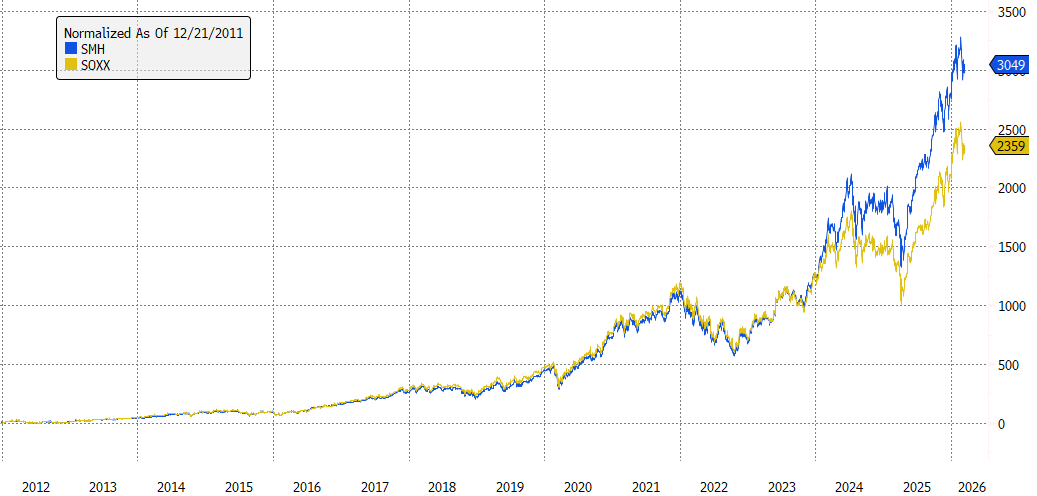
The performance divergence reflects SMH’s heavier concentration in the industry’s largest winners.
Investors have taken notice. Over the past year, SMH has attracted about $7.3 billion in inflows while SOXX has gathered roughly $1.9 billion.
Fees are nearly identical. SMH charges 0.35% while SOXX costs 0.34%.
The larger flows into SMH suggest many investors are comfortable leaning more heavily into the industry’s biggest companies, particularly Nvidia.
Ultimately, the choice between the two funds comes down to portfolio construction. SMH offers a more concentrated bet on the semiconductor giants driving the AI boom. SOXX puts greater limits on the influence of any single company.
Investors concerned about concentration, especially in Nvidia, may prefer the structure of SOXX. But SMH’s willingness to let the largest companies dominate the portfolio has also been the key reason for its stronger performance and larger asset base.


