ETFs Fluctuate as Ford Tumbles; Airlines Soar on Earnings


- • News

Healthcare, Transportation Sectors Are Mixed Amid Varying Q2 Results
ETFs experienced mixed performance Thursday as various sectors reacted to second-quarter earnings reports.
First Trust Nasdaq Transportation ETF (FTXR), holding 8.6% of Ford Motors, fell 0.6%, while Invesco S&P Ultra Dividend Revenue ETF (RDIV), holding 8.6% of Ford, rose 0.3%. This came after Ford shares plummeted 18%, heading for their worst day since 2008 after second-quarter earnings came in far below analysts’ expectations.
U.S. Global Jets ETF (JETS) climbed 3%, benefitting from its 9.6% stake in American Airlines, whose shares rose 5% after beating second-quarter earnings estimates. JETS also holds 10% in Southwest Airlines, which saw a 6.1% increase following better-than-expected second quarter results.
The Pinnacle Focused Opportunities ETF (FCUS) rose 1.2% boosted by its 4% holding in Viking Therapeutics. Viking’s shares surged 29% following the announcement that its experimental obesity treatment will advance to a phase 3 clinical trial. The company also revealed plans for phase 2 trials of an oral version of the drug in the fourth quarter.
The IShares U.S. Medical Devices ETF (IHI) dropped 3%, partly due to its 4.4% holding in Edwards Lifesciences. Edwards’ stock fell 31% after the medical-technologies company reduced its full-year sales guidance for transcatheter aortic valve replacements.

Small-caps lead equities higher after VOO’s worst day in nearly two years.
Equity ETFs rose, reversing earlier declines, as small-cap stocks surged after a government report showed the U.S. economy rose faster than expected in the second quarter.
The iShares Russell 2000 ETF (IWM), which holds smaller public companies like Insmed Inc. and Sprouts Farmers Market Inc., jumped 2.5% in trading shortly after noon. The fund has gained 11% since July 9 as investors sold tech-heavy funds like the Invesco QQQ Trust (QQQ), which has dropped 6.3% over that same period, and today inched up less than a full percent.
Stock markets initially dropped after the U.S. Commerce Department said second-quarter gross domestic product rose 2.8%, hotter than the expected 2.1%, and accelerating from the first quarter’s 1.4%.
Investors appeared to shrug off concerns that a hoped-for interest rate cut would be pushed further into the future; expectations for a September cut have declined to 90% from 94% a week ago, according to the CME Group’s Fed Watch tool.
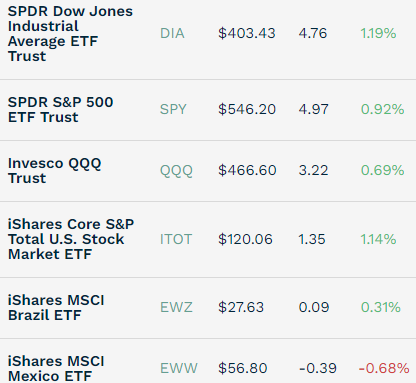
The Vanguard S&P 500 ETF (VOO), the third-largest ETF, added 1.1%, reversing early declines. Crypto ETFs slipped, along with gold and silver.

Rotation Continues Following GDP, Jobless Claims
Markets were mixed this morning as investors considered faster economic growth combined with slower personal income and savings revealed in today's release of Q2 GDP.
Early beneficiaries of the new economic data were real estate, small caps and Treasuries, as the Vanguard Real Estate Index Fund ETF Shares (VNQ), the iShares Russell 2000 ETF (IWM), and the iShares 20+ Year Treasury Bond ETF (TLT) were all up 1% or more in morning trading.
The broader market, as measured by the SPDR S&P 500 ETF Trust (SPY), was down 0.5%.
Q2 U.S. Gross Domestic Product rose at an annual rate of 2.8%, compared to 2.0% expected, and markedly higher than the 1.4% increase in Q1.
The acceleration in real GDP primarily reflected increases in consumer spending, private inventory investment, and non-residential fixed investment, according to today's report released by the U.S. Bureau of Economic Analysis.
Real disposable personal income rose 1.0% in Q2, slowing from the 1.3% rate in Q1. Personal saving rate was 3.5%, declining from 3.8% in Q1.
Related Stories



Related Media