



Hormuz Is Closed. Why Is Oil Only at a Nine-Month High?
The world's most important oil chokepoint is shut down, but the market's muted response says more than the spike itself.

Roughly 20 million barrels per day, or about 20% of global oil production, normally pass through the Strait of Hormuz. With the waterway effectively closed amid escalating conflict between Iran and the United States, crude prices jumped and energy stocks rallied on Monday—unsurprisingly.
The Energy Select Sector SPDR Fund (XLE) extended its gains for 2026 to 27.6% after rising 2%, making it far and away the best-performing stock market sector of the year and far outpacing the S&P 500's roughly 0.7% gain.
Meanwhile, front-month Brent oil prices jumped 7.8% to $78, a move that puts oil back to…where it was less than nine months ago.
Read that again: one of the most strategically important chokepoints in the world is shut, and oil is sitting at only a nine-month high.
That tells you something about how soft the oil market had been coming into this event.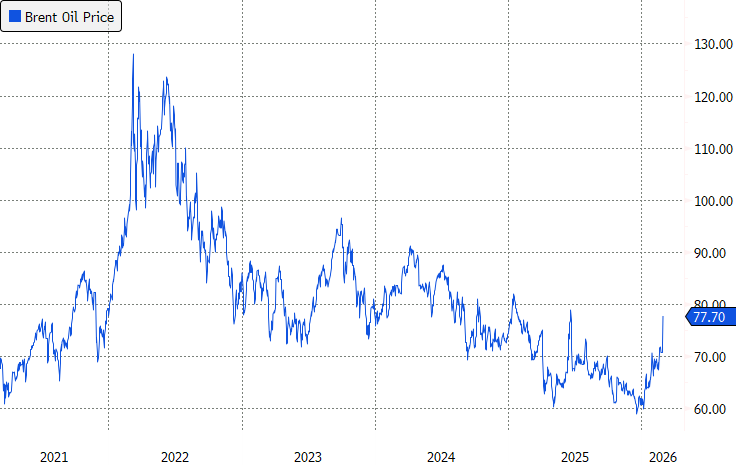
A Market That Was Already Well Supplied
In its latest Oil Market Report, the International Energy Agency projected global oil supply would rise by 2.4 million barrels per day this year, far exceeding the expected 850,000 barrel-per-day increase in demand.
That imbalance comes after global oil inventories swelled by 477 million barrels in 2025, or about 1.3 million barrels per day.
Supply growth has been robust, while demand growth has been tepid as the ongoing shift toward electrification weighs on consumption.
That's the backdrop for the current spike.
The Duration Question
None of that means the disruption is trivial. If Gulf producers can't ship crude, the supply overhang can shrink quickly. In the short term, they can store output in inventory, but there's a limit, and eventually, production itself has to be curtailed.
A quick resolution, on the other hand, would reopen the artery and refocus attention on the underlying surplus.
In other words, where oil goes from here likely depends on how long the Strait stays closed. A prolonged shutdown means tightening supply and potentially much higher prices. A rapid de-escalation puts the oversupplied fundamentals back in the driver's seat.
ETFs Reflect the Surge
Oil-focused ETFs have climbed sharply. The United States Brent Oil Fund (BNO) is up 31.9% year to date, outpacing the 28.5% gain in Brent futures themselves.
That outperformance comes from backwardation. When front-month crude trades above later-dated contracts, funds that roll futures can effectively sell high and buy low, picking up positive roll yield along the way.
That tailwind doesn't always exist. In contango, the dynamic reverses and can drag on performance.
Oil Stocks vs. Oil Itself
Over longer periods, energy stocks have generally been the more lucrative way to express a bullish oil view.
Companies can generate profits even in flat price environments. An oil ETF tied directly to futures relies almost entirely on the direction of crude and the shape of the futures curve.
That distinction matters, especially in an environment like this. If oil spikes and then settles back into a range, producers may still benefit. A futures-based ETF may not.
For now, the market is balancing two opposing forces: a dramatic geopolitical shock and a market that, until very recently, was swimming in supply.


