



Semiconductor ETFs Have Never Had a Run Like This
The iShares Semiconductor ETF has gained 42% in 17 trading days, its longest winning streak on record.

Semiconductor stocks are in the midst of a record-breaking rally.
The iShares Semiconductor ETF (SOXX) has risen for 17 consecutive trading days, climbing from a low of $309.79 on March 30 to $441 at the close on April 23, 2026.
That's a 42% gain in just under four weeks, without a single down day along the way. SOXX is now up 46.5% year to date and 156% over the past year.
The fund, which has just under $29 billion in assets under management, has been around since 2001 and tracks the NYSE Semiconductor Index. Its previous longest winning streak was 15 trading days in May and June of 2014, but that rally only produced a gain of about 8%. The current streak has delivered more than five times that in just two additional days.
SMH Nearly Matched It
SOXX is the second-largest semiconductor ETF, trailing only the $55 billion VanEck Semiconductor ETF (SMH).
The two funds usually move in lockstep, and they have during this rally as well. SMH is up 33% since March 30, and its own winning streak reached 13 days before a 0.04% decline on April 20 broke it. Without that small dip, SMH would have posted an identical streak.
Still, despite moving in the same direction, when it comes to returns, the two funds have diverged meaningfully this year. SOXX is up 46.5% year to date versus 33.8% for SMH, a noticeable reversal after a long stretch where SMH was the clear winner.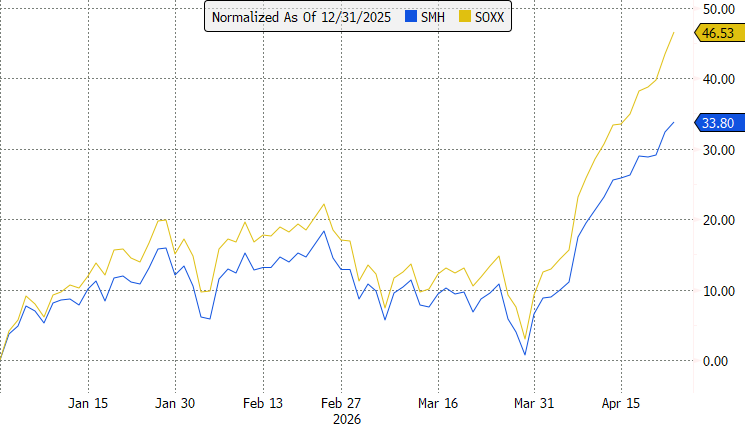
Two Different Approaches to the Same Industry
The divergence comes down to how the two funds are built.
SMH tracks the MVIS US Listed Semiconductor 25 Index, which includes the 25 largest and most liquid U.S.-listed semiconductor companies. To qualify, firms must derive at least half of their revenue from semiconductors or semiconductor equipment, keeping the portfolio tightly focused on the industry.
The index uses a modified market-cap weighting approach, capping individual holdings at 20%. Even with that cap, the fund is heavily concentrated.
Nvidia, with a market capitalization of around $4.8 trillion, has frequently sat near the maximum weight. Taiwan Semiconductor, the world's leading chip manufacturer and a $1.7 trillion company, currently holds the second-largest weight at about 11%. Broadcom accounts for 9%, while Advanced Micro Devices sits at just under 6%.
The result is a portfolio tilted heavily toward the biggest players in the semiconductor ecosystem.
On the other hand, SOXX takes a more balanced approach. It tracks the NYSE Semiconductor Index, which holds 30 U.S.-listed semiconductor companies and applies much stricter position limits.
No company can exceed an 8% weight, constituents outside the top five are capped at 4%, and the combined weight of ADRs is limited to 10%.
Those constraints produce a more evenly distributed portfolio. Broadcom currently sits near 9%, slightly above its cap between rebalancing periods. Micron Technology follows with an 8% weight.
Nvidia accounts for around 7%, while AMD and Marvell Technology make up 7% and 6% of the portfolio, respectively.
AMD has a market cap of around $500 billion, while Marvell is worth just $143 billion, yet they end up with weights comparable to Nvidia, whose market capitalization is significantly larger.
Taiwan Semiconductor is also significantly underweight in the ETF relative to its size. Despite its $1.7 trillion market value, the stock accounts for only about 3% of the index.
A Decade of Parity, Then a Split
For many years, SOXX and SMH performed similarly. From December 2011 through November 30, 2022, the day ChatGPT was released, SMH gained 781% while SOXX rose 811%.
However, once generative AI took off, that changed. Nvidia became the single biggest driver of semiconductor returns, and SMH's heavy weighting paid off in a way SOXX's construction couldn't match. The gap between the two funds widened sharply over the following years.
The current rally is the first real sign that dynamic may be shifting. Nvidia has been underperforming the broader semiconductor complex, and smaller chip names have picked up steam.
Still, both ETFs remain standout performers, as the big gains and lengthy winning streaks make clear.


